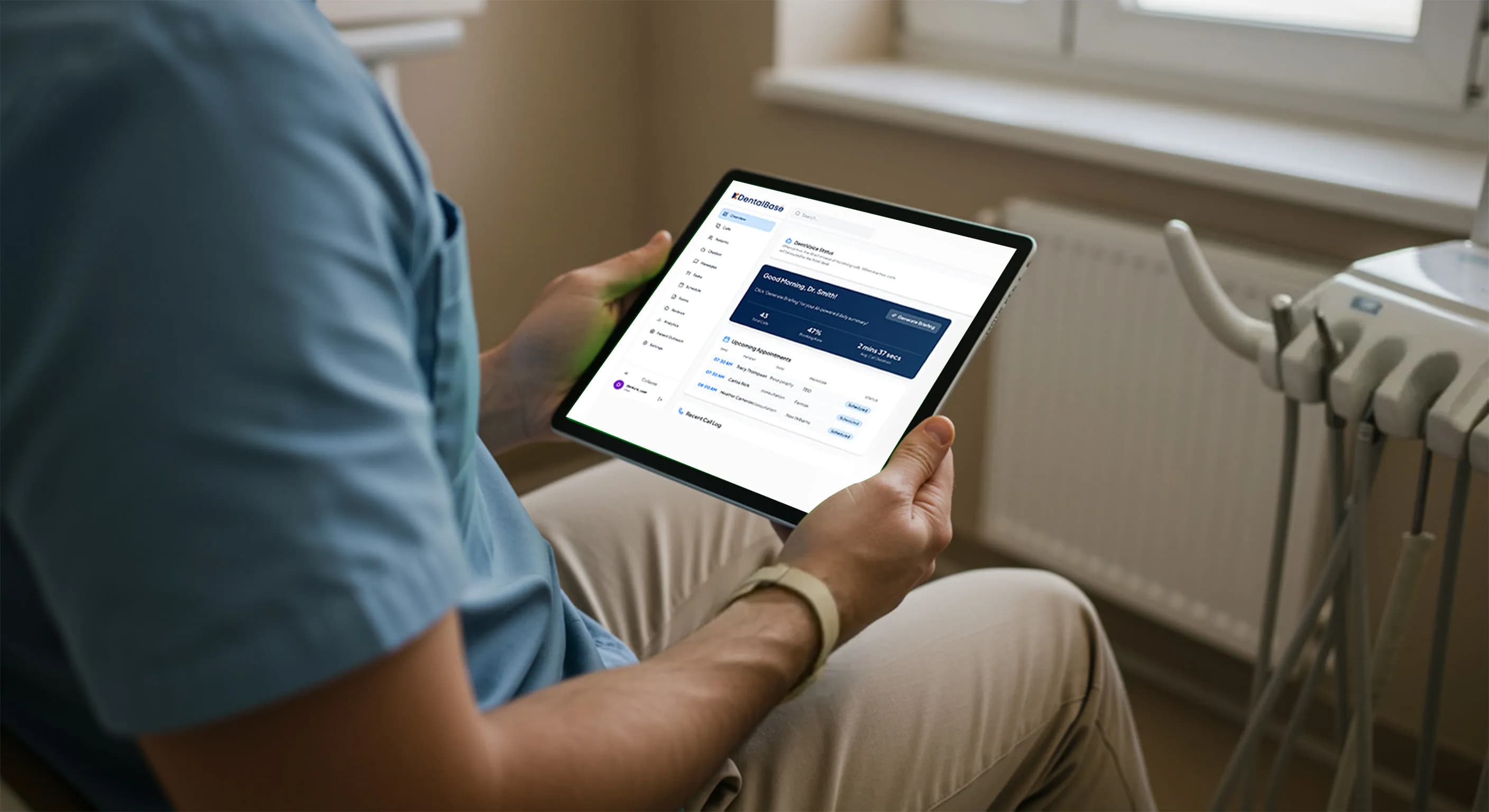
What to Expect When You Try DentiVoice for the First Time

Understand what happens when a dental practice adopts DentiVoice, from setup to daily use, and what owners should evaluate before continuing.
Share:
Table of contents
In a typical dental practice, front desk strain builds during predictable moments. Phones ring while patients are being checked in. Calls peak mid-day. After-hours messages accumulate overnight. These patterns increase missed calls, staff overload, and delayed patient responses.
When a practice tries an AI dental receptionist for the first time, the key question is operational: what actually changes once it is live. This guide explains what to expect when you try Dentivoice, with a focus on setup, daily use, and early evaluation.
Switching on a new phone system mid-practice sounds risky. It usually is not. The change most owners notice first is quiet: the line stops ringing through to a busy front desk. What follows is the detail, week by week, so you know what is normal and what deserves a second look.
Related: Before you change anything, it helps to know what a missed call actually costs your schedule. Calculate the true cost of missed dental calls →
What Is Dentivoice
Dentivoice is an AI dental receptionist that answers patient calls, handles routine questions, and supports appointment requests using practice-defined rules.
It operates alongside front desk staff, managing predictable communication while escalating urgent or complex calls to humans.
Dentivoice is designed to give practices direct control over how calls are handled, when automation is applied, and when staff involvement is required. This ensures routine communication is managed consistently without removing oversight from the practice. To judge that control objectively during a trial, use a scoring framework for AI receptionist voice and script customization.
Think of it as a layer that sits in front of your phone line, not a box that sits on a desk. It listens, follows the rules you wrote, and hands off the moment a call needs a human. The split between what runs on its own and what your team takes is something you set deliberately.
Handled automatically
Office hours questions. Appointment requests. Directions and parking. Insurance accepted. After-hours message capture. Recall and confirmation follow-up.
Routed to your team
Dental emergencies. Upset or sensitive callers. Clinical judgment calls. Anything outside the rules you set. You decide where the line sits, not the software.
That control matters more than any single feature. A practice that decides up front where the handoff sits will see far fewer awkward moments in week one. For a wider view of how this model compares to a live answering service or an in-house hire, the dental phone coverage models comparison lays out the tradeoffs side by side.
Is Dentivoice Difficult to Set Up
No. Most practices configure Dentivoice through rule setup rather than technical installation.
Setup Typically Includes
-
Defining office and after-hours behavior
-
Setting call routing and escalation rules
-
Aligning appointment request handling with existing workflows
No new hardware is required. Effectiveness depends on clarity of rules, not system complexity.
Why Rule Setup Matters More Than Technology
Practices that clearly define how calls should be handled experience fewer workflow disruptions and smoother early adoption.
The work that makes the biggest difference happens before launch, and it is not technical. It is deciding, in plain language, what your team should never hand to automation. Write that down first. Everything else is configuration.
If you want the full sequence rather than just the pre-launch checklist, a day-by-day plan for getting operational in one week lays out what happens before and after this readiness check.
Pre-launch readiness check
Tick each item before you go live. The more you can check, the smoother day one will feel.
Your score: count your checks out of 5.
See how setup scales to your size
A solo practice and a four-provider office configure call rules very differently. This sizing guide walks through both.
Read the solo practice sizing guide →Core Features You Will Use First
Dental practices typically rely on a small set of features immediately after activation.
1.Call Answering and Call Routing
Dentivoice answers incoming calls automatically and routes them to staff when escalation criteria are met.
Primary benefit: fewer call interruptions during peak hours.
The routing piece is what keeps this from feeling robotic. Routine questions get answered. A caller in pain gets your team, fast. The logic behind that decision is worth understanding before you launch, and the guide to how AI triages urgent versus routine calls explains exactly how the line gets drawn.
2.Appointment Request Handling
Patients can submit appointment requests guided by practice-defined scheduling rules.
Primary benefit: appointment intent is captured without disrupting staff mid-task.
3.After-Hours Call Coverage
Dentivoice answers calls outside clinical hours and documents patient requests. Urgent concerns can be flagged for follow-up.
Primary benefit: patient access without extending staff schedules.
This is where most practices feel the change first. Calls that used to die in a voicemail box now turn into something you can act on the next morning. If you have ever wondered how much that gap costs you, why dental voicemail quietly loses patients makes the case plainly.
4.Common Patient Question Responses
The system answers frequently asked questions such as office hours and general service information using consistent messaging.
Primary benefit: reduced variation and clearer patient communication.
5.Message Capture and Follow-Up Visibility
Calls requiring follow-up are recorded as structured messages rather than voicemails.
Primary benefit: improved follow-up accuracy and reduced information loss.
Feature-to-Problem Mapping for Dental Practices
| Front Desk Challenge | Feature Used | Result |
|---|---|---|
| Missed calls during busy hours | Call answering and routing | Calls answered without interrupting in-office care |
| Frequent task switching | Appointment request handling | Lower cognitive load for staff |
| After-hours inquiries | After-hours coverage | Continued patient access |
| Inconsistent responses | Common question handling | Predictable, approved messaging |
| Lost voicemails | Structured message capture | Clearer follow-up |
Want to see this mapped to your own calls?
A short walkthrough uses your real front desk scenarios, not a generic script, so you can judge fit before committing.
Request a DentiVoice demo →What Happens During the First Days of Use
Dentivoice begins answering calls immediately once activated.
Patients can request appointments, ask routine questions, or leave messages. Routine calls are handled automatically. Nonstandard calls are escalated or flagged.
Staff typically notice fewer interruptions rather than reduced total call volume.
Rules will need small adjustments once real calls start arriving, and that is normal rather than a sign something was set up wrong. Keeping those early edits under basic version control saves a lot of confusion once more than one person is making changes.
Your first two weeks, at a glance
A rough map of what most practices see after switching on AI call handling.
Calls answered live
The line picks up on the first ring. Routine questions get handled. Urgent callers route straight to your team.
Rules settle in
You tune escalation triggers and after-hours scripts. Front desk interruptions start dropping during midday peaks.
Patterns become clear
You can see which call types were absorbed, which were escalated, and where follow-up improved.
None of this requires a perfect first day. Expect to adjust an escalation rule or reword an after-hours greeting in the first week. That tuning is the point of the early period, not a sign something is wrong.
How Dentivoice Affects Front Desk Workload
Front desk strain is driven as much by cognitive load as by call volume.
Staff regularly switch between phones, check-ins, scheduling, and payments. Each interruption adds mental overhead.
By handling predictable call types, an AI dental receptionist reduces task switching and stabilizes workflow.
Dental Economics has identified front desk overload as a common contributor to staff fatigue and inefficiency.
Cognitive load is the quiet tax here. Every interrupted check-in costs more than the seconds it takes. Your team loses their place, the patient at the counter waits, and the next caller hears a busy line. Breaking that loop is most of the value. If the front desk already feels stretched thin, the signs of an overwhelmed dental front desk and real fixes is a useful gut check.
It also helps to know what the phone is actually carrying. Most of the volume is predictable, which is exactly why it automates well. A breakdown of what patients call dental offices about shows how much of a typical day is routine.
After-Hours Access and Patient Continuity
Many patient calls occur outside business hours.
Without automation, these calls usually go to voicemail. Dentivoice provides structured after-hours responses and captures actionable requests.
The American Dental Association emphasizes timely patient communication as a factor in maintaining trust and continuity of care.
The practical question is staffing. You should not have to pay for overnight coverage to answer a 9pm scheduling question. For the options here, including what changes when you stop relying on an answering service, see how to answer dental calls after hours without hiring.
What Owners Should Evaluate After the Trial
Owners should review operational indicators rather than surface metrics.
Key Evaluation Questions
-
Are fewer calls going unanswered
-
Are staff interruptions reduced
-
Are after-hours messages clearer
-
Are urgent calls escalated correctly
The honest answer to most of these questions is in the pattern, not a single call. Read the first two weeks as a trend. This table is a simple way to tell a healthy rollout from one that needs a rule change.
| What to watch | A good early sign | A sign to adjust rules |
|---|---|---|
| Unanswered calls | The midday backlog shrinks | Callers still hit a busy line at peak |
| Escalations | Urgent calls reach staff quickly | Routine calls get escalated too often |
| After-hours messages | Requests arrive clear and actionable | Messages are vague or missing details |
| Front desk focus | Fewer mid-task interruptions | Staff still feel pulled off check-ins |
Related: Once the basics look right, the numbers tell you where revenue is leaking. See the 7 call metrics that drive revenue →
How AI Dental Reception Support Fits Long Term
An AI dental receptionist is not a replacement for staff.
It functions as a communication layer that absorbs routine interactions, helping practices maintain access and reduce administrative strain without immediate staffing expansion.
Over months, the value compounds in a quiet way. Your team stops dreading the midday rush. New patients stop slipping through after-hours gaps. And you finally have a record of what callers actually ask for. Still weighing it? The 30 most common questions about an AI receptionist for dental offices answers the practical concerns owners raise most.
Final Thoughts
Many practices revisit communication systems when front desk pressure becomes persistent rather than seasonal.
For those evaluating AI supported call handling, Dentivoice is one option to consider as part of that operational review.
Frequently Asked Questions
What is Dentivoice
Dentivoice is an AI dental receptionist that answers patient calls, handles routine questions, and supports appointment requests using practice-defined rules.
How long does it take to get started with Dentivoice
Most practices complete setup through configuration rather than technical installation. Initial setup typically focuses on defining call handling rules and workflows.
Does Dentivoice answer all patient calls automatically
Dentivoice handles routine calls automatically and routes urgent or complex calls to staff based on escalation rules set by the practice.
Will patients know they are speaking with an AI dental receptionist
Most patients experience faster responses and shorter wait times. Perceived experience is driven more by clarity and speed than by awareness of automation.
Can Dentivoice help with after-hours patient calls
Yes. Dentivoice provides structured after-hours call coverage, allowing patients to leave actionable requests and receive guidance when the office is closed.
Does Dentivoice replace front desk staff
No. Dentivoice is designed to support front desk staff by handling predictable communication, not to replace human roles.
What types of dental practices benefit most from Dentivoice
Practices with frequent call interruptions, after-hours inquiries, or front desk workload strain typically see the most operational benefit.
How should owners evaluate Dentivoice after a trial
Owners should assess missed calls, staff interruptions, after-hours message quality, and escalation accuracy rather than focusing only on call volume.
Ready to See How Dentivoice Works in Your Practice
If your front desk regularly misses calls, feels overwhelmed during peak hours, or struggles with after-hours coverage, the next step is seeing how AI call handling fits your actual workflow. The demo is designed to help practices evaluate fit, not to push immediate adoption
Request a Dentivoice demo to walk through your call flows, escalation rules, and real examples using your actual front desk scenarios
Request a Dentivoice demo to see how it would work for your front desk.
Frequently Asked Questions
Yes. Dentivoice handles routine questions and appointment requests, but urgent or complex calls are routed to front desk staff based on set rules. If your concern needs human attention, the call is escalated automatically so you can speak with someone directly.
In most cases, calls are answered immediately instead of going to voicemail. This reduces hold times, especially during busy mid-day hours or after regular business hours.
Yes. Dentivoice provides after-hours call coverage and records your appointment request or concern in a structured message. The dental office reviews these messages and follows up when they reopen.
Most patients notice faster responses and clearer answers rather than focusing on whether the system is automated. The goal is efficient, accurate communication, not impersonation.
Yes. Dentivoice captures messages using practice-defined protocols, helping ensure your information is recorded accurately and reviewed by the dental team rather than lost in voicemail.
Sources & References
- 1
- 2
- 3
Topics
Was this article helpful?
Written by
DentalBase Team
Expert dental industry content from the DentalBase team. We provide insights on practice management, marketing, compliance, and growth strategies for dental professionals.