Dental Receptionist AI: How the Front Desk Evolved

See how dental receptionist AI took the front desk from paper books to 24/7 call answering, and which jobs still need a human.
Share:
Table of contents
For decades, the dental receptionist was the heartbeat of the practice. They answered phones, booked appointments, and managed patient expectations one call at a time. Today that role is changing fast, and dental receptionist AI is a big reason why.
This shift is reshaping how practices handle patient communication. Not by removing the human touch, but by taking the repetitive work off the front desk so people can do the parts only people can do. This is the story of how the role got here, and where it goes next.
What Did the Traditional Role of the Dental Receptionist Look Like?
The traditional dental receptionist ran the front desk on phones, paper schedules, and manual follow-ups. Every call, confirmation, and reschedule passed through one person. The system worked, but it lived or died on availability.

Before practice management software became standard, the front desk was a juggling act. The receptionist greeted patients, collected payments, verified insurance, and answered the phone. All at once. Often during the same minute.
Their core responsibilities included:
- Answering inbound calls. New patients, reschedules, billing questions, all on one line.
- Scheduling and rescheduling. Done by hand, usually in a paper book or a basic calendar.
- Managing patient questions. From insurance coverage to post-op care concerns.
- Handling reminders manually. Calling each patient the day before to confirm.
Here's the problem. This model depended entirely on one thing: someone being free to pick up. If the phone rang while the receptionist was checking out a patient, the caller waited. Or hung up. And many never called back. A phone that's always busy isn't a sign of demand. It's a sign of lost revenue walking out the door.
That single point of failure is the reason the role had to evolve. When growth meant more calls than two hands could handle, something had to change.
That gap shows up in real numbers today. A February 2026 Peerlogic analysis of 4,280 calls across 26 dental practices found that 38% of inbound calls went unanswered. New patients converted to appointments at only 25.24%, compared with 55.77% for existing patients. A first-time caller is the easiest one to lose.
How Did Dental Offices Shift From Phones to Digital Tools?
Dental offices shifted from phones to digital tools in two waves: practice management software first, then online booking and email reminders. Each wave cut paperwork and call volume, but neither closed the after-hours gap.
Early Practice Management Software
The first big shift came with digital calendars and practice management systems. Names like Dentrix, Eaglesoft, and Open Dental replaced the paper appointment book. Scheduling got cleaner. Records got searchable.
But there was a catch. These tools still needed a human to drive nearly every interaction. The software remembered the appointment. It didn't make the confirmation call for you. The phone still rang the same way it always had, and someone still had to stop what they were doing to answer it.
Online Booking and Email Reminders
The second wave arrived as patient expectations changed. Online scheduling let people book without dialing. Automated email reminders cut down on no-shows. Call volume dropped during business hours.
Still, gaps remained. Email reminders get buried. Online booking widgets only capture patients who land on your website. And neither answers the phone at 8 p.m. when a patient with a cracked tooth is searching for help.
The demand was there. One patient survey cited by DentistryIQ found that 42% of patients would rather book online than by phone, yet only 17% of practices offered it at the time.
Put simply, the front desk has changed in three waves:
- Phones and paper. One person, one line, one appointment book.
- Software and online booking. Cleaner schedules, but a human still drove every call.
- AI call answering. Every call picked up, day or night, with people handling what needs a person.
That unsolved gap, the after-hours call, set the stage for the next evolution.
What Is Dental Receptionist AI and What Does It Do?
Dental receptionist AI is software that uses artificial intelligence to handle routine front desk communication: answering calls, booking appointments, and sending reminders automatically. It works around the clock and routes anything complex to a human.
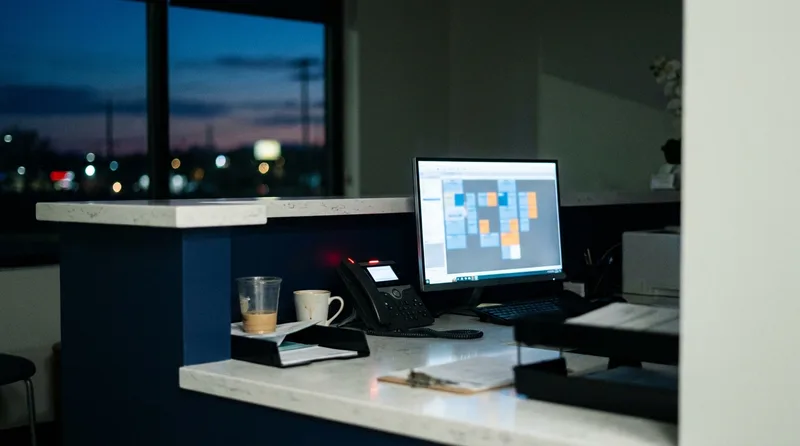
Think of it as a layer that sits in front of your existing systems. It plugs into your practice management software, picks up calls your team can't get to, and books directly into your real schedule. No double entry. No callback list piling up.
Common functions include:
- Answering inbound calls automatically, including overflow during peak hours and every call after close.
- Booking and confirming appointments 24/7, writing straight into your calendar.
- Sending SMS and email reminders so confirmations don't depend on a staff member having time.
- Routing complex inquiries to human staff, flagging emergencies and sensitive issues for a real person.
The timing matters. Convirza's analysis of thousands of tracked dental calls found that 75.2% of missed calls happen after hours, and another 16.2% land during lunch breaks. Those are the exact windows an AI receptionist covers.
The shift is subtle but huge. Instead of reacting to whatever the phone throws at them, practices can manage communication on their own terms.
Stop losing patients to voicemail
See how a dental receptionist AI answers every call, books appointments, and hands off the tricky ones to your team.
Why voicemail loses patients →What Changed, and What Stayed the Same?
AI changed the mechanics of front desk work: availability, speed, consistency, and scale. What stayed the same is the human core: judgment, empathy, and the relationships that keep patients coming back. AI handles volume. People handle nuance.
What Changed
| Factor | Before AI | With AI Support |
|---|---|---|
| Availability | Limited to staffed hours | Every call answered, day or night |
| Speed | Depends on who is free | Instant response, no hold |
| Consistency | Varies by person and day | Standardized on every call |
| Scalability | Capped by headcount | Grows with the practice |
What Stayed the Same
Human judgment, empathy, and relationship-building remain essential. A nervous patient who needs reassurance. A billing dispute that needs tact. A long-time patient who just wants to talk to someone they know. None of that goes to a machine. What has changed is how the two roles divide the call load in practice, with automation taking the predictable volume and staff keeping the conversations that need a person.
The most successful practices treat AI as a support layer, not a replacement. The technology absorbs the repetitive volume so the team has room for the moments that actually build loyalty.
How Does AI Support Modern Dental Receptionists?
AI supports modern receptionists by removing the high-volume, repetitive work that causes burnout. It filters routine calls, handles confirmations, and frees the team to focus on patients in the chair and complex cases that need a human.
Reduced Call Overload
AI filters routine requests before they ever interrupt your team. Appointment bookings, basic FAQs, reminder confirmations, all handled in the background. Your receptionist stops being a switchboard and starts being a host. That single change reshapes the whole front desk day.
That matters for revenue, too. According to Dentaltown, the average practice converts only about one-third of new patient calls into booked appointments. Calmer calls give your team a real chance to improve that number.
Better Work-Life Balance
Fewer interruptions mean less context-switching. Less repetitive work means less burnout. Front desk turnover is one of the most expensive, least talked-about costs in dentistry, and constant phone pressure is a big driver of it.
Related: Burnout starts at the front desk. → Read the full guide to reducing front office burnout
Higher Quality Patient Interactions
When receptionists aren't rushed, conversations get better. Calmer. Clearer. More personal. A patient who feels heard is a patient who books treatment and refers their family. AI doesn't remove the receptionist. It hands the role back the parts that matter most.
What Do Patients Expect in the AI Era?
Patients now expect the same speed and convenience they get from every other service in their life: instant responses, booking outside office hours, and almost no time on hold. Practices that meet those expectations win the appointment. Those that don't lose it to whoever picks up first.

The bar has been reset by Amazon, by online banking, by food delivery. A patient who can reschedule a dinner reservation at midnight does not understand why they can't reschedule a cleaning the same way.
The numbers back this up. Henry Schein One reports that 43% of patients search for a dentist after hours and 71% of dental consumers prefer to book online.
Here's what that looks like in practice:
- Immediate responses. A ringing phone that goes to voicemail reads as "closed for business."
- Flexible booking after hours. Most people research and book around their own work, which is exactly when your office is closed.
- Clear, consistent communication. The same accurate answer every time, not whatever the busiest person could manage.
- Minimal hold time. Every extra minute on hold raises the odds the caller hangs up and dials a competitor.
Dental receptionist AI helps you meet all of it without adding payroll. That last part is why the math works for small practices, not just groups.
Related: No staff to spare for evening calls? → How to answer dental calls after hours without hiring
What Are the Biggest Misconceptions About Dental Receptionist AI?
The biggest misconceptions are that AI replaces staff, that patients only want humans, and that the technology is too complex for small offices. None hold up. AI replaces tasks, not people. Patients want fast answers. And most tools are built for small teams first.
"AI replaces front desk staff"
It doesn't. AI replaces the repetitive tasks that eat the day, not the person doing them. The receptionist stays. Their job just gets less frantic and more focused on the work that matters.
"Patients only want to talk to humans"
Patients want answers. When AI delivers fast, accurate help and a real person steps in for anything sensitive, satisfaction goes up, not down. The frustration was never "I talked to a computer." It was "nobody picked up."
"AI is too complex for small practices"
The opposite is usually true. Many tools are built specifically for solo and small group offices. And small teams, the ones with one or two people fielding everything, tend to see the fastest gains because AI absorbs the volume that was crushing them.
Worried about patient data? That's fair. The right systems are built for it, with HIPAA compliance and encrypted communication baked in from the start. Ask any vendor to show you their compliance posture before you sign. A serious one will have an answer ready.
What Does the Future of the Dental Front Desk Look Like?
The future front desk is less about answering calls and more about coordinating care. As AI handles routine workflows, the receptionist role shifts from call handler to communication coordinator, focused on patient experience and growth rather than putting out phone fires.
Picture a typical Tuesday a few years out. The phone is covered around the clock. The reminder sequence runs itself. So the front desk team spends its energy on:
- Patient experience. Greeting people warmly and making the in-office visit feel personal.
- Relationship building. Following up with patients who matter, the way a friend would.
- Care coordination. Helping patients understand treatment plans and next steps.
- Practice growth. Reactivating lapsed patients and supporting referrals.
This evolution was never really about technology. It's about making the job sustainable, the schedule full, and the patient experience something people remember. The receptionist isn't disappearing. The title might even change. But the human at the heart of the practice matters more than ever, not less, once the busywork is off their plate.
Related reading: our complete guide to what an AI dental receptionist actually is.
See where your front desk is leaking patients
Most practices don't know how many calls they miss until they look. Start with the metrics that actually move revenue.
See the 7 metrics that drive revenue →The path from phones to dental receptionist AI mirrors a wider shift in dentistry toward smarter systems and better patient experiences. The practices that adopt it thoughtfully, using AI for volume and people for connection, will be the ones still thriving as patient expectations keep climbing.
Ready to make that shift? This step-by-step guide to implementing an AI receptionist in a dental office covers the practical rollout, from vendor setup to staff training.
Frequently Asked Questions
Dental receptionist AI is software that handles routine front desk communication automatically, including answering calls, booking appointments, and sending reminders. It works 24/7 and routes complex issues to human staff.
Yes, but only the repetitive part. AI absorbs high-volume routine calls so your receptionists can focus on in-office patients and complex cases that need a human touch. Your team stays at the center of the front desk.
If the practice uses dental receptionist AI, your call is answered immediately. The AI can book appointments, answer common questions, or message the office, so you don't wait until the next business day.
Reputable dental AI systems are HIPAA-compliant and use encrypted communication. You should expect the same privacy standards you get from a phone call or an online patient portal. Ask any vendor to show you their compliance details before you sign.
Yes. AI handles routine requests but automatically routes complex, emotional, or sensitive issues to a human receptionist during office hours. You always have a path to a person. Just ask for a person and the call is handed off.
Absolutely. Many tools are built for solo and small group offices. Small teams often see the biggest efficiency gains because AI absorbs the call volume that overwhelms one or two staff.
Sources & References
- 1
- 2
- 3
- 4
- 5
Topics
Was this article helpful?
Written by
DentalBase Team
Expert dental industry content from the DentalBase team. We provide insights on practice management, marketing, compliance, and growth strategies for dental professionals.