Dental Phone System Failover: What Happens During an Outage

Dental phone system failover keeps calls covered when internet, power, PMS API, or carrier links fail. See the four fallback paths and how to recover.
Share:
Table of contents
Dental phone system failover is what keeps your practice reachable when the normal path from a ringing phone to a booked appointment breaks. It isn't one plan. Four separate things can fail on their own: the internet connection, the building's power, the link to your practice management software, and the carrier network itself. Our broader practice technology coverage looks at each piece of that stack in more depth. Each breaks differently. Each needs its own fallback, not one generic backup line taped to the wall.
A recent ADA member survey found that prolonged power outages and computer system failures rank among the most commonly reported disruptions in dental offices. Only the pandemic ranked higher. This guide covers what should happen automatically during an internet, power, PMS API, or carrier failure. It also covers what to do afterward, when an AI receptionist's fallback response gets something wrong.
What Are the Four Failure Classes Behind Dental Phone System Failover?
Dental phone system failover breaks down into four distinct failure classes: internet outage, power loss, PMS API disconnection, and carrier-level incidents. Each cuts off a different link in the call-to-appointment chain. So each needs a distinct fallback path, not one shared backup plan. Confusing the four is the most common planning mistake.
How This Differs From Switching Phone Systems
This is a different question from the one covered in our guide to switching phone systems without losing calls. That guide deals with moving to a new system during a planned transition. Here, the system doesn't change. It just has to keep functioning through disruption it didn't cause and didn't schedule.
For the version without an outage in the picture, the complete answer-to-appointment call flow this technology follows shows how a call is meant to move end to end.
Why the Four Failures Look Different From the Front Desk
Not every outage looks the same from the front desk. A dead internet connection is obvious within seconds. A PMS API timeout is sneakier. It can look like a slow system rather than a broken one. Staff sometimes wait ten minutes before realizing calls aren't syncing to the schedule at all. Not every dead-sounding line is an outage, though. Sometimes the phone is simply swamped, which is the problem covered in what a dental office line that is always busy is really telling you.
Failure Classes at a Glance
| Failure Class | Typical Trigger | Automatic Fallback |
|---|---|---|
| Internet outage | ISP drop, router failure, fiber cut nearby | Cellular or LTE failover reroutes calls to a backup line within seconds |
| Power loss | Utility outage, breaker trip, storm damage | Battery or UPS bridges short gaps; calls forward to mobile numbers if it runs longer |
| PMS API down | Vendor maintenance, integration timeout, database lock | Calls continue; booking details are captured manually and synced once the API responds |
| Carrier incident | Regional carrier outage, porting error, SIP trunk failure | Traffic reroutes to a secondary carrier or an alternate published number |
Walk through each of the four below. Know which one you're in before you start troubleshooting. The fix for a dead router looks nothing like the fix for a stuck integration. A solid dental phone system failover plan treats them as four separate playbooks, not one shared checklist.
What Happens When Your Practice Loses Internet?
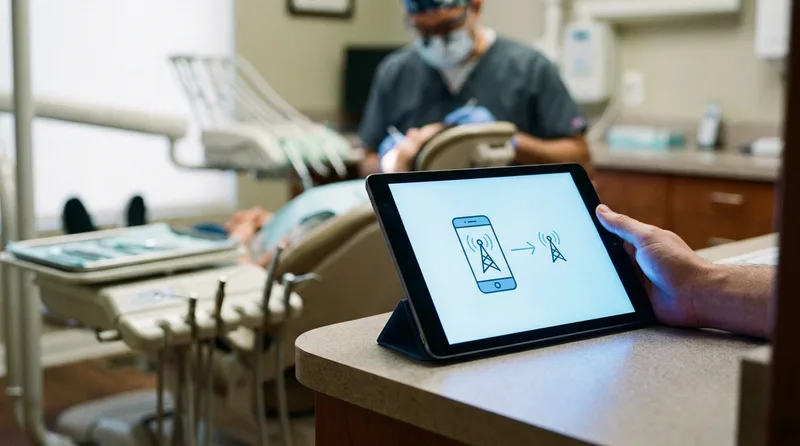
When your practice loses internet, calls fail over to a cellular or LTE backup connection, usually within seconds. The receptionist keeps answering and booking exactly as before. Nothing changes on the patient's end. That's the entire point of the fallback.
What to Expect From Backup Call Quality
The cellular path is typically slower than the primary fiber or cable line. Call audio may sound a little less crisp during a longer outage. That's expected. It's not a sign anything else is wrong. What matters is whether the failover actually triggered. A short blip, under 30 seconds or so, might resolve before failover kicks in at all, and the call continues on the original line without anyone noticing a switch happened.
Why a Longer Outage Is the Real Risk
The real risk isn't the phone call itself. It's everything else riding on the same connection: online booking widgets, insurance eligibility checks, text reminders. A ten-minute outage rarely costs you a patient. A four-hour outage during a Monday morning rush is a different story. That's when a documented cellular failover, tested at least twice a year, actually earns its keep.

What Happens When the Power Goes Out?
When the power goes out, a battery or UPS unit bridges the phone system through short gaps, typically 30 minutes to a few hours depending on the hardware. Beyond that window, calls need to forward to a staff mobile number or an answering line the practice has documented in advance.
Why Power Loss Is Harder Than an Internet Drop
Power loss is trickier than an internet drop. It can take down more than the phones. Routers, modems, and on-site servers usually share the same circuit. A battery sized only for the phone system won't help if the router it depends on goes dark first, and most battery backups bridge only 30 minutes to a few hours before they need a generator or a forwarding number behind them. Storms are the most common cause. Prolonged power outages sit near the top of the disruptions dental offices report experiencing, right behind the pandemic itself. Most practices have already lived through one, even without a formal response plan.
Building a Forwarding Plan Before You Need It
Build the plan around one question: who receives forwarded calls when the office goes dark, and for how long? Write the answer down. A generator or extended battery buys time. Only a documented forwarding number turns that time into booked appointments instead of missed ones.
What Happens When the PMS API Goes Down?
When the PMS API goes down, call answering does not have to stop. Booking details get captured manually, held in a queue, and synced to the schedule automatically once the integration reconnects. The patient never has to know the practice management system was unreachable.
Why This Failure Is Easy to Miss
This failure class is the one front-desk teams misread most often. Nothing about the phone line changes. The call connects fine. The receptionist talks fine. But the write to the scheduling database silently fails or times out. Integration architecture varies by vendor. Open Dental's published API specification, for example, documents the request and authentication model a third-party system relies on. Outages like this are almost always on the vendor's infrastructure, not something the practice controls. An AI receptionist should never be expected to fix a PMS-side outage. The only sound goal is a graceful fallback that doesn't lose the request.
What to Capture While the Integration Is Down
What a receptionist or automated system should capture during a PMS API outage:
- Patient name, phone number, and reason for the call.
- Requested appointment date and time window.
- Provider preference, if the patient names one.
- Whether the patient is new or existing.
- A timestamp, so the office can confirm how long the queue built up.
Vendor-Side Incidents Happen at Scale, Too
Vendor incidents happen at scale, too. Henry Schein's 2023 cybersecurity incident disrupted parts of its distribution business and reportedly exposed personal data for roughly 29,000 people. The company maintained that its practice management software itself remained unaffected. That distinction matters for any practice trying to gauge which systems a given incident actually touches.
Related: integration reliability affects more than the phone line
Insurance clearinghouse connections face similar reconnection questions when a downstream system stalls.
Read the insurance integration guide →What Happens During a Carrier-Level Outage?
A carrier-level outage happens upstream of the practice's own equipment, often across an entire region. No amount of rebooting a local router will fix it. The only practical response is rerouting traffic to a secondary carrier or an alternate published number the practice set up in advance.
Why Carrier Incidents Take Longer to Resolve
Carrier incidents are rarer than internet or power failures. They're also harder to shorten once they start. A regional fiber cut, a botched number port, or a SIP trunk failure on the provider's side can take hours to resolve. That timeline sits entirely outside the practice's hands. The unified communications market has moved sharply toward hosted, cloud-based systems in recent years, valued at $136.11 billion in 2023 and projected to reach $417.86 billion by 2030, according to Grand View Research. The hosted segment specifically is projected to grow at over 20% annually in that window, faster than on-premise deployments. A hosted architecture simply makes multi-carrier redundancy easier to configure than a single on-site PBX ever could.
Publishing a Backup Number Patients Can Actually Find
Publish a backup number somewhere patients can actually find it, not just internally. A voicemail greeting stating the alternate number, plus a note on the practice's own website, covers the gap before rerouting fully takes effect. The same logic applies to a documented after-hours call strategy. Patients just need to know where a call goes when the primary path is unavailable. Groups with offices in several states should also confirm that backup routing respects each location's local hours, which is covered in multi-state call routing schedules.
How Do You Recover After an AI Receptionist Makes a Failover Mistake?
Recovering from a failover mistake follows four steps in order: detect the error, call the affected patient directly, repair the schedule, and make the configuration change that keeps the same mistake from repeating. Skip that last step, and a practice ends up fixing the same problem three times in a year.
How This Differs From the General "AI Makes a Mistake" Question
This is narrower than the question covered elsewhere on this site about what happens generally when an AI receptionist makes a mistake. That piece is philosophical: what a mistake means, how much trust an automated system should carry. This section is the operational version. It's the specific sequence a practice runs the morning after a failover-related booking error, whether that's a double-booked slot, a missed detail from a manually captured call, or a patient told the wrong provider was available.
The Four-Step Recovery Sequence
- Detection. Someone has to notice, usually a front-desk staff member reviewing the queue of manually captured calls from a PMS outage, or a patient calling back confused about their appointment time.
- Patient recovery call. Call the patient directly rather than waiting for them to notice something is wrong. A short, direct call acknowledging the mix-up and confirming the correct details resolves most of the frustration on its own, and handling a difficult patient call well at this stage often prevents a second call later.
- Schedule repair. Fix the booking itself: correct the time, provider, or duplicate entry in the practice management system, and confirm the fix reflects correctly on the patient's side too.
- Configuration change. Identify why the error happened during failover specifically. Maybe a queue field wasn't captured, a sync rule dropped data, or a fallback script skipped a needed question. Adjust the configuration so the next outage doesn't reproduce it.
Why the Configuration Fix Gets Skipped
The fourth step is the one practices most often skip. The first three already feel like enough work for one day. But skip it, and the same failover gap sits there, waiting for the next outage to expose it again. A dental phone system failover plan without the configuration fix isn't really a plan. It's a one-time patch.
Who Controls Changes to the AI Receptionist's Instructions?
Changes to an AI receptionist's instructions should go through a named owner and a staging environment before reaching the live system. Untracked edits made directly to production are the single most common cause of a regression after a fee schedule change, a new provider's hours, or a holiday closure update. That same configuration layer usually governs vendor and sales call routing rules, covered in the vendor call routing rules living in that same configuration, so an untracked edit can quietly break both at once.
Why Untracked Edits Break Failover Specifically
Here's why this matters for failover specifically. Every fallback behavior described above, cellular rerouting, manual capture during a PMS outage, secondary carrier paths, lives inside the same configuration that governs the receptionist's day-to-day script. Edit the wrong field while patching something unrelated, and you can quietly break the failover path. Nobody notices until the next outage hits. That's a bad time to discover a typo from three weeks ago.
Three Things Every Change Process Needs in Writing
A workable change process doesn't need to be complicated. It does need three things, in writing:
- A single named person, not "whoever's at the front desk," responsible for approving instruction changes.
- A staging version of the configuration that gets tested before anything touches the live system.
- A short re-test checklist covering hours, fee schedule, and provider changes specifically, run every time one of those three things changes.
What Re-Testing Actually Means
Re-testing doesn't mean running the entire script from scratch. It means checking the specific call flows tied to whatever changed. Confirm a new provider's availability shows correctly. Check that a fee update didn't accidentally break the phrasing used during a cost question. Practices that train and update their AI receptionist's FAQ handling on a regular basis tend to catch these issues faster. Someone is already in the habit of reviewing the configuration, rather than treating it as something set once and forgotten. Regular call quality monitoring is what actually catches a regression before a patient does.
The HIPAA Contingency Plan Connection
Under HIPAA's Security Rule, the contingency plan standard at 45 CFR 164.308(a)(7) requires covered entities to maintain policies for system failures that could affect protected health information. Prolonged phone or PMS disruptions fall squarely within that requirement, even when no data is actually exposed. Documenting who can change the AI receptionist's configuration, and how those changes get tested, is real evidence a practice takes that obligation seriously. It isn't just a technical nicety.
Keep the failover plan and the change log in the same place
A documented failover plan is only useful if the staff who answer calls know the change process, too.
See the staff rollout guide →Dental phone system failover isn't a single switch that flips when something breaks. It's four separate plans: one for internet, one for power, one for a stalled PMS integration, one for a carrier-side incident. Each has its own detection signal and its own fallback. The practices that recover fastest aren't the ones with the fanciest equipment. They're the ones with a written answer to one question, for each failure type: what happens next, and who checks that it worked.
Start with the configuration side, not the hardware side. Confirm who owns changes to your AI receptionist's instructions. Put a staging step between any edit and the live system. Schedule a re-test after every fee, hours, or provider change. That single habit prevents more failover mistakes than any battery backup or secondary carrier line ever will.
Build a failover plan that actually holds up
Explore more guides on keeping an AI receptionist reliable through outages, integration changes, and everyday practice operations.
Browse AI receptionist guides →Want the practice management side of this covered too?
Browse practice management guides →Outages during business hours are one issue; how unanswered calls after hours turn into lost patients covers the other half of the problem.
Frequently Asked Questions
Dental phone system failover is the automatic and manual process that keeps a practice reachable when its normal call path breaks. It covers four separate failure types, internet, power, PMS integration, and carrier, each with a distinct backup route.
Cellular failover typically reroutes calls to a backup line within seconds of an internet drop. Appointment booking continues as normal on the backup connection, though staff should confirm which line is active before assuming the system recovered on its own.
A battery or UPS unit typically bridges short power gaps, and calls can forward to a mobile number for anything longer. Practices without a documented forwarding number often lose calls the moment the battery runs out.
Calls should continue to be answered even when the PMS API is unreachable. Booking details get captured manually and synced automatically once the integration reconnects, so no appointment request is lost.
A carrier incident happens upstream of the practice's own connection, often across a whole region, and cannot be fixed by rebooting local equipment. Rerouting to a secondary carrier or alternate number is the only practical fallback.
Recovery follows four steps in order: detect the error, call the affected patient directly, repair the schedule, and make the configuration change that prevents the same failure-related mistake from happening again on the next outage.
Changes should go through a named owner and a staging environment before reaching the live system. Untracked edits made directly to production are the leading cause of regressions after a fee schedule or hours change.
Any edit to hours, fees, or provider availability should trigger a re-test of related call flows before the change goes live. Skipping this step is how a single untracked edit becomes a week-long booking problem.
Sources & References
- 1
- 2
- 3
- 4
- 5
- 6
- 7
Topics
Was this article helpful?
Written by
DentalBase Team
Expert dental industry content from the DentalBase team. We provide insights on practice management, marketing, compliance, and growth strategies for dental professionals.