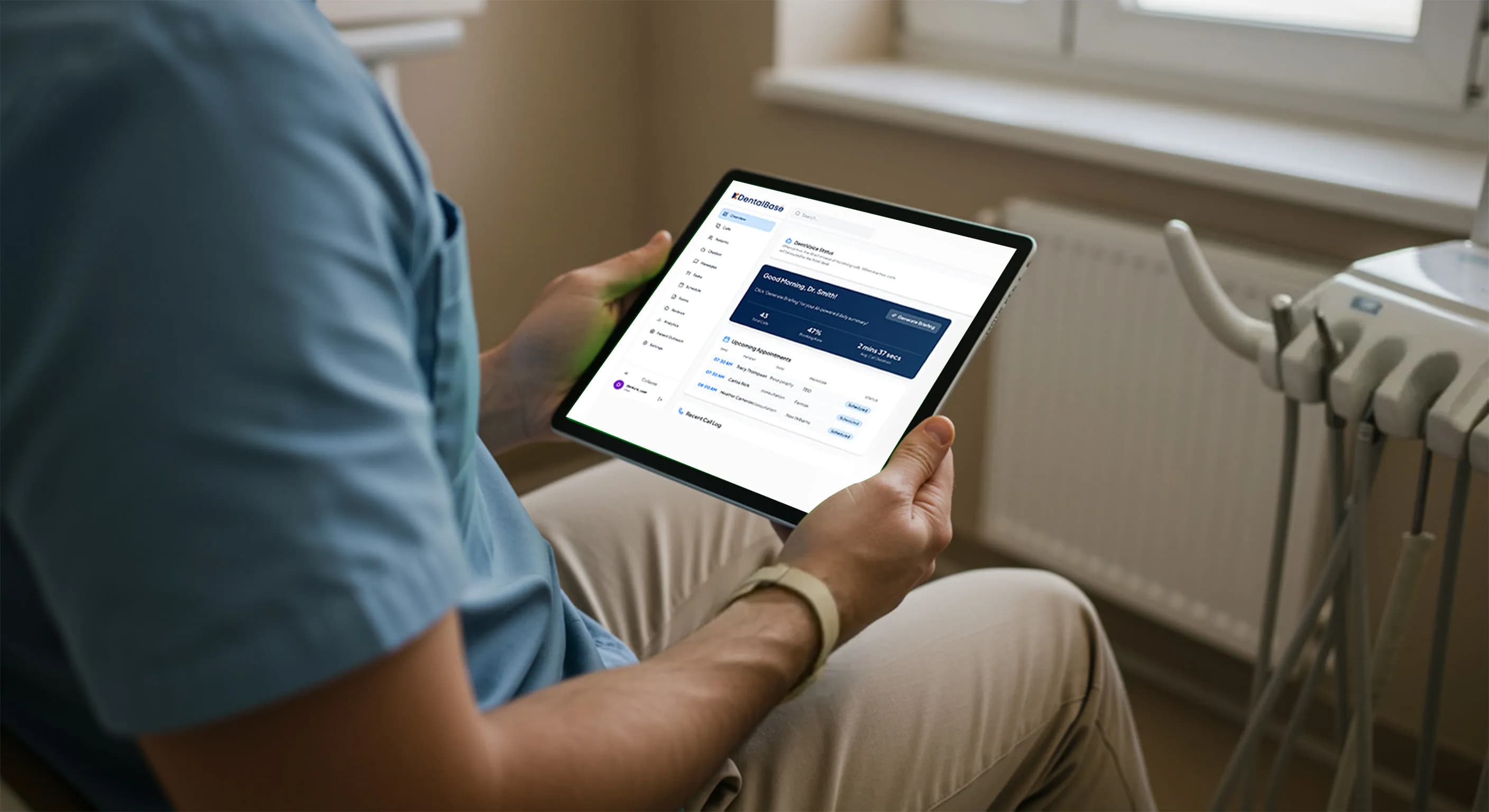
Dental Caller ID Screen Pop AI: Why Context Matters Too

Dental caller ID screen pop AI shows patient data before a call connects. See what fields matter and how AI receptionists build context automatically.
Share:
Table of contents
Dental caller ID screen pop AI is the feature that shows a patient's history, appointment status, and reason for calling before your team says a word. Most practices still greet every caller the same way: a name and a number, nothing else. That gap costs time on routine calls and costs trust on the ones that matter, like a patient calling back about a canceled root canal. A three-provider office fielding 150 calls a week loses real minutes re-asking questions a screen pop would have already answered.
This article breaks down what screen pop actually means for a dental office, why competitors are marketing it as a headline feature, and how an AI receptionist can deliver the same caller context without bolting on a separate system. You will also see where it overlaps with missed-call text-back and what to ask a vendor before you buy into the term.
What Is a Caller ID Screen Pop for a Dental Practice?
A caller ID screen pop is a popup window that surfaces patient information the instant a call arrives, before anyone picks up. For a dental office, that usually means the caller's name, last visit date, outstanding balance, and any open treatment plan pulled straight from the practice management system.
A caller with no patient record at all, a vendor rep or a cold solicitation call, needs a different kind of context handling. See how screening a vendor call with no patient record covers that side of inbound traffic.
Without Context vs. With Context
No Screen Pop
"Thanks for calling, can I get your name and date of birth?" Then a pause while staff pulls up the chart, re-verifies the balance, and asks why the patient is calling.
With Screen Pop
"Hi Mrs. Alvarez, calling about your appointment with Dr. Patel next week?" No verification lag, no repeated questions, no dead air while a chart loads.
The concept started in call centers decades ago, tied to CTI (computer telephony integration) linking phone hardware to a CRM. Dental practices adopted a version of it later, mostly through VoIP providers bundled with front-desk software. Weave built much of its early reputation on this exact feature, pairing text messaging with a caller profile that pops up on a front-desk screen. Becker's Dental + DSO Review has tracked this kind of communications consolidation as DSOs standardize technology stacks across dozens of locations.
For the broader mechanics of how that VoIP layer talks to your practice management software in the first place, see how dental offices handle calls between VoIP and PMS.
For a solo practice, a basic screen pop with name and chart number covers most of what matters. A multi-location DSO usually wants more: which location the patient is assigned to, whether they are new or returning, and any flags like a balance past due or a broken appointment history.
Why Does Caller Context Matter as Much as Answering the Call?
Caller context matters because how a call opens decides whether a patient feels remembered or interrogated. Answering fast means nothing if the first question is "can I get your date of birth" to someone who already gave that information twice this month.
Think about the emergency call. A patient with a swollen jaw does not want a script. They want someone who already knows they are a patient of record, saw Dr. Patel in March, and have a standing referral note for an endodontist. That is the difference between a call that reassures and one that adds friction to an already stressful moment. The same logic applies to difficult patient calls, where context often defuses tension before a word of de-escalation script gets used.
Here's the thing: most patients cannot articulate why one call felt smooth and another felt clunky. They just remember the practice that "gets it" versus the one that doesn't. Context is invisible when it works and glaring when it's missing. Front office analysis from Dental Economics on why practices lose new patients traces a similar pattern back to how the first moments of a call are handled.
What Better Context Actually Changes on a Call
- Faster verification, since the caller does not repeat identifying details
- Fewer transfers, because the person on the line already knows the account status
- Better first impressions for returning patients after a long gap
- Lower risk of a scheduling error tied to a mixed-up chart
What Information Should Actually Show Up Before a Call Connects?
The information that should show up before a call connects is limited to what changes how the conversation opens: name, patient status, last visit, and any active flag. Anything beyond that becomes clutter a receptionist has to scan under pressure.
Vendors love to list a dozen data fields as a selling point. In practice, a front desk answering three lines during a Monday morning rush does not have time to read a dashboard. A useful screen pop favors fewer, higher-signal fields over a full patient record dump.
The Fields Worth Showing
- Patient name and whether they are new or existing
- Assigned provider and preferred location, for multi-site practices
- Last visit date and next scheduled appointment, if any
- One flag only: balance due, broken appointment, or open treatment plan
Keep the fourth field to one flag at a time. Stacking three warnings on a single popup just trains staff to ignore all of them, which defeats the purpose entirely.
Which flag shows up most often depends heavily on which call types dominate your queue in the first place, so it's worth checking that mix before finalizing your fields.
How Does an AI Receptionist Build Caller Context Without a Separate Screen Pop Tool?
An AI receptionist builds caller context by matching the inbound number against the practice management system in real time, then carrying that profile through the entire call instead of displaying it once and discarding it. No separate CTI box, no extra monthly line item.
The natural language processing layer is what actually turns that caller profile into something usable mid-conversation, pulling out the date, provider, or symptom a patient mentions and matching it against the record that just loaded. For a full breakdown of how speech recognition, NLP, and dialogue management work together on a live call, see how an AI dental receptionist actually works.
Caller context is only one piece of what happens during that call. For the complete sequence from the first ring to a confirmed booking, see how dental call handling AI works from call to booking.
This matters more than the marketing framing suggests. A screen pop on its own is a display layer. It shows a human the data and then depends on that human to use it correctly, every time, on every call, including the 4:45pm Friday call nobody wants to take. An AI receptionist that already has the caller's record does not need a display step. It can greet the patient by name, reference the open treatment plan directly, and hand off to staff with that same context attached, so nothing gets re-explained at the transfer point.
How the Context Actually Travels
Match the number
Inbound call is matched to the patient record in the practice management system in real time.
Build the profile
Name, visit history, balance, and any active flag are pulled into a single working profile.
Carry it through
The profile stays attached through the call and into any handoff, so nothing is re-explained.
That handoff quality is where most comparisons miss the real differentiator. A smooth handoff depends entirely on what context travels with the call, not on how good the popup looked five seconds earlier.
Screen Pop vs. Missed-Call Text-Back: Are They Solving the Same Problem?
No, screen pop and missed-call text-back solve different problems. Screen pop helps a live call go better by surfacing context in the moment. Missed-call text-back recovers a call nobody answered by sending a follow-up text, and the two features rarely overlap in what they fix.
| Question | Screen Pop | Missed-Call Text-Back |
|---|---|---|
| Problem solved | Weak context on answered calls | Lost revenue from unanswered calls |
| Triggers on | Any inbound call, answered | Unanswered or abandoned call |
| Value shows up as | Shorter, smoother conversations | Recovered bookings, less lost revenue |
| Do you need both? | Yes, if calls both get answered late and get missed. Most practices have both problems. | |
When You Actually Need Both
Most practices do not have to choose. An AI receptionist that answers every call removes most of the missed-call problem outright, while still needing good caller context for the calls it handles or hands off. Judge a vendor on both, not whichever one is easier to demo.
How Does Caller Context Work With Your Practice Management Software?
Caller context works by pulling live data from whatever practice management system already holds the patient record, matching it against the incoming phone number, and refreshing it on every call rather than relying on a stale export. That matching breaks the moment your incoming number changes without warning, which is exactly the gap practices hit when they switch phone providers without a migration plan.
The same number-matching logic runs in reverse, too. If your practice's own outbound line ever starts getting flagged as spam, callbacks and confirmation calls can go unanswered before a patient ever sees your practice's name.
Why Real-Time Matching Beats a Nightly Sync
This is where a lot of screen pop claims fall apart. A popup fed by a nightly data sync shows yesterday's balance and yesterday's appointment status, which is close enough for most calls and dead wrong for the one where a patient paid an invoice an hour ago. Real-time matching against systems like Open Dental or a comparable PMS avoids that gap, though the depth of the connection depends entirely on what the vendor actually built versus what they advertise.
For offices on Dentrix specifically, how Dentrix feeds real-time data into an AI receptionist’s screen pop shows what that named connection looks like versus a generic PMS sync. Denticon offices can see the same idea applied to their PMS in the AI dental receptionist Denticon integration guide, which covers real-time patient lookup and booking sync.
Before assuming context and integration are the same thing, it helps to run a structured evaluation of how a vendor actually connects to your systems rather than taking a demo screenshot at face value.
Questions Worth Asking About the Integration
- Is patient data refreshed in real time, or on a scheduled sync?
- Does the connection read only, or can it also write appointment changes back?
- What happens to caller context if the PMS integration goes down mid-call?
These same questions apply just as much to a website booking widget. AI receptionist online booking integration walks through the vendor questions for that channel specifically.
What Should You Ask a Vendor Before Buying Into "Screen Pop"?
Ask a vendor exactly what data populates the screen, how fresh it is, and where it travels after the initial popup closes. Most sales conversations stop at "yes, we have screen pop," which tells you nothing about whether the feature will hold up on a real Tuesday morning.
A Quick Vendor Checklist
The Privacy Question Behind the Feature
Caller data also raises a genuine privacy question, since a popup showing balance and treatment history is protected health information the moment it touches a screen. The HHS HIPAA guidance is worth reviewing alongside any vendor's security documentation, and DentiVoice's own SOC 2 dental security guide covers what certifications actually mean versus marketing language. Practices should also confirm whether the tool tracks the marketing source of a call, not just the patient identity, since attribution data tied to a call is often bundled into the same integration.
Not sure what your current setup actually shows staff?
See how DentiVoice carries caller context through an entire call, not just a five-second popup, before your team ever transfers the line.
See how it works →Healthcare-wide, automation of routine administrative tasks like this is accelerating. McKinsey's healthcare research has pointed to front-office automation as one of the faster-adopting categories in the sector, which tracks with how quickly screen pop went from a Weave differentiator to a baseline expectation across the category.
Do Patients Actually Notice the Difference?
Yes, patients notice, even if they cannot name the feature that caused it. A returning patient greeted by name with an accurate appointment reference reads as attentive; one asked to re-verify basic details after their third call in a month reads as careless, regardless of how good the practice's actual clinical care is.
What the Data Actually Shows
Data on how patients respond to AI-handled calls shows the tone and accuracy of the opening moments matter more to satisfaction scores than whether a human or an AI answered at all. Context, in other words, outweighs the channel.
General wellness communication research from the CDC's oral health program reinforces a related point: patients are more likely to follow through on care recommendations when the interaction feels personalized rather than generic. A screen pop, or the AI equivalent of one, is a small mechanism in service of that larger goal.
The single most useful thing a screen pop or its AI equivalent can do is make the first ten seconds of a call feel like a continuation of the last one, not a fresh interrogation. That is the entire value proposition, stripped of vendor language.
Dental caller ID screen pop AI is not a feature you either have or don't. It is a spectrum, from a nightly-synced popup showing yesterday's balance to an AI receptionist that carries live, accurate context through the whole call and into the handoff. Practices evaluating vendors should judge based on that spectrum, not the marketing term alone.
Evaluating a vendor on that spectrum should include their paperwork, not just their pitch. Our guide to the business associate agreement clauses to require from any AI receptionist vendor is a good next stop.
Ready to see real-time caller context in action?
DentiVoice matches every inbound call to your patient record and carries that context through the entire conversation, from greeting to handoff.
Explore DentiVoice →Curious how this compares to what Weave built its reputation on?
Read the full comparison →Curious how small context wins like this add up across the whole visit?
See how technology improves the dental patient experience end to end →Frequently Asked Questions
It's a popup showing patient information the moment a call arrives, usually name, last visit, balance, and treatment status pulled from the practice management system before anyone answers. A good one keeps that list short, not a full record dump staff have to scan under pressure.
No. Screen pop improves answered calls by adding context. Missed-call text-back recovers calls nobody picked up at all. They fix different problems, so most practices with both issues need both features running together.
A screen pop displays data once and depends on staff to use it correctly. Caller context, as an AI receptionist builds it, travels through the entire call and into any handoff, so nothing gets re-explained at the transfer point.
Yes. Balance, treatment status, and visit history displayed on a screen count as protected health information the moment they appear on a screen, so encryption and access controls matter just as much as the display feature itself.
In real time, ideally, rather than on a nightly batch sync. A stale nightly export can show yesterday's balance or appointment status, which is wrong often enough during an active call to undermine a patient's trust in the practice.
Ask exactly which fields display and why, how often the data refreshes, whether context survives a transfer to a human staff member, and what happens to the connection if the practice management integration goes down mid-call.
Sources & References
- 1
- 2
Topics
Was this article helpful?
Written by
DentalBase Team
Expert dental industry content from the DentalBase team. We provide insights on practice management, marketing, compliance, and growth strategies for dental professionals.