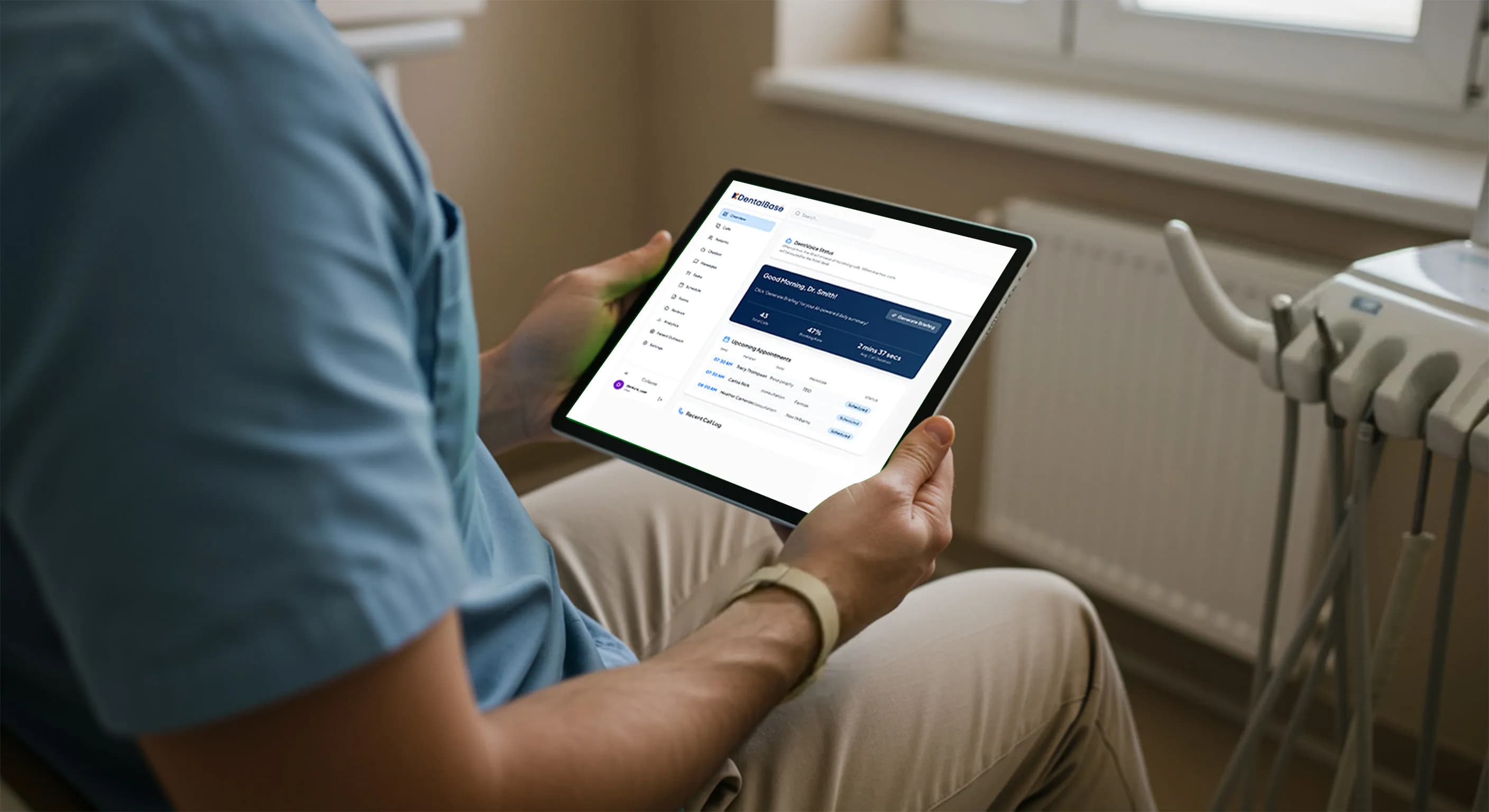
AI Dental Reception Duties: What AI Can and Cannot Do

AI dental reception duties like call answering and scheduling can be automated. Learn what AI handles, what stays human, costs, privacy, and hybrid setup.
Share:
Table of contents
Dental reception duties encompass call answering, appointment scheduling, handling patient inquiries, and supporting front desk workflows. With recent advances in artificial intelligence, many practice owners are asking whether AI dental reception duties can be handled reliably by software and what this means for daily operations.
In this article, we define what AI can and cannot do in dental reception, describe practical work scenarios, and outline how practices can evaluate solutions that handle routine communication tasks.
5 Reasons Why You Need a Dental AI Receptionist
As patient expectations rise and front desks face increasing call volume, relying solely on manual reception creates operational strain. An AI dental receptionist helps practices maintain responsiveness and consistency without increasing staffing pressure.
Key reasons practices adopt AI reception support include:
-
Continuous call coverage beyond office hours
-
Reduced missed calls and voicemail dependency
-
Faster response times for patient inquiries
-
Lower administrative burden on front desk staff
-
More predictable and scalable reception workflows
Rather than replacing staff, AI strengthens front desk operations by handling volume efficiently.
What Does “AI Dental Reception Duties” Mean
AI dental reception duties refer to administrative and communication tasks that a dental front desk typically performs, but managed through an artificial intelligence system. These duties include answering inbound calls or messages, understanding caller intent, scheduling or rescheduling appointments, sending reminders, and delivering consistent practice information.
Instead of replacing humans, this technology is designed to support staff by automating repetitive tasks, allowing human team members to focus on complex inquiries and in-office patient care.
An AI dental receptionist is a software tool that can be integrated with practice phone systems and workflows to perform these duties. One example of this technology is the AI dental receptionist offered by DentiVoice.
Typical Reception Duties Handled by AI
Modern AI receptionist systems can perform a range of common front desk tasks, including:
-
Answering calls and messages using natural language understanding
-
Providing office hours, directions, and basic practice information
-
Scheduling and rescheduling appointments based on availability
-
Sending automated reminders and confirmations
-
Routing urgent or complex calls for human follow-up
These functions reduce the administrative burden on staff and help practices maintain continuity of communication outside standard business hours.
Which Dental Reception Duties Can AI Handle, and Which Stay Human?
AI dental reception duties fall into three tiers: tasks AI handles independently, tasks it handles with human review, and tasks that always stay with staff. Mapping each duty to the right tier is the single most useful step when planning an AI rollout for your front desk.
| Reception Duty | Who Handles It | Why |
|---|---|---|
| 24/7 call answering | AI | Consistent, never misses a ring, no overtime cost |
| Routine scheduling and rescheduling | AI | Real-time slot lookup prevents double bookings |
| FAQs (hours, directions, services) | AI | Repetitive, fact-based, easy to script accurately |
| Insurance verification follow-up | AI + human review | AI gathers details; staff confirm edge cases |
| Emotional or distressed callers | Human | Requires empathy and judgment AI cannot replicate |
| Clinical and treatment questions | Human | Clinical judgment and liability rest with staff |
Practices usually begin with the AI-only tier, then expand into shared duties once staff trust the call summaries. For a deeper look at how triage decisions are automated, see how AI triages urgent versus routine calls.
Not sure which duties to automate first?
A short call-overflow audit shows where your front desk loses the most time and which tasks are safe to hand to AI on day one.
Read the overflow guide →How AI Dental Receptionists Will Help You Get Your Time Back
Front desk teams often lose hours each day to repetitive interruptions answering the same questions, rescheduling appointments, or managing follow-up calls. AI reception technology absorbs this repetitive workload.
By automating predictable communication, AI allows staff to:
-
Focus on patients physically present in the office
-
Reduce task switching and burnout
-
Spend more time on billing, treatment coordination, and patient experience
-
End the day with fewer unfinished administrative tasks
Time reclaimed at the front desk directly improves operational efficiency and staff satisfaction.
How Does an AI Receptionist Move a Call From Hello to Booked?
An AI receptionist follows a predictable five-stage path on every call: greet, understand intent, check the schedule, act, and summarize. Each stage maps to a specific front desk task, which is what makes the handoff between software and staff clean and auditable.
STEP 1
Answer & Greet
Picks up on the first ring, day or night, with your practice name and tone.
STEP 2
Understand Intent
Uses natural language processing to detect why the patient is calling.
STEP 3
Check Schedule
Looks up live availability inside the practice management system.
STEP 4
Act or Route
Books the slot, or routes complex calls to a human with full context.
STEP 5
Summarize
Logs a written summary so staff can review and follow up.
Because every stage produces a record, front desk managers can audit how a call was handled, which is harder to do with voicemail or a traditional answering service. Practices replacing voicemail often see the difference quickly, as covered in why dental voicemail loses patients.
How AI Understands and Responds to Patients
AI systems use natural language processing (NLP) to interpret what patients say and respond conversationally. This allows callers to speak naturally instead of navigating rigid menus. AI can extract intent such as scheduling a cleaning, asking about insurance, or requesting provider availability then respond with appropriate actions or information.
Integration with practice management systems improves accuracy by enabling real-time lookup of schedule availability and appointment slots.
Why Are More Dental Practices Adopting AI Reception in 2026?
Front desk demand is rising while staffing stays tight, so practices are turning to AI to keep phone coverage steady. The shift is less about cutting costs and more about answering calls that were previously going to voicemail, especially outside office hours. Coverage in ADA News and other trade outlets has repeatedly flagged front desk staffing as a persistent challenge for U.S. dental offices.
Industry analysts tracking the dental practice management software market, including Grand View Research, point to sustained growth in software that automates scheduling and patient communication. At the same time, organizations such as the American Dental Association continue to highlight staffing and front desk workload as ongoing operational pressures for U.S. practices.
For a single-doctor office weighing the move, the AI receptionist sizing guide for solo practices breaks down what a realistic rollout looks like. Larger offices fielding constant ringing may relate more to the reasons a dental office phone is always busy and how to fix it.
See how AI reception fits your call volume
DentiVoice answers, schedules, and summarizes every call so your team can focus on patients in the chair.
Explore phone coverage models →How an AI Receptionist Helps Improve Schedule Utilization in Dental Offices
Missed calls and delayed follow-ups often translate into empty chair time. AI receptionists directly address this problem by ensuring every scheduling opportunity is captured.
AI improves schedule utilization by:
-
Booking appointments immediately during the first patient interaction
-
Offering available slots without back-and-forth calls
-
Handling after-hours appointment requests automatically
-
Promptly rescheduling cancellations and no-shows
The result is fuller schedules, fewer gaps, and better use of clinical time.
Is Patient Information Safe When AI Handles Dental Calls?
Patient information can be handled safely by AI reception systems when the platform follows healthcare privacy standards and integrates through secure connections. The same privacy obligations that apply to human staff also apply to any software touching patient data.
In the United States, practices remain responsible for protecting patient data under HIPAA rules administered by the U.S. Department of Health and Human Services. A compliant AI receptionist should operate under a business associate agreement, limit what data it stores, and route any clinically sensitive request to staff. Confirming caller identity is part of that picture, which is why many offices adopt a patient phone verification step before sharing account details.
Privacy and trust also depend on accurate clinical context. Public health bodies like the CDC Division of Oral Health stress consistent patient communication, and an AI receptionist supports that by keeping messaging uniform across every call. National research institutes such as the National Institute of Dental and Craniofacial Research similarly emphasize clear, accurate patient information as a foundation of good oral health care.
What AI Cannot Do in Dental Reception
Although AI handles many routine tasks, it has limitations. Understanding these limitations is essential when setting expectations and workflows.
Clinical Decision Making
AI does not have the clinical judgment, empathy, or nuanced understanding required for diagnosing dental conditions or discussing treatment recommendations.
Complex Problem Solving
Insurance disputes, emotional patient situations, or unusual scheduling constraints often require human judgment.
Deep Relationship Building
AI cannot replace the trust and rapport built through human interaction over time.
Choosing the Right Approach for Your Practice
When evaluating AI for dental reception duties, practices should consider:
-
Natural language capability
-
Scheduling integration with practice management systems
-
Clear escalation rules for unresolved calls
-
Call summaries and performance reporting
Operational Implementation Tips
Successful integration involves thoughtful planning:
-
Start with after-hours calls and FAQs
-
Train staff on reviewing AI-generated call summaries
-
Refine scripts using real patient language
-
Monitor performance metrics regularly
What Does It Cost to Hand Reception Duties to AI?
The cost of AI dental reception duties is best measured against the revenue lost to missed calls, not just the monthly subscription. A single unbooked new-patient call can outweigh a month of software fees, which reframes the spend as recovered revenue rather than overhead.
Most practices model three figures: missed-call rate, average value of a new patient, and after-hours call volume. The true cost of missed dental calls walks through that math, and answering after-hours calls without hiring shows how the savings compound when no overtime is involved. Trade publications covering practice operations, including Dental Economics, consistently frame the front desk as a revenue center rather than a cost center.
Is your front desk ready for AI reception?
Check each item that already describes your practice.
Three or more checks usually means a hybrid AI workflow is worth piloting.
Balancing AI and Human Staff
AI dental reception duties are most effective when part of a hybrid approach. AI handles high-volume, predictable tasks, while human staff focus on complex inquiries requiring empathy and judgment. Practices that adopt this balance often see improved call coverage, higher patient satisfaction, and more productive front desk teams.
Conclusion
AI can reliably handle many dental reception duties, especially routine communication, scheduling, and administrative inquiries. However, it is not a replacement for skilled staff. Dental practices evaluating AI solutions should focus on operational fit, integration capabilities, and defined escalation workflows. When implemented thoughtfully, AI receptionist technology enhances responsiveness, protects staff time, and supports consistent patient communication.
Related: If you want a side-by-side look at coverage options before deciding, this guide compares the trade-offs in detail. In-house vs service vs AI phone coverage →
Ready to see AI reception in your own practice?
Watch how DentiVoice answers calls, books appointments, and hands off the complex ones, all while your team stays focused on patient care.
See the front desk fixes →A few related reads worth pairing with this one: how the whole call-to-booking flow actually works, which calls an AI receptionist can take on, and the ten most common calls a front desk fields.
Frequently Asked Questions
You may initially speak with an AI assistant that answers calls and helps with scheduling or common questions. If your request is complex or urgent, the system is designed to transfer you to a human receptionist or flag the office to follow up.
Yes, when properly integrated, AI can book and reschedule appointments directly into the practice’s system in real time. This reduces wait times and prevents double bookings while giving you immediate access to available appointment slots.
Reputable AI dental reception systems use secure data handling and integrate with existing practice software. It is still recommended to discuss sensitive clinical or insurance issues directly with office staff if you prefer.
You can ask about office hours, directions, appointment availability, reminder confirmations, and basic services. Clinical advice, treatment discussions, and complex insurance questions are usually handled by human staff.
No. AI handles routine dental reception duties like call answering, scheduling, and FAQs well, but emotional calls, clinical questions, and complex insurance disputes still require trained human staff.
Many practices start with after-hours calls and FAQs within days, then expand into scheduling once staff trust the call summaries. Deeper practice management integration may take a few weeks.
Sources & References
- 1
- 2
- 3
- 4
- 5
Topics
Was this article helpful?
Written by
DentalBase Team
Expert dental industry content from the DentalBase team. We provide insights on practice management, marketing, compliance, and growth strategies for dental professionals.