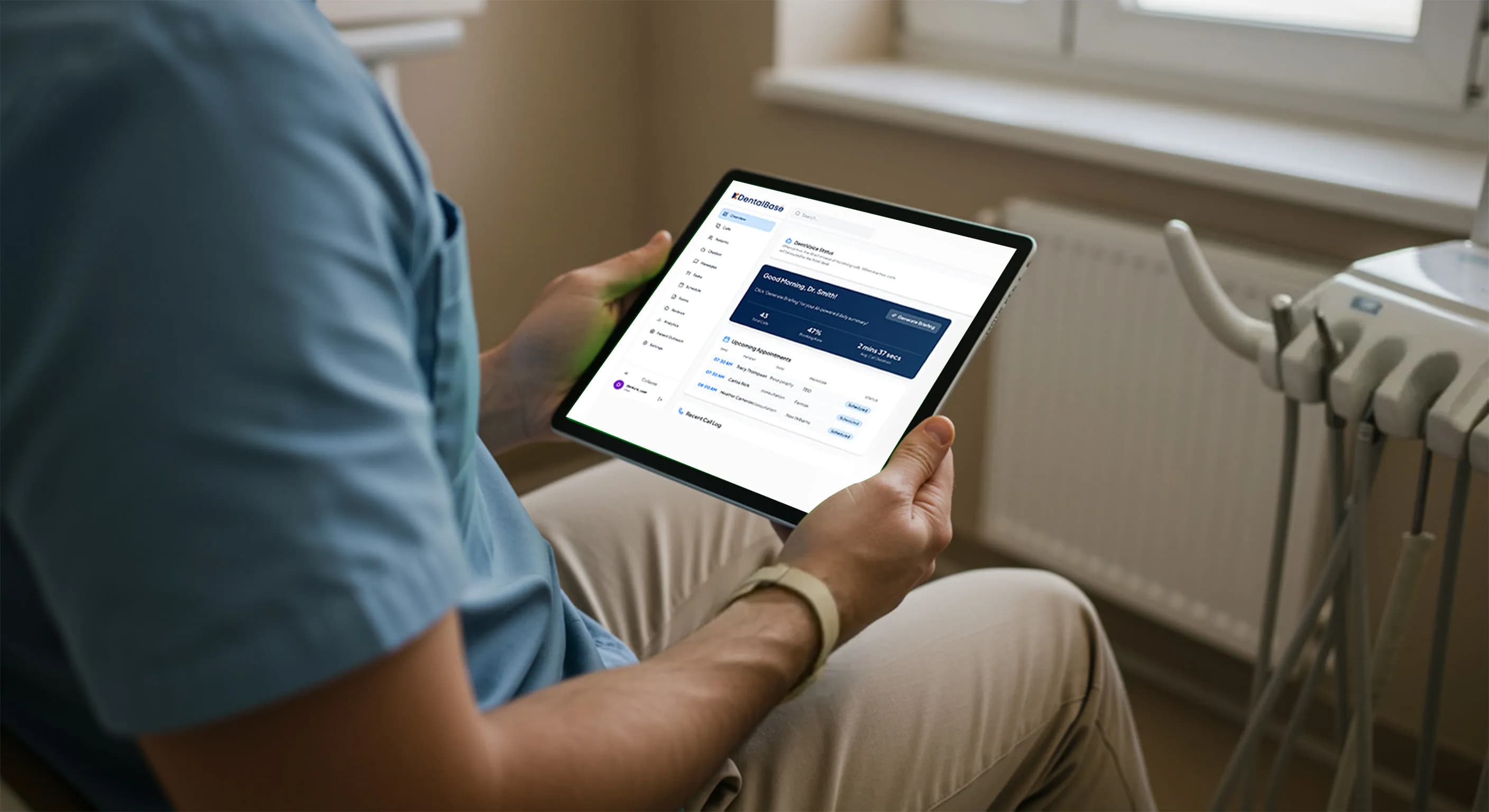
AI Receptionists for Dental Practices: Benefits & ROI

See how AI receptionists for dental practices capture every call, cut no-shows, book appointments around the clock, and support your front desk team.
Share:
Table of contents
Running a modern dental practice goes far beyond clinical excellence. Phone calls, appointment scheduling, follow-ups, and patient inquiries all compete for your front desk’s attention. Missed calls often mean missed revenue.
This is where AI receptionists for dental practices are transforming operations. Designed to handle patient communication intelligently and efficiently, AI receptionists help clinics scale without increasing staffing costs.
In this guide by Dentivoice, we explore the real business, operational, and patient-experience benefits of AI receptionists for dental practices, and why adoption is accelerating across the dental industry.
AI receptionists for dental practices are software systems that answer inbound calls, book appointments, and follow up with patients automatically, so your front desk can stay focused on the people in front of them. Booking is the piece most practices want to understand first, so it gets its own walkthrough: how AI-powered scheduling works for dental clinics.
What Is an AI Receptionist for Dental Practices?
An AI receptionist is an intelligent, voice- or chat-based system that manages front-desk tasks such as:
-
Answering inbound calls
-
Booking, rescheduling, and confirming appointments
-
Responding to common patient questions
-
Sending reminders and follow-ups
-
Routing complex cases to human staff
Unlike traditional automated phone systems, AI receptionists use natural language processing (NLP) to understand patient intent and respond conversationally.
Key Benefits of AI Receptionists for Dental Practices
1. 24/7 Call Coverage Without Extra Staff
Dental offices often miss calls after hours, during lunch breaks, or when the front desk is overwhelmed.
An AI receptionist works around the clock, ensuring:
-
No missed appointment inquiries
-
Patients can book anytime, day or night
-
Emergency calls are handled promptly
Result: Increased appointment volume and improved patient satisfaction.
2. Higher Appointment Booking Rates
Every unanswered call is a potential lost patient.
AI receptionists:
-
Instantly answer incoming calls
-
Reduce hold times to zero
-
Guide patients smoothly through booking
By eliminating friction, practices experience higher conversion from inquiry to appointment.
More answered calls = more booked chairs
3. Reduced Front Desk Workload
Front desk teams often spend most of their day repeating the same tasks:
-
“What are your hours?”
-
“Do you accept my insurance?”
-
“Can I reschedule?”
AI receptionists handle routine, repetitive inquiries, allowing staff to focus on:
-
In-office patient care
-
Complex insurance issues
-
Upselling elective treatments
This improves staff morale and reduces burnout.
4. Consistent, Error-Free Communication
Human error happens, especially during busy hours.
AI receptionists deliver:
-
Consistent answers every time
-
Accurate appointment scheduling
-
No forgotten reminders or confirmations
This consistency helps reduce:
-
Double bookings
-
No-shows
-
Patient frustration
5. Fewer No-Shows Through Automated Reminders
Missed appointments are costly for dental practices.
AI receptionists automatically:
-
Send appointment confirmations
-
Deliver reminders via call, SMS, or WhatsApp
-
Allow easy rescheduling
Result: Lower no-show rates and better chair utilization.
6. Improved Patient Experience
Today’s patients expect:
-
Fast responses
-
Convenience
-
Minimal waiting
AI receptionists offer:
-
Instant answers
-
Conversational interactions
-
Seamless booking experiences
Patients feel heard, even when staff are busy.
7. Cost Savings Compared to Hiring Staff
Hiring and training front desk staff involves:
-
Salaries
-
Benefits
-
Turnover costs
AI receptionists offer a predictable, scalable cost model, often replacing the need for additional hires as the practice grows.
This makes AI ideal for:
-
Small practices
-
Multi-location clinics
-
Rapidly expanding dental groups
8. Scales Easily as Your Practice Grows
Whether you add:
-
New dentists
-
New services
-
New locations
An AI receptionist scales instantly, without retraining or onboarding delays.
This is especially valuable for DSOs and multi-branch dental networks.
9. Better Data & Call Insights
AI receptionists don’t just answer calls, they collect data.
Practices gain insights into:
-
Call volume trends
-
Peak inquiry hours
-
Common patient questions
-
Missed revenue opportunities
These insights help optimize staffing, marketing, and service offerings.
10. Seamless Integration With Dental Systems
Modern AI receptionist solutions integrate with:
-
Practice management systems
-
Appointment scheduling tools
-
CRM platforms
This ensures real-time availability, accurate bookings, and smooth workflows.
How Much Revenue Does a Missed Dental Call Cost?
A single missed new-patient call can represent hundreds to thousands of dollars in lifetime treatment value, since the caller often books with the next practice that picks up. When you multiply unanswered calls across evenings, weekends, and busy mornings, the leak becomes one of the largest hidden costs in a dental practice.
The math is simple but uncomfortable. If your front desk answers roughly two-thirds of calls and a meaningful share of the rest are first-time patients, the lost production adds up month after month. This is the gap an AI receptionist is built to close, and it is why so many practices now treat phone coverage as a growth lever rather than an afterthought.
Illustrative ranges based on common dental front-desk patterns. Actual results vary by practice.
Understanding your own answer rate is the first step. Many offices are surprised when call analytics reveal how many calls go unanswered during peak hours, and even more surprised by how many of those callers never try again. If your phones feel relentless, the warning signs of a front desk that has outgrown its current setup are usually visible long before staff burn out.
What Happens to Dental Calls Made After Hours?
After-hours calls are where most practices quietly lose patients. Evenings, early mornings, weekends, and lunch breaks generate a steady stream of inquiries, yet these are exactly the windows when no one is at the desk to answer. The orange bars below show how call demand keeps flowing long after the office closes.
Sending those callers to voicemail rarely works. Most patients hang up and dial a competitor instead, which is why voicemail quietly costs dental practices new patients more often than owners realize. An AI receptionist answers on the first ring at any hour, captures the appointment, and routes anything urgent appropriately. For practices weighing their options, there are several ways to cover after-hours dental calls without hiring overnight staff.
How Does an AI Receptionist Compare to an Answering Service?
An AI receptionist answers and books appointments in real time, while a traditional answering service usually just takes a message and a voicemail captures nothing at all. The difference shows up most clearly in whether a caller leaves with a confirmed appointment or simply leaves.
The table below lines up the three approaches dental practices most often compare. Notice how the gap is widest on the tasks that drive revenue: booking directly into your schedule and answering every call without exception.
| Capability | Voicemail | Traditional answering service | AI receptionist |
|---|---|---|---|
| Answers 24/7 | No live answer | Often limited hours | Yes, every hour |
| Books into your software | No | Takes a message only | Books in real time |
| Consistent answers | None | Varies by operator | Same every call |
| Cost as volume grows | Low, but loses patients | Per-minute, scales up | Predictable flat model |
| Call data & insights | None | Minimal | Full transcripts & trends |
For a deeper look at how these systems stack up against each other and what to ask vendors, our breakdown of leading dental AI voice receptionist platforms covers the features that matter most. The short version: anything that books the appointment beats anything that only records a request to call back.
How Does an AI Receptionist Actually Handle a Call?
An AI receptionist follows a predictable path on every call: it answers immediately, identifies what the patient needs, completes the booking or routes the request, and then confirms the outcome. Each step is logged, so nothing depends on memory or handwritten notes.
Call is answered instantly
No ring-out, no hold music, no voicemail. The patient is greeted within the first ring at any hour.
Intent is understood
Natural language processing identifies whether the caller wants to book, reschedule, ask a question, or report an emergency.
Appointment is booked or routed
Routine requests are scheduled directly into the practice software; urgent or complex calls are triaged to the right person.
Confirmation & follow-up sent
The patient receives a confirmation, and reminders go out automatically by call, SMS, or text before the visit.
Call is logged for the team
A full transcript and outcome are saved, giving the front desk a clear record and the practice usable data.
The routing step is where dental-specific design matters most. A well-built system knows the difference between a cleaning request and a knocked-out tooth, which is why thoughtful call routing triages urgent and routine dental calls differently. Once the appointment is set, the same system can confirm details and book appointments directly inside your dental software without a staff member touching the keyboard.
Is an AI Receptionist Worth the Investment for a Small Practice?
For most small and solo practices, an AI receptionist pays for itself when it recovers even a handful of otherwise-missed new-patient appointments each month. Because the cost is a predictable monthly figure rather than a per-minute rate, the return becomes easier to forecast as call volume grows.
up to ~100%
of inbound calls answered, including nights and weekends
15-30%
estimated lift in booking rate vs. missed-call scenarios
20-40%
typical reduction in no-shows from automated reminders
$300, $800
common monthly cost, usually below a full-time hire
Figures are general industry ranges for illustration; results depend on call volume, market, and setup.
The value is rarely just the recovered bookings. Fewer no-shows protect the schedule, automated recall reminders bring lapsed patients back on the books, and the front desk reclaims hours previously lost to repetitive questions. If you run a one- or two-operatory office, our sizing guide for solo dental practices walks through what coverage actually looks like at that scale.
Are AI Receptionists Replacing Human Staff?
No, they enhance, not replace.
AI receptionists handle high-volume, repetitive tasks, while human staff focus on:
-
Complex patient needs
-
In-person interactions
-
Relationship building
The result is a hybrid front desk model that’s more efficient and patient-friendly.
Who Should Use AI Receptionists?
AI receptionists are ideal for:
-
Solo dental practices seeking efficiency
-
Multi-location clinics needing centralized call handling
-
Cosmetic dentists managing high inquiry volume
-
Dental specialists with complex scheduling needs
Why Dentivoice Recommends AI Receptionists for Dental Practices
At Dentivoice, we specialize in AI-powered communication solutions built specifically for dental practices.
Our approach focuses on:
-
Dental-specific conversation design
-
Patient-friendly voice interactions
-
Revenue-driven appointment flows
-
Compliance and data security
The goal is simple: turn every call into an opportunity, not a missed chance.
How Do You Choose the Right AI Receptionist for Your Practice?
Choosing the right AI receptionist comes down to four things: how well it books into your software, how it handles urgent calls, what it costs as you grow, and the quality of the data it gives back. Start with the workflows that already cause friction at your front desk.
AI receptionist evaluation checklist
Check each item a vendor can clearly demonstrate.
Integration is usually the deciding factor. If your office runs on a common platform, confirm the system supports it the way a dedicated Open Dental integration does, and review how each tool stacks up in a dental patient communication software buyer guide. It also helps to map the most common dental call types patients ask about so you can test the system against real scenarios before committing.
See how many calls your practice is missing
Dentivoice answers, books, and follows up on every call so your front desk can focus on patients in the chair.
Explore Dentivoice →What Can an AI Receptionist Actually Do for a Dental Practice?
An AI receptionist for dental practices can answer calls, book and reschedule appointments, send reminders, route urgent callers, verify insurance details, and follow up after treatment. It covers the repetitive, time-sensitive work that pulls a front desk away from in-person patients.
The fastest way to understand the value is to map common front desk tasks against how an AI receptionist handles each one. The point is not to remove people from the equation, but to take the high-volume, after-hours, and overflow work off their plate so the team can focus on patients in the operatory. If your team is asking whether this changes staffing, this practical guide to whether AI can take over the dental front desk covers it.
| Front desk task | How an AI receptionist helps | Why it matters |
|---|---|---|
| Answering calls | Picks up every inbound call, including evenings, weekends, and busy clinical hours. | New-patient callers rarely leave voicemail and often dial the next practice instead. |
| Scheduling | Books, reschedules, and cancels appointments directly in the practice calendar. | Fills open chair time without back-and-forth phone tag. |
| Reminders and recall | Sends automated confirmations and recall outreach by call or text. | Fewer gaps in the schedule from forgotten or unconfirmed visits. |
| Call routing | Identifies urgent callers and routes them to the right person or instructions. | Genuine emergencies reach staff quickly while routine questions are handled automatically. |
| Insurance questions | Captures and confirms coverage details so the team is not stuck on hold. | Front desk time shifts from data entry to patient-facing work. |
For a deeper look at the calls themselves, the breakdown in the top dental call types patients ask about shows how much of daily phone volume is routine and automatable. Coverage gaps are easiest to see when you compare staffing approaches side by side in in-house, answering service, and AI coverage models.
See how phone coverage adds up across a full week
Walk through in-house, answering service, and AI options so you can match coverage to your real call patterns.
Read the phone coverage guide →Which Dental Practices Benefit Most From an AI Receptionist?
Solo offices, group practices, specialty practices, and multi-location organizations all benefit from an AI receptionist, though the priorities differ. Smaller offices gain coverage they could not otherwise staff, while larger groups gain consistency across locations and overflow protection during peaks.
The common thread is call volume that outpaces front desk capacity at certain hours. A solo practice may only need help during lunch and after closing, while a specialty practice fielding referrals needs reliable capture of every new caller. The fit depends on where calls are being missed, not on practice size alone.
Solo and small practices
Covers lunch breaks, after-hours, and single-receptionist gaps without a new hire.
Group practices
Absorbs overflow during peak windows so no caller waits on long holds.
Specialty practices
Captures every referral and new-patient call, where one missed lead is costly.
Multi-location groups
Delivers a consistent greeting and booking experience across every office.
Specialty offices have their own call patterns. Orthodontic practices, for example, field a different mix of questions, as covered in how AI receptionists work for orthodontic practices, while pediatric dental practices weigh parent communication heavily. Practices serving multilingual communities can also route Spanish-speaking patient calls without a dedicated bilingual hire.
How Do You Roll Out an AI Receptionist Without Disrupting Your Front Desk?
Most dental practices start an AI receptionist on a narrow slice of calls, such as after-hours and overflow, then expand coverage once the team trusts the booking quality. This staged approach protects the patient experience while staff learn how the system handles real conversations.
A practical rollout begins by deciding which calls the AI should own first, confirming it books cleanly into your scheduling software, and reviewing call transcripts in the early weeks. The goal is a smooth handoff between automated and human coverage, not an overnight switch. Clear escalation rules keep urgent callers connected to a person while routine bookings run on their own.
| Phase | Focus | What to confirm |
|---|---|---|
| Start | After-hours and overflow calls | Calls are answered and messages or bookings reach the team. |
| Expand | Daytime overflow and routine scheduling | Appointments book accurately into your software. |
| Optimize | Reminders, recall, and follow-up | Reminder cadence and escalation rules match your workflow. |
Integration with your practice management system is the step most worth getting right. The mechanics of a typical setup are detailed in this Open Dental integration walkthrough. Before you compare vendors, it also helps to review what to look for in dental patient communication software so the AI receptionist fits the rest of your stack. Practices weighing the financial side can model lost revenue with a missed-call cost calculator.
Not sure how many calls you are missing?
Estimate the bookings slipping through after hours and during peak times, then see how staged AI coverage closes the gap.
Calculate your missed-call cost →Final Thoughts
The benefits of AI receptionists for dental practices go far beyond automation. They deliver:
-
More booked appointments
-
Happier patients
-
Less stressed staff
-
Lower operational costs
As patient expectations rise and competition increases, AI receptionists are no longer optional, they’re a strategic advantage.
Turn every dental call into a booked appointment
Dentivoice is an AI receptionist built for dental practices, answering around the clock and booking straight into your schedule.
See Dentivoice in action →Still getting oriented? Start with our complete guide to what an AI dental receptionist is, then see how a dental AI assistant supports your team day to day.
Frequently Asked Questions
Yes. AI receptionists provide 24/7 call coverage, meaning your call can be answered even after hours or on weekends. You can usually book, reschedule, or ask common questions immediately instead of leaving a voicemail.
Most AI receptionists allow real-time appointment booking by checking the clinic’s schedule and confirming availability instantly. This avoids long hold times and lets you secure an appointment in under a few minutes.
Yes. AI receptionists are designed to route complex or urgent issues to human staff when needed. You’ll be transferred if your question requires personal attention or detailed discussion.
Yes. AI receptionists typically send automated confirmations and reminders via calls or text messages. These reminders significantly reduce missed appointments and make it easier for you to reschedule if needed.
An AI receptionist books appointments directly into your software in real time, while most answering services only take a message. It also answers 24/7 with consistent responses and gives you full call transcripts and trends an answering service rarely provides.
Costs commonly fall in the range of about $300 to $800 per month, depending on call volume and integrations. Because pricing is usually a predictable monthly fee rather than per-minute billing, it is often lower than adding a full-time front desk hire.
Most modern AI receptionists integrate with common practice management and scheduling systems so bookings sync in real time. Always confirm your specific platform is supported and test the integration before committing to a vendor.
Most dentists connect an AI receptionist to their existing phone number and practice management system in a few steps. The AI receptionist for dentists then answers calls in your practice voice, so patients notice better coverage rather than a complicated new tool.
Sources & References
- 1
- 2
- 3
- 4
- 5
- 6
Topics
Was this article helpful?
Written by
DentalBase Team
Expert dental industry content from the DentalBase team. We provide insights on practice management, marketing, compliance, and growth strategies for dental professionals.