AI Receptionist Accent Recognition: How Accuracy Works

AI receptionist accent recognition explained: how dental phone AI parses diverse accents, filters background noise, and where accuracy still breaks down.
Share:
Table of contents
A patient calls a dental office with a heavy Nigerian accent, a bad cell connection, and a toddler crying in the background. The receptionist on the other end is an AI dental receptionist, not a person. Whether that call ends in a booked appointment or a frustrated hang-up depends almost entirely on AI receptionist accent recognition, the part of the system most vendors talk about the least.
Dental practices in the U.S. serve some of the most linguistically diverse patient populations of any small business. Spanish, Mandarin, Vietnamese-accented English, Southern drawls, Caribbean patois, and half a dozen regional dialects can all show up in a single day of calls. An AI receptionist that only performs well on flat, Midwestern-accented English in a quiet room is not production-ready for most U.S. practices. This guide breaks down how accent recognition and noise handling actually work. It covers where the technology still struggles and what a practice should test before trusting an AI system with its front desk.
What Is AI Receptionist Accent Recognition, and Why Does It Matter?
AI receptionist accent recognition is the ability of a phone AI's speech-to-text engine to correctly transcribe callers who don't speak in a standard, textbook accent. It matters because a single misheard word, a date, an insurance name, a procedure, can send a booking or an intake form down the wrong path entirely.
Why This Is a Front-Desk Risk, Not Just a Tech Detail
Every automated speech recognition (ASR) engine is trained on a dataset of recorded speech, and that dataset has an accent distribution baked into it. Engines trained mostly on North American broadcast English perform noticeably worse on Indian English, Nigerian English, and heavily accented Spanish-influenced English. Those speech patterns were simply underrepresented in the training data.
Getting the words right is only the first step. how the AI processes what it hears and turns it into a scheduled visit covers what happens once the transcript is accurate.
The core issue
Independent research on speech recognition accuracy across different accents has repeatedly found meaningful gaps between standard-accent and non-standard-accent speakers, even when audio quality is identical. That gap does not disappear just because a vendor calls its product "AI-powered", it depends entirely on how broad and recent the underlying training data is. That is why accent handling deserves a test call during any vendor demo, one of the checks in the dental AI receptionist software selection guide.
The American Dental Association has started publishing its own guidance on where AI genuinely helps versus where it introduces new risk to patient communication. ADA
How Do AI Dental Receptionists Actually Understand Different Accents?
AI dental receptionists understand accents by running audio through a speech-to-text model trained on thousands of hours of varied speech, then correcting likely errors using dental-specific vocabulary lists. The stronger systems layer a second pass of context-aware correction on top of raw transcription, catching mishears before they reach scheduling logic.
The Three-Stage Recognition Process
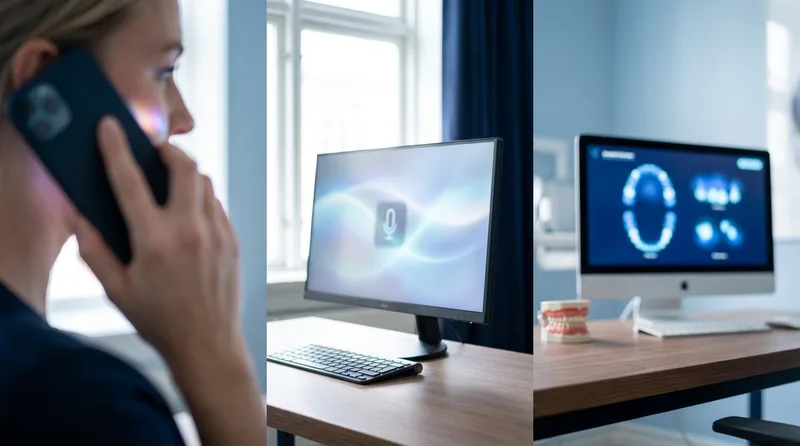
The process generally happens in three stages. First, the raw audio is converted to text by the ASR engine, which is the stage most affected by accent. Second, a natural-language-understanding layer maps that text to an intent, booking, rescheduling, a billing question, a step covered in more depth in how an AI dental receptionist works. Third, a dental-specific vocabulary layer re-checks likely candidates against a list of common procedure names, insurance carriers, and local place names. Generic ASR models are rarely trained on words like "periodontal" or "Invisalign," so this layer catches errors the first two steps miss.
- Broad training data across regional and non-native English accents.
- Dental-specific vocabulary correction for procedure and insurance terms.
- Confidence scoring that flags low-certainty transcriptions for confirmation.
Where Generic Systems Fall Short
Systems that skip the third layer tend to mishear brand names and insurance carriers more often, because those words simply don't appear in general-purpose training data at meaningful volume.
Why Do Background Noise and Call Quality Affect Accent Recognition Accuracy?
Background noise and poor call quality compound accent-related errors because they strip away the acoustic detail an ASR engine needs to distinguish similar-sounding words. A caller with a moderate accent on a clear line is usually understood correctly; the same caller on a noisy cell connection is not.

Common Noise Sources on Real Practice Calls
Common noise sources on real dental practice calls include road noise from a caller driving, a television or crying child in the background, and the caller's own phone speaker quality. Compression artifacts from cellular networks or Bluetooth headsets also remove high-frequency detail that carries consonant sounds. That detail is exactly where accent-driven pronunciation differences live. A practice evaluating a vendor should specifically ask what happens when a call arrives at low bitrate over a cellular network, not just how the system performs on a clean landline demo call.
How Different Noise Types Affect Accuracy
| Noise Source | Effect on Accent Recognition |
|---|---|
| Cellular compression | Strips consonant detail, increases mishears. |
| Background voices/TV | Competes with caller's voice for the same frequency range. |
| Road/wind noise | Masks softer consonants (s, f, th sounds). |
| Bluetooth headset lag | Can clip word starts, changing perceived vowel length. |
Which Patient Populations Are Most Likely to Be Misunderstood by AI Receptionists?
Non-native English speakers, older patients with softer or slower speech, and callers in loud environments like job sites or moving vehicles are the groups most likely to be misunderstood by an AI receptionist. These are also, not coincidentally, patients who already report more friction with automated phone systems generally.
Why This Is an Equity Issue, Not Just an Accuracy One
This matters for equity as much as it matters for booking volume. A meaningful share of non-English households speak accented English on the phone even when calling an English-language practice. A practice serving a diverse patient base should treat accent handling as a core requirement, not a nice-to-have, when evaluating a phone AI vendor.
The scale of the patient population
U.S. Census Bureau data shows well over 60 million U.S. residents speak a language other than English at home, spanning hundreds of distinct languages nationwide. More than 40 million of them speak Spanish, the single most common non-English language in the country. Census Bureau
Related patient-experience research is covered in do patients like AI receptionists.
How Does DentiVoice Handle Accent and Noise Variability on Live Calls?
DentiVoice handles accent and noise variability with a multi-accent trained speech engine, real-time confidence scoring, and a fallback confirmation step that repeats back key details before finalizing a booking. If the system's confidence score drops below a set threshold, it asks a clarifying question instead of guessing.
Why Confirmation Loops Matter More Than Raw Accuracy
Confirmation loops are the single biggest practical defense against accent-driven booking errors. Instead of silently transcribing "Tuesday the 13th" as "Tuesday the 30th" and locking it in, a well-built system repeats the detail back first. It says something like "just to confirm, that's Tuesday the 13th at 2pm" before committing the entry to the calendar. This same confirmation logic is part of what makes caller context and screen pop useful for staff, since a flagged low-confidence call surfaces with a note for the front desk to double-check.
How the Confirmation Loop Runs Step by Step
- Audio is captured and run through the multi-accent ASR engine.
- A confidence score is generated for each transcribed segment.
- Low-confidence segments trigger a spoken confirmation question.
- Confirmed details are passed to scheduling; unresolved ones escalate to staff.
Voice customization settings, covered in custom AI receptionist voice, can also be tuned to speak more slowly and clearly for callers the system detects are struggling, which measurably improves mutual comprehension on both ends of the call.
What Happens When an AI Receptionist Truly Can't Understand a Caller?
When an AI receptionist genuinely cannot understand a caller after repeated clarification attempts, a properly configured system escalates the call to a human staff member rather than guessing or looping the caller through the same question indefinitely. This escalation threshold is one of the most important settings a practice can configure.

What a Clean Escalation Looks Like
Practices should insist on seeing the exact escalation trigger during a vendor demo: how many failed confirmation attempts happen before the system hands off, and what information is passed to the human who picks up. A silent, context-free transfer is a worse patient experience than no AI at all. The ADA has written about how AI tools should support, rather than obscure, direct patient communication when a handoff happens. ADA News The mechanics of a clean handoff are detailed in AI receptionist handoff patient experience. On the patient side, how patients can fix a misheard name on an AI call is worth sharing with callers who worry about being misunderstood.
What Questions Should Practices Ask Vendors About Accent and Noise Handling?
Practices should ask vendors for accent-specific accuracy benchmarks, a demo call placed over a real cell connection with background noise, and a clear explanation of the escalation threshold before signing a contract. Generic "99% accuracy" marketing claims without this context are close to meaningless.
Industry critics have specifically called out inflated accuracy claims as one of the biggest gaps between AI receptionist marketing and real-world performance. Dentaltown
Building the Right Checklist for Your Patient Base
A useful evaluation checklist starts with the specific accents relevant to the practice's actual patient base, not just Spanish if the practice also sees Vietnamese, Haitian Creole, or Indian callers. It should also include a live test call from a real mobile phone rather than a wired demo line, plus a direct question about how often the confirmation-loop fallback triggers in production versus a lab environment. Industry coverage of AI receptionist rollouts has been blunt about the gap between vendor demos and real-world call handling. Dental Economics
Vendor Evaluation Checklist
Confirm each item before signing a contract.
The broader vendor evaluation process, including voice quality testing, is walked through step by step in how to evaluate AI receptionist voice customization.
Is Voice AI or Text-Based AI Better for Callers With Strong Accents?
Voice AI generally books more appointments overall, but text-based AI can be a useful fallback for callers whose accent or connection quality repeatedly triggers escalation on voice calls, since typed English removes pronunciation from the equation entirely. Neither replaces the other; they solve different friction points.
When a Text Fallback Makes Sense
Some practices route a caller to an SMS follow-up link after two failed voice confirmation attempts, letting the patient finish booking by text instead of repeating themselves to a machine a third time. This hybrid approach is explored further in voice AI vs text AI dental receptionist, which breaks down when each channel converts best. The goal is not to replace front-desk judgment about which channel a patient prefers, it's to give the AI system a graceful off-ramp instead of forcing a frustrated caller through repeated failed attempts.
How Should Multilingual and Diverse Practices Prepare for Rollout?
Multilingual and diverse practices should pilot an AI receptionist against real historical call recordings from their own patient base before full rollout, not just a vendor's demo script. A one-week supervised pilot, with staff listening in on flagged calls, catches accent-related gaps before they affect real patients.
What to Track During a Pilot
During a pilot, track three numbers: the percentage of calls that trigger a confirmation loop, the percentage that escalate to staff, and the percentage of AI-only bookings that later need correction by front-desk staff. If escalation rates are dramatically higher for certain call patterns than others, that's a signal the vendor's accent handling has a real gap for this specific patient population, not a random fluke.
Accent Coverage Is Not a One-Time Setup Task
Practices with especially high linguistic diversity should also confirm the vendor's roadmap for adding new accent training data, since accent coverage improves, or stagnates, over time depending on how the vendor invests in it.
Related: Recognition failures on a noisy call often surface later as a mis-booked visit. how to diagnose and correct a wrong appointment type booking →
Accent handling connects to a few other pieces of the voice experience: what makes a synthetic voice sound natural to callers, how the same system handles Spanish-language calls, and getting a system like this live within a week.
Frequently Asked Questions
Most modern AI receptionists can understand moderate non-native accents reasonably well, but accuracy drops with heavier accents, especially combined with background noise or a poor phone connection. Vendor-specific training data quality determines the real-world gap.
The two compound each other rather than acting separately. A moderate accent on a clear line is usually understood correctly, but the same accent over a noisy cellular connection often is not, because noise removes the detail needed to tell similar words apart.
A well-configured system uses confidence scoring to flag uncertain transcriptions and asks a spoken confirmation question before finalizing a booking, rather than silently locking in a guess that could send an appointment to the wrong date or time.
Yes. A short supervised pilot using the practice's own historical call recordings reveals accent-related gaps that a vendor's clean demo script will not, and lets staff verify the escalation threshold before real patients are affected.
Voice AI still books more appointments overall, but text-based follow-up removes pronunciation from the equation entirely. Some practices route a caller to an SMS link after repeated failed voice confirmations instead of forcing a third spoken attempt.
Sources & References
- 1
- 2
- 3
- 4
- 5
Topics
Was this article helpful?
Written by
DentalBase Team
Expert dental industry content from the DentalBase team. We provide insights on practice management, marketing, compliance, and growth strategies for dental professionals.