The True Cost of Missed Dental Calls (Calculate Yours)

The cost of missed dental calls adds up fast. Use this simple formula to put a dollar value on every unanswered call and model your monthly loss.
Share:
Table of contents
The cost of missed dental calls is the easiest number in your practice to ignore and the most expensive one to keep ignoring. A phone that rings into voicemail doesn't show up on a profit and loss statement. The revenue just quietly walks out the door and into the practice down the street. For a broader look at every way that single missed call ripples through a practice, see what a missed dental call really costs, and how to fix it.
Most owners feel the problem without measuring it. They sense the front desk is buried. They notice voicemails stacking up. What they rarely do is assign a dollar figure to a single unanswered call, then multiply it across a month. This article hands you that formula. You'll learn how to value one missed call, model your monthly loss, and see worked examples for a solo office, a group practice, and a DSO location.
What Is the Real Cost of a Missed Dental Call?
The real cost of a missed dental call is the lifetime value of the patient you never booked, not the price of one appointment. A first-time caller who would have stayed for years and referred others represents thousands in future production. One unanswered ring can forfeit all of it.

Here's the trap. When you think a missed call costs you "a cleaning," you assign it maybe 150 dollars and move on. But a new caller isn't worth one visit. They're worth every visit they would have had, plus the family members and coworkers they would have sent your way. That's why the unit of measurement matters so much.
Lifetime patient value (LPV) is the number to anchor on. It's the total production a patient generates across their entire relationship with your practice. The per-visit figures alone are meaningful: Dental Economics reports that the average dental patient spends about $685 per visit, with specialists earning as much as $1,755. Stack those visits over a decade of recurring hygiene, restorative work, and referrals, and a single relationship is worth far more than any one procedure.
So the question isn't "what did I lose by missing that call." It's "what relationship did I just hand to a competitor." Different framing. Much bigger number.
Coverage is a system, not a single fix.
Before you can recover lost revenue, you need to see every gap where calls slip through. Our complete guide maps each one.
Read the phone coverage guide →How Do You Calculate the Cost of Missed Dental Calls?
To value one missed call, multiply your lifetime patient value by the share of callers who become patients, then by the share of missed callers who never call back. The result is the average revenue you lose every time the phone goes unanswered. One reusable number.
Walk through it with real inputs. Say your LPV is 1,200 dollars. Roughly 40 percent of new-patient callers book when someone answers, so each answered new-patient call is worth about 480 dollars in expected lifetime production. Now the painful part. When a caller hits voicemail or a busy signal, most don't try again. They dial the next listing and never look back.
If 75 percent of your missed callers never return, then each missed new-patient call costs you roughly 360 dollars in expected lifetime value (480 dollars multiplied by 0.75). That's your per-call number. Here are the variables to plug in:
| Variable | What it means | Example |
|---|---|---|
| Lifetime patient value (LPV) | Total production one patient generates over the relationship | $1,200 |
| New-patient booking rate | Share of answered new-patient calls that schedule | 40% |
| Non-return rate | Share of missed callers who never call back | 75% |
| Cost per missed call | LPV × booking rate × non-return rate | $360 |
Use your own numbers. If you don't track your booking rate yet, that's the first thing to fix, because you can't price a missed call without it. The beauty of this formula is that it scales to any practice. Plug in a higher LPV or a busier phone, and the loss climbs fast.
How Much Revenue Do Missed Calls Cost a Practice Each Month?
Monthly missed-call cost equals your per-call loss multiplied by the number of new-patient calls you miss each month. Even a modest miss rate produces a number that should change how you staff the phone. And the leakage scales sharply with practice size.
Take the 360 dollar per-call figure from above. Now estimate missed new-patient calls per month. A busy front desk that handles heavy call volume routinely misses calls during lunch, after hours, and peak check-in windows. The reality is that many practices miss far more than they think, because abandoned calls during hold time never register as "missed" in anyone's memory.
Here's how the monthly math plays out across three practice types:
| Practice type | Missed new-patient calls/month | Cost per call | Monthly loss |
|---|---|---|---|
| Solo practice | 15 | $360 | $5,400 |
| Group practice (3 providers) | 45 | $360 | $16,200 |
| DSO location (per site) | 70 | $360 | $25,200 |
Multiply the DSO figure across a dozen locations and you're looking at an annual loss that rivals the payroll of an entire support team. And it lands on an industry already stretched thin, with front desks short-handed exactly when call volume peaks. Phone coverage deserves to be treated as infrastructure, not a chore.
Related: Knowing what callers actually want changes how you prioritize coverage. See the top dental call types →
Why Do So Many Dental Calls Go Unanswered?
Dental calls go unanswered because phone coverage has predictable gaps that no single front desk can close alone. Lunch breaks, after-hours windows, weekends, and peak check-in chaos all create dead zones where the phone rings into nothing or sits on hold until the caller quits.
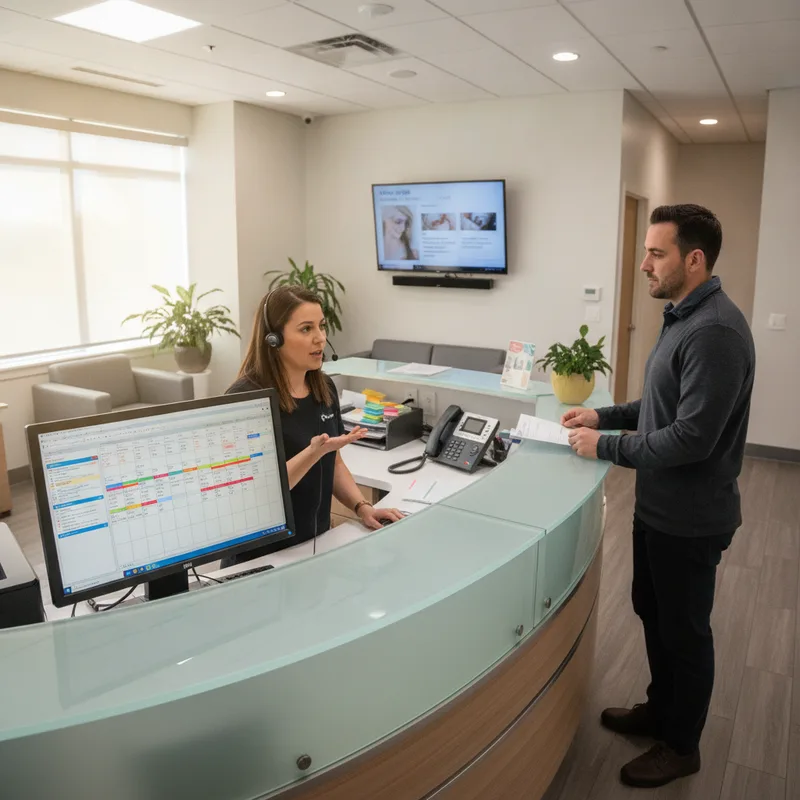
Think about a normal Tuesday. The front desk is checking in a patient, verifying insurance on hold with a payer, and answering a billing question at the counter. Two more lines light up. Both roll to voicemail. Neither caller leaves a message, because most people calling a dentist want a human, not a beep.
Then there's the after-hours problem. A meaningful share of new-patient calls land in the evening or on weekends, when people finally have time to deal with that nagging tooth. Research in the journal Dental Abstracts found that about 43% of patients look for a dentist after hours, while 85% of dental appointments are still booked by phone. So if your line rolls to voicemail at 5:01 PM, you're invisible during the exact hours patients decide to act. And demand is steady: the CDC reports that about 64.8% of adults aged 18 and older had a dental visit in the past year.
Hold abandonment is the quietest culprit. A caller waits 45 seconds, then 90, then hangs up and dials the next office. No one at your practice ever knew the call happened. These invisible losses are why measured miss rates almost always exceed what owners estimate from memory.
Related: Voicemail feels like coverage but quietly pushes patients away. Why dental voicemail loses patients →
Beyond Revenue: What Else Does a Missed Call Cost?
A missed dental call costs more than booked production. It erodes your reputation, drains your team, and quietly redirects referrals to competitors. These second-order costs rarely make it into an ROI model, yet they compound over time just as real revenue does.
Start with reputation. A caller who can't reach you forms an impression before they ever meet you: this office is hard to reach. Some of them say so publicly. Online reviews that mention unanswered phones and full voicemail boxes do measurable damage to local search performance, where most new patients begin looking.
Then consider your staff. When the phone never stops and there's no backup, your front desk operates in constant triage. That pressure shows up as burnout, errors, and turnover, all of which carry their own costs. According to the American Dental Association's Health Policy Institute, staffing and recruitment remain among the top challenges facing dental practices, so every avoidable source of front-desk strain matters. A team that's drowning can't deliver the warm first impression that converts callers into patients.
Referrals leak too. A patient you never booked can't refer their spouse, their kids, or their coworker. The stakes are real: the NIH's National Institute of Dental and Craniofacial Research notes in Oral Health in America: Advances and Challenges that many people still lack access to routine dental care, so a practice that's easy to reach fills a genuine gap. One missed call doesn't just cost one relationship. It quietly closes off the entire network that relationship would have opened.
A large share of this hidden cost concentrates outside business hours. For the data on why after-hours dental calls matter more than you think, including how much ends up in the emergency room instead of your chair, see our full breakdown.
Is your front desk constantly underwater?
The warning signs usually show up long before turnover hits. Here's how to spot and fix an overwhelmed front desk.
See the 7 signs and fixes →How Can You Recover Missed-Call Revenue?
You recover missed-call revenue by measuring it first, then closing the coverage gaps that create it. You can't fix what you don't track, so the starting point is call analytics: how many calls come in, how many get answered, and how many convert.
Recovering that revenue in real time depends on the receptionist actually seeing your live schedule, not a stale copy of it. This AI dental receptionist Denticon integration guide covers what that real-time booking sync looks like for practices running Denticon.
Begin with the data. Pull your call logs and look at answer rate, missed-call volume by hour, and the booking rate on answered new-patient calls. Most practices are surprised by what the numbers show, especially around lunch and after hours. Once you can see the leak, you can size it with the formula above.
Next, close the gaps your data exposes. That might mean overflow coverage during peak hours, after-hours answering so evening callers reach a real conversation, and outbound follow-up to recover callers who slipped through. An AI voice receptionist can handle overflow and after-hours volume so no caller hits a dead line, while your team focuses on the patients in front of them. The goal isn't to replace your front desk. It's to make sure no call goes to nobody. Set that coverage cost against the leak you just calculated, since what an AI dental receptionist costs in 2026 typically lands well under the monthly loss figures in the table above. This is exactly how dental practices scale without overloading the front desk. If you want the full payback math behind that comparison, see how quickly an AI receptionist pays for itself.
The gaps worth closing first usually fall into a few buckets:
- Overflow during peak hours. Monday mornings and the post-lunch rush generate the most simultaneous calls, and that's when a second line goes unanswered.
- After-hours and weekends. Evening callers with a sudden toothache won't leave a voicemail. They book wherever someone picks up.
- Hold abandonment. Callers stuck on hold for more than a minute often hang up, and these losses never show in a call log.
- No follow-up on missed numbers. A number that rang in but didn't connect is a warm lead you can win back with a quick callback.
Finally, build in recovery. Missed-call recovery means automatically following up with numbers that rang in but didn't connect, turning a near-miss back into a booked appointment. Pair that with steady measurement and the monthly loss you calculated starts shrinking. Small, structural fixes. Real revenue back.
Related: The right metrics turn your phone into a measurable revenue channel. 7 call analytics metrics that drive revenue →
Answering after hours is one of the fastest ways to stop the bleed, since so many new-patient calls arrive outside business hours. If hiring overnight staff isn't realistic, there are practical ways to cover those hours without adding headcount, and recall outreach can recover patients who already know you. To see how practices handle evening and weekend volume, read how they answer dental calls after hours without hiring, and use automated recall reminders that get answered to bring lapsed patients back into the chair.
The staffing cost hiding behind missed-call revenue
Missed-call revenue gets most of the attention, but there's a second cost that rarely makes it into the spreadsheet: the toll unanswered call volume takes on the staff left trying to keep up with it.
- Front-desk teams chasing a growing voicemail backlog often absorb the callbacks on top of their regular workload, not instead of it.
- Chronic understaffing relative to call volume is one of the most common precursors to front-office turnover.
- Replacing a burned-out front-desk hire typically costs more than the missed-call revenue for the month that triggered it.
Before you put the missed-call number to work, it's worth checking whether your staffing model can absorb the fix. Our front-office burnout prevention guide covers how to tell the difference between a call-volume problem and a staffing problem.
Conclusion: Put a Number on It, Then Protect It
The cost of missed dental calls only feels invisible because most practices never run the math. Once you assign a dollar value to one unanswered call and multiply it across a month, the phone stops being a chore and becomes the highest-return revenue channel you own.
Your next step is concrete. Pull last month's call data, plug your real LPV and booking rate into the formula, and calculate your own monthly loss. That single number will tell you exactly how much coverage is worth to your practice, and whether your current setup is quietly costing more than it would take to fix.
See how many calls your practice is really missing
DentiVoice answers overflow and after-hours calls, tracks every missed call, and follows up so revenue stops slipping through the cracks.
Explore phone coverage that pays for itself →Want the full picture on phone coverage gaps?
Read why your dental office phone is always busy →Frequently Asked Questions
Multiply your lifetime patient value by your new-patient booking rate, then by the share of missed callers who never call back. The result is the average revenue lost per missed call. Multiply that by your monthly missed calls for total monthly loss.
It depends on your numbers, but a common estimate runs around $360 per missed new-patient call, using a $1,200 lifetime patient value, a 40% booking rate, and a 75% non-return rate. Higher lifetime value pushes the figure well above that.
Because the unit of loss is the patient's lifetime value, not a single visit. A first-time caller represents years of recurring hygiene, restorative work, and referrals. Losing that relationship to a competitor forfeits all of it, not just one appointment.
Miss rates vary, but most owners underestimate their own because abandoned hold-time calls leave no record. Calls slip through during lunch, peak check-in windows, after hours, and weekends, so measured rates almost always exceed memory-based guesses.
Yes. Unanswered calls hurt your online reputation, strain and burn out front-desk staff, and cut off referral networks. A caller who can't reach you forms a poor first impression, and lost patients can't refer the family and coworkers they would have sent.
Start by measuring answer rate and missed-call volume by hour, then close the gaps. Overflow coverage, after-hours answering, and outbound follow-up recover callers who slipped through. An AI voice receptionist can support staff so no call hits a dead line.
Sources & References
- 1
- 2
- 3
- 4
- 5
Topics
Was this article helpful?
Written by
DentalBase Team
Expert dental industry content from the DentalBase team. We provide insights on practice management, marketing, compliance, and growth strategies for dental professionals.