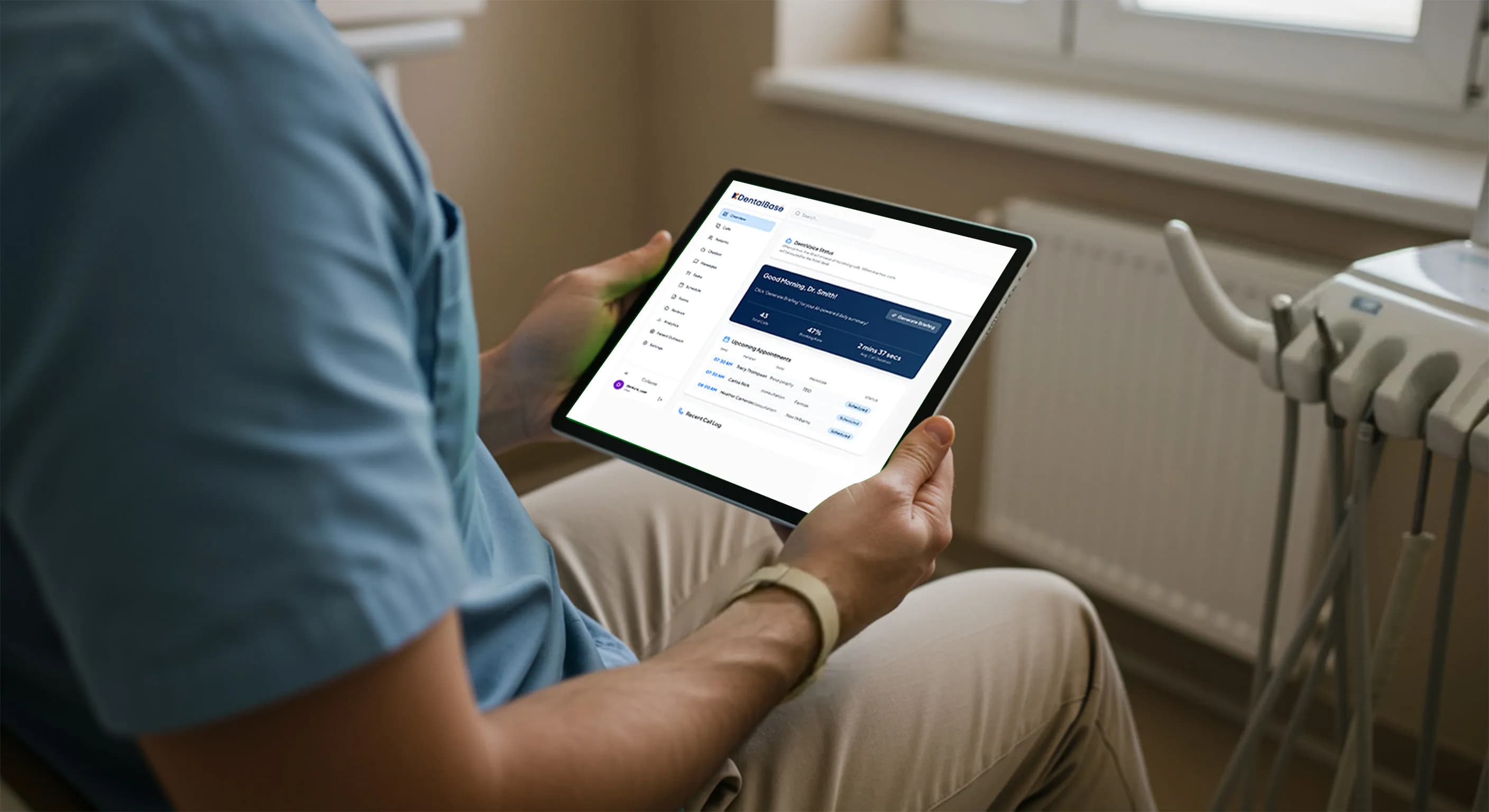
How AI Reduces Dental Front Desk Burnout

Dental front desk burnout is rising. Learn how a dental AI receptionist cuts call overload, automates reminders, and eases staff stress and turnover.
Share:
Table of contents
Dental front desk teams are under more pressure than ever. Between nonstop phone calls, appointment scheduling, insurance questions, reminders, and walk-in patients, burnout has become a serious and growing problem.
Staff shortages, rising patient expectations, and limited time create a perfect storm. When front desk teams are overwhelmed, it impacts patient experience, revenue, and staff retention.
This is where the dental AI receptionist is changing the game. By automating repetitive communication tasks, AI reduces stress, improves efficiency, and helps dental teams focus on what truly matters.
What Is Dental Front Desk Burnout?
Burnout is not just feeling tired, it’s a state of chronic stress that affects performance, morale, and retention.
Dental front desk burnout is the chronic emotional and mental exhaustion that builds when reception staff absorb high call volumes, constant interruptions, and administrative overload without enough recovery time. It erodes accuracy, patient experience, and retention long before anyone names it.
For a full breakdown of causes, warning signs, and operational fixes, see our dental front office burnout prevention guide.
It rarely arrives all at once. A coordinator who once managed the schedule comfortably starts dreading the morning rush, lets calls roll to voicemail, and stops following up on unconfirmed appointments. Over weeks, those small lapses compound into lost production and a front office that feels permanently behind. Recognizing the pattern early is what separates practices that fix it from practices that keep replacing people. The signs below are the same ones we explore in our guide to a front desk that is overwhelmed.
Common Signs of Front Desk Burnout
-
Constant interruptions and call overload
-
Missed calls and delayed patient responses
-
Increased errors in scheduling or billing
-
Emotional exhaustion and frustration
-
High staff turnover
When burnout goes unaddressed, it leads to lost appointments, unhappy patients, and higher hiring costs.
What unaddressed front desk burnout actually costs
Missed calls
Every unanswered call is a potential new patient who books with another practice instead.
Rehiring
Recruiting and retraining a departing coordinator pulls weeks of productivity from the whole team.
Errors
Tired staff double-book, mis-key insurance details, and forget recall follow-ups.
Why the Front Desk Is Under So Much Pressure
The dental front desk serves as the communication hub of the practice.
The front desk is under pressure because it is the single point where phones, scheduling, insurance, check-ins, and patient questions all converge at once. One person is often expected to hold a live conversation, work the schedule, and greet an arriving patient in the same minute, which makes sustained focus nearly impossible.
That overlap is why a phone that never stops ringing feels so different from a steady workload. The interruptions are unpredictable and they all feel urgent. If your lines stay tied up through the busiest hours, the deeper causes are worth understanding, which we break down in our look at why the dental office phone is always busy.
Key Contributors to Burnout
-
High call volumes during peak hours
-
Manual appointment scheduling and rescheduling
-
Repetitive insurance and availability questions
-
After-hours inquiries with no coverage
-
Limited staff handling growing patient bases
Traditional phone-based workflows simply do not scale with modern patient demand.
These pressures show up as a recognizable pattern across most practices, not a one-off bad week. The most common front desk challenges dental practices report map closely onto the list above.
What Is a Dental AI Receptionist?
A dental AI receptionist is an intelligent, automated communication system designed to handle patient interactions across digital channels.
A dental AI receptionist is software that answers patient calls and messages, books and confirms appointments, and responds to routine questions automatically. It works across phone, SMS, and chat, follows the practice's own rules, and hands anything complex to a human team member.
Unlike basic chatbots, AI receptionists:
-
Understand natural language
-
Respond contextually
-
Integrate with dental systems
-
Escalate complex issues to staff
They work alongside front desk teams, not as replacements.
Related: If you are weighing automation against adding another hire, this comparison walks through the trade-offs in detail. AI receptionist vs. a traditional front desk →
How AI Reduces Dental Front Desk Burnout
AI directly addresses the most stressful aspects of front desk work.
The clearest way to see the impact is to compare a typical front desk day before and after AI support handles the routine load.
| Front desk task | Without AI support | With an AI receptionist |
|---|---|---|
| Routine calls | Interrupt staff all day; many roll to voicemail | Answered instantly or shifted to text |
| Reminders & confirmations | Manual, easy to skip when busy | Sent automatically on schedule |
| After-hours inquiries | Pile up overnight as voicemail backlog | Captured and answered 24/7 |
| Peak-hour focus | Constant context switching, more errors | Calmer desk, attention on in-office patients |
| Staff workload | Reactive, always behind | Proactive, focused on high-value work |
1. Eliminating Call Overload
Phone calls are the biggest source of front desk stress.
How AI Helps
A dental AI receptionist:
-
Answers common questions instantly
-
Handles appointment confirmations and rescheduling
-
Engages patients via SMS or WhatsApp instead of phone calls
Result: Fewer interruptions and quieter front desks during peak hours.
Related: Shifting routine calls to text is one of the fastest ways to quiet a busy front desk. See how automated appointment confirmations work →
2. Automating Repetitive Tasks
Many front desk tasks are repetitive and time-consuming.
Tasks AI Can Handle Automatically
-
Appointment reminders
-
Confirmation requests
-
Recall and follow-up messages
-
Office hours and location inquiries
By automating these workflows, staff reclaim hours every day.
Bold insight: Automation reduces administrative workload by up to 50% in many practices.
Give your team back its busiest hours
Dentivoice handles the repetitive calls, reminders, and confirmations that drain your front desk, so your staff can focus on patients in the chair.
See how Dentivoice works →3. Supporting After-Hours Communication
Patients don’t stop messaging after 5 PM.
24/7 Coverage Without Overtime
A dental AI receptionist:
-
Responds to patient inquiries outside office hours
-
Collects information for next-day follow-ups
-
Prevents missed opportunities and voicemail backlogs
This removes the pressure of “always being on” for staff.
Related: After-hours coverage does not have to mean another salary. Learn how to answer dental calls after hours without hiring →
4. Reducing Errors and Mental Fatigue
Multitasking increases the risk of mistakes.
AI Improves Accuracy
AI systems:
-
Follow consistent workflows
-
Eliminate manual data entry errors
-
Reduce cognitive load on staff
With fewer interruptions, teams work more calmly and accurately.
5. Improving Patient Behavior and Expectations
Burnout often comes from difficult patient interactions.
Clear, Instant Communication
AI:
-
Sets clear expectations
-
Provides immediate answers
-
Reduces patient frustration caused by delays
Better communication leads to more respectful, smoother interactions at the front desk.
What Front Desk Tasks Can an AI Receptionist Handle?
An AI receptionist handles the high-volume, repeatable work: answering routine calls, sending reminders and confirmations, booking and rescheduling, fielding insurance and hours questions, and capturing after-hours inquiries. It routes anything urgent or sensitive to a human, so staff own the conversations that need judgment.
It helps to picture the work as a simple flow. Every patient request enters the same front door, and the AI sorts it in seconds: routine items are resolved on the spot, while anything complex is escalated with full context so a team member is never starting cold.
That sorting logic is the mechanism behind a broader shift in daily front desk work. How AI receptionists actually change front desk operations looks at that shift in more detail.
How a request moves through an AI receptionist
1. Request arrives
Call, text, or web message, day or night.
2. AI understands intent
Identifies what the patient actually needs.
3a. Resolve routine
Books, confirms, reschedules, answers FAQs.
3b. Escalate complex
Hands urgent cases to staff with context.
Because the routine path is handled without a human touch, the front desk only sees the conversations that genuinely need a person. That is the mechanism behind a calmer day, not a smaller team. For a closer look at how the AI decides what is urgent, see our guide to dental call routing and triage.
AI as a Support System, Not a Replacement
A common misconception is that AI replaces human staff.
The Reality
AI handles:
-
High-volume, low-complexity interactions
Humans focus on:
-
Complex patient needs
-
In-office experiences
-
Relationship building
This balance leads to happier teams and better patient care.
Getting that balance right is really a design question, not just a tooling choice. How to automate front desk overload without replacing staff covers how to draw that line deliberately.
Why Dentivoice’s AI Receptionist Is Different
Dentivoice is built specifically for dental practices, not generic healthcare.
Dentivoice Key Advantages
-
Dental-trained AI conversations
-
SMS and WhatsApp-first communication
-
Seamless integration with dental workflows
-
HIPAA-compliant messaging
-
Scalable for single clinics or DSOs
Dentivoice acts as a digital front desk assistant that works 24/7 without fatigue.
Is Your Front Desk at Risk of Burnout?
Your front desk may be at risk of burnout if calls routinely go unanswered, reminders slip during busy stretches, errors are rising, and staff turnover is climbing. The more of these signs you recognize, the more value automated support is likely to deliver. Use the quick check below.
Front Desk Burnout Risk Check
Check each statement that sounds like your practice this month.
Your score: count your checks out of 5. Three or more means routine automation would likely ease real pressure.
The Measurable Impact on Staff Well-Being
Practices using AI receptionists report:
-
Lower stress levels among staff
-
Fewer missed calls and complaints
-
Improved job satisfaction
-
Reduced staff turnover
When teams feel supported, they stay longer and perform better.
The Business Case for Reducing Burnout
Burnout isn’t just a people issue, it’s a business risk.
Financial Impact of Burnout
-
Lost appointments and revenue
-
Increased hiring and training costs
-
Declining patient satisfaction scores
Investing in a dental AI receptionist delivers ROI through both operational efficiency and staff retention.
That ROI compounds as a practice grows, not just at a single location. How practices scale patient volume without scaling front desk headcount covers what that math looks like past the first office.
Turn front desk pressure into protected production
See how a dental-specific AI receptionist captures more calls, retains staff, and pays for itself through fewer missed appointments.
Explore Dentivoice →Related: Tracking the right numbers shows exactly where automation pays off. Review the 7 dental call analytics metrics that drive revenue →
The Future of the Dental Front Desk
The front desk is evolving from reactive call handling to proactive patient engagement.
What’s Coming Next
-
Fully AI-driven scheduling workflows
-
Predictive patient communication
-
Voice-enabled AI receptionists
-
Deeper personalization at scale
Practices that adopt AI early gain a competitive advantage in both patient experience and staff well-being.
Multi-location groups feel this pressure earliest, since front desk load multiplies faster than staff can hire for it. How dental support organizations scale growth shows what that looks like at the DSO level.
If you are starting to compare options, our 2026 dental patient communication software buyer guide walks through what to look for so the tools you choose actually reduce front desk load instead of adding to it.
Conclusion: A Smarter Way to Support Your Front Desk
Front desk burnout is not inevitable, it’s solvable.
A dental AI receptionist empowers teams by:
-
Reducing call overload
-
Automating repetitive tasks
-
Providing 24/7 patient communication
-
Creating calmer, more efficient workflows
With solutions like Dentivoice, dental practices can protect their staff, improve patient experience, and build a more sustainable future.
Frequently Asked Questions
Many dental offices handle hundreds of calls daily while also managing check-ins, scheduling, and insurance questions in person. AI receptionists help by answering common questions instantly and handling routine requests through text, reducing hold times and missed calls.
No. Dental AI receptionists are designed to handle repetitive communication tasks like reminders and basic scheduling. Human staff still manage complex cases, in-office care, and personal interactions, which improves overall service quality.
Yes. AI receptionists can respond instantly via SMS or messaging apps, confirm availability, and collect appointment details 24/7, often reducing booking delays by several hours or even days.
Dental-focused AI systems like Dentivoice use HIPAA-compliant messaging and secure integrations, which means your personal and health information is protected while communicating digitally.
It handles high-volume routine work: answering calls, sending reminders and confirmations, booking and rescheduling, and fielding hours and insurance questions. Urgent or sensitive cases are routed to staff with full context.
Sources & References
- 1
- 2
- 3
- 4
- 5
Topics
Was this article helpful?
Written by
DentalBase Team
Expert dental industry content from the DentalBase team. We provide insights on practice management, marketing, compliance, and growth strategies for dental professionals.