Dental Office Phone Stress: A Practice Manager's Guide

Dental office phone stress shapes team morale. This guide helps practice managers spot call overload and build a calmer front desk routine.
Share:
Table of contents
Dental office phone stress rarely announces itself. It shows up as a sigh before the third call of the hour, a callback that slips to tomorrow, or a team member who quietly stops taking lunch. If you manage the practice, you've probably felt it long before you could measure it, and it's tied to the strain behind how AI reduces dental front desk burnout.
Here's the catch. Stress that never reaches a report is easy to wave away, and stress that gets waved away tends to end in a resignation. A practice manager sits in the middle: close enough to see the strain, but usually without numbers to prove it.
This guide covers how phone stress appears at the front desk, what you can measure with tools you already own, which changes help fastest, how to talk with your team, and what a calmer routine looks like.
How does dental office phone stress show up at the front desk?
Dental office phone stress shows up as small, repeated changes in how your team works: clipped greetings, skipped lunches, slipped callbacks and tiny entry errors. Any one of them looks minor. Together they describe a front desk where the phone sets the pace, not the people running it.
What do the early signs look like?
Start with behavior, because people rarely announce that the phone is wearing them down. They show it.
- Short patience late in the day. A warm greeting turns clipped by mid-afternoon, even with easy callers.
- Small mistakes. A misspelled name, or the wrong appointment type that someone fixes later.
- A flinch when the line rings, especially during check-in.
- Lunch at the desk. Nobody wants to leave the phone uncovered, so nobody leaves.
- Quiet avoidance. Team members trade away phone duty or find a reason to be in the back.
For a longer list, see dental front desk overwhelmed: 7 signs and real fixes.
Why does staffing make it heavier?
Because fewer hands share the same ringing line. About 62% of dentists named staffing shortages their top challenge for 2025, according to ADA News, reporting on an ADA Health Policy Institute survey. When the team is short, every call lands on someone who is already busy.
62%
of dentists named staffing shortages their top challenge for 2025
Source: ADA Health Policy Institute survey of dentists in late 2024, reported by ADA News.
How many of these apply to your office?
Phone stress checklist: a two-week tally
Tick what you saw in the last two weeks. It's a rule of thumb, not a diagnosis.
On the phones
At the counter
On the team
Your tally: count your checks out of 7. Three or more? The 4-week plan below is written for you.
Related: Phone stress and phone fatigue share a cause, but fatigue focuses on the drain of constant interruptions. Dental front desk phone fatigue: why calls drain teams →
What can a practice manager measure?
A practice manager can measure missed calls, voicemail age, same-day callbacks, calls by hour and interruptions at check-in. Five simple numbers, plus one weekly team question, turn a vague feeling of stress into a pattern you can act on without buying anything new.
Which five numbers matter most?
Your phone system probably tracks most of these already. If it doesn't, a paper tally covers the gaps.
- Missed calls per week. A Dental Economics analysis cites industry benchmarks of 30% to 38% of incoming calls missed during business hours. Compare your own rate with that range.
- Voicemail age. How long messages sit before someone listens.
- Same-day callbacks. How many messages get a reply before you close.
- Calls by hour. Which stretch is loudest, and whether it collides with check-in.
- Interruptions at check-in. A tally sheet at the desk works fine. Every ring while a patient stands at the counter earns one mark.
Picture a three-provider office where Monday's report shows the line ringing out most between 8 and 10 a.m., exactly when check-in peaks. That one pattern points to a fix, such as a second person at the counter or routine calls handled before they ever reach the desk.
Why do missed-call numbers matter for stress?
Because the same analysis assumes 60% to 65% of missed calls are new-patient related. So every unanswered ring can feel like lost opportunity, not just lost time. Teams feel that pressure even when nobody says it out loud, and a number on paper lets you talk about it calmly.
How do you turn the numbers into a weekly report?
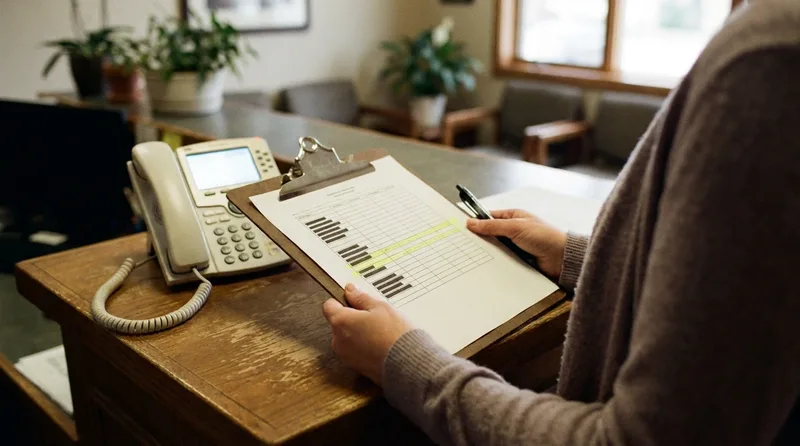
Keep it to one page. Print it every Monday, mark the loudest hour in yellow, and add one line from the team about how the week felt. A page you'll actually read beats a dashboard you won't. For ideas on which numbers to track as call support grows, see KPIs for measuring AI receptionist success in dental offices.
Which changes lower dental office phone stress fastest?
The fastest changes remove repeat work from the desk: lunch cover, agreed answers for routine questions, protected check-in time and fixed callback windows. They cost little, and they work because they cut interruptions, not because anyone is asked to try harder.
Which fixes should you start with?
Match every problem to one owner and one next step. Vague fixes die in the break room. This table gives you a starting point you can adjust. Don't launch all six at once. Pick the two your checklist points to, finish them, then add the next.
| Issue | Owner | Next step |
|---|---|---|
| Lunch leaves the phone uncovered | Practice manager | Stagger breaks so one person is always on the line and another is truly off it. |
| The same routine questions repeat all day | Front desk lead | List the five most common questions and agree on one short answer for each. |
| Calls interrupt check-in | Front desk lead | Name a phone owner for the loudest hour so the counter has its own person. |
| Voicemail and callbacks pile up | Front desk team | Set two callback windows, mid-morning and mid-afternoon, and log each reply. |
| Nobody sees the numbers | Practice manager | Print the one-page call report every Monday and mark the loudest hour. |
| Staff don't feel heard | Practice manager | Hold a five-minute huddle each week and ask one open question. |
Where can AI support the team?
Some calls repeat so often that they don't need a person at all: hours, parking, plans accepted and basic reschedules. An AI receptionist can answer those and pass urgent or sensitive calls to staff. That doesn't replace anyone. It takes repeat work off the desk so your people can focus on the patient in front of them. How a dental AI assistant supports your team explains how the work divides.
Take Routine Calls Off the Front Desk
DentiVoice answers repeatable calls and hands urgent or complex ones to your team, so the phone supports the day instead of running it.
Explore AI receptionist guides →How should you talk with the team about it?
Start with a private, low-pressure conversation that asks how the phone feels, then agree on one change to test. Listen first and defend nothing. People share more when they don't expect a lecture, and they'll back a fix they helped choose.
What should you ask?
Keep the questions open. When does the phone feel loudest? Which calls do you wish someone else could take? What would make lunch feel like a real break? A simple opener works: "I want the phone to be easier on everyone, so what would help most?" Skip "Is anything wrong?" because it invites a polite "no." Pick a quiet time, not the 8 a.m. rush, and ask each person separately before you bring it to the group. The American Psychological Association offers a helpful overview of work stress if you want language for the conversation.
How do you handle what you hear?
Thank people, even for the uncomfortable parts. Write down what you heard, pick one change, and say when you'll review it, ideally in two weeks. If the answers point past the phone, toward workload, schedule or morale, say so honestly and plan for those separately.
What mistakes should you avoid?
Three come up often. Promising fixes you can't deliver burns trust faster than silence. Raising the topic in front of the whole group first makes people guard their answers. And treating the phone as the only problem can hide the real cause. Keep promises small, ask privately, and stay curious about what sits underneath.
How do you bring up AI support without creating worry?
If AI call support is part of the plan, raise it early and say plainly what it does: it takes repeat calls and passes the rest to people. Team members may wonder about their roles, and silence makes that worse. Introducing an AI receptionist to dental staff offers a way to frame the conversation.
Related: When the phone is only one source of strain, the full burnout guide covers the rest. How to reduce dental front office burnout: a complete guide →
What does a calmer routine look like?
A calmer routine gives every call a clear owner, a clear order and clear limits. Lunch has cover, routine questions have an agreed answer, callbacks have fixed windows and the counter gets protected time. Your team knows what to do when the phone rings, so nobody improvises under pressure.
What does the 4-week plan look like?
- Week 1: measure. Print your first weekly call report, run the two-week checklist and ask each person the three open questions.
- Week 2: fix the easy gaps. Cover lunch, set two callback windows and write agreed answers for the five most repeated questions.
- Week 3: protect the counter. Pick the loudest hour and give check-in its own person, or route routine calls away from the desk so the line stops competing with the patient.
- Week 4: review and keep what worked. Compare this week's report with week one, ask the team how the phone feels now, and drop anything that didn't help.
How do you keep it calm?
Review once a month. Lay the weekly reports side by side, ask the team how the phone feels, and keep only what helped. If you use an AI receptionist, check a sample of its calls on a schedule too; what to review and how often covers that rhythm. For more ways to organize front office work, browse the ADA's practice management resources. And if you want wider context on staffing, the ADA Health Policy Institute publishes workforce research.
Where to start this week
Dental office phone stress won't fix itself, because the phone isn't going to stop ringing. What you can change is how many calls land on one person at the worst moment.
Start small. Print one week of call data, tick the checklist with your team and ask one open question. Then pick one change and try it for two weeks. If you're also thinking about keeping the people you have, dental receptionist retention: 9 ways to keep good staff is a natural next read.
Make the Phone Work for Your Team
DentiVoice answers routine calls and passes urgent or complex ones to your team, so the phone supports your day instead of running it.
See How DentiVoice Works →Want more practice management guidance?
Browse Practice Management articles →Frequently Asked Questions
Look for patterns, not single bad days: skipped lunches, voicemail left unplayed until late morning, callbacks that wait overnight and small entry errors. If you see several across two weeks, the load is likely too heavy. Confirm it with your call report and a quiet conversation with the team.
Start with five numbers: missed calls, voicemail age, same-day callbacks, calls by hour and interruptions at check-in. Your phone system covers the first four, and a paper tally covers the last. Keep the report to one page so you'll actually read it each Monday.
Small changes like lunch cover and fixed callback windows often ease pressure within a week or two, because they remove interruptions right away. Bigger shifts, such as new call handling, take longer to settle. Review at two weeks and again at four before you decide what stays.
Yes, ask directly, but in private and without a fix already chosen. Open questions such as "When does the phone feel loudest?" get more honest answers than "Is anything wrong?" Thank people for what they share, even the uncomfortable parts, and tell them when you'll review the change.
An AI receptionist supports your team by answering routine calls such as hours, parking and plan basics, and by passing urgent or sensitive calls to staff. It doesn't replace your people. It reduces interruptions at the counter so the team can focus on patients.
Sources & References
- 1
- 2
- 3
- 4
- 5
Topics
Was this article helpful?
Written by
DentalBase Team
Expert dental industry content from the DentalBase team. We provide insights on practice management, marketing, compliance, and growth strategies for dental professionals.