Dental Lab Communication Workflow: End the Phone Tag
A broken dental lab communication workflow turns simple case status calls into phone tag. Here's how to route lab calls without slowing your front desk.
Share:
Table of contents
Your dental lab communication workflow probably runs on hold music and hope. A lab technician calls about a crown that is three days late. The front desk puts the caller on hold, hunts for a chart, then promises a callback that never quite happens. Meanwhile, a patient is standing at the counter waiting to check out.
That is not a staffing problem. It is a routing problem. Case status calls, remake questions, and delivery window updates get treated exactly like new patient inquiries, and they should not be. Practices already using AI call routing built for urgent versus routine dental calls handle this differently. The lab's request gets captured and sent to the right person immediately, no hold music required.
This guide breaks down why lab calls fall through the cracks, what your team should actually capture on each one, and how to build a routing policy that keeps labs, staff, and patients out of each other's way.
What Is a Dental Lab Communication Workflow, and Why Does It Break Down?
A dental lab communication workflow is the set of rules for who takes a lab's call, what gets written down, and who hears about it next. Most practices never wrote one down. Whoever answers the phone decides in the moment, which is why the same question gets asked three separate times.
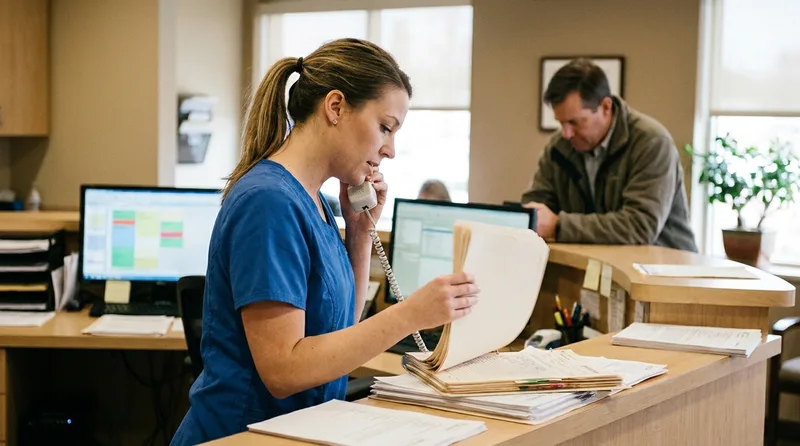
Without a workflow, a lab call lands wherever the phone happens to be answered. If that person is checking in a patient, the case gets a half-answer and a vague promise to call back. That promise depends on someone remembering. It also depends on finding the chart and having five free minutes. Those three things rarely line up at once.
The cost shows up downstream. Industry benchmarking on lab overhead and remake rates puts the average remake rate around 4%, and the same poll found 38% of practices split cases across two labs to manage that risk. A peer-reviewed survey of dental laboratories found that only 11% routinely receive clear work authorizations. That gap is exactly where phone tag starts. A remake question turns into a call. The call turns into a voicemail. The voicemail turns into another call the next day.
Without a Workflow vs. With One
| Moment | Without a Workflow | With a Workflow |
|---|---|---|
| Lab calls about a case | Whoever answers guesses at a response | Five fields captured, routed to the owner |
| Case detail is unclear | Front desk promises a callback and forgets | Note logged in the PMS, checked daily |
| Lab doesn't hear back | Lab calls again, same question repeated | Provider or coordinator responds same day |
Fix the structure, not the staff. Name one role, not one person, as the default owner of lab calls. Require every call to end with a logged note, and read it back to the lab tech before they hang up. A single remake can still cost 20 to 30 minutes of chairside adjustment time, so getting the message right the first time is worth protecting.
Why Do Case Status Calls Turn Into Phone Tag at the Front Desk?
Case status calls turn into phone tag because front-desk staff cannot resolve them on the spot and have no reliable way to signal an answer back once they find one. The lab hangs up without resolution, so they call again.
Front-desk teams are already stretched thin. According to Dental Economics, industry benchmarks show dental practices miss 30% to 38% of incoming calls during business hours. That number climbs during checkout rushes and lunch coverage gaps. A lab call competes for the same attention as a patient rescheduling a cleaning. But the lab caller cannot actually be helped by the front desk. Only a provider or treatment coordinator can answer a case status question with real authority.
So the pattern repeats. The lab calls, gets put on hold, and hangs up without an answer. Nobody flags the message as urgent, because nothing distinguishes it from a routine call. NIDCR data puts the U.S. oral health workforce at over 750,000 professionals. Yet the average practice still routes every lab call through one overloaded front-desk line.
Break the loop by separating lab calls from patient calls at intake. That intake might be a person, or an AI layer on an always-busy front desk phone. Either way, a caller who identifies as a lab should never wait behind a patient checkout. This is not about picking sides between staff and technology. It is about giving the phone a clear traffic pattern.
Never Let a Lab Call Sit on Hold
See exactly which calls an AI dental receptionist is built to capture and route, and which ones it always hands to your team.
See What Calls Get Handled →What Should Your Team Capture When a Dental Lab Calls?
Your team should capture five details on every lab call: the patient's name, the case type, the specific ask, how urgent it is, and the best way to reach someone back. Skipping any one of these guarantees a second call.
Most practices capture whatever the person on the phone happens to remember. That varies wildly by who picks up. A written capture format fixes this. It should stay identical whether a human or an AI receptionist trained on your practice's FAQs takes the call.
The Five Fields to Capture
- Patient name and the provider tied to the case
- Case type: crown, denture, night guard, implant abutment, and so on
- The specific ask: status update, remake request, or delivery window
- Urgency: is a patient already scheduled to seat this case this week
- Callback method and best time to reach the right staff member
These five fields take under a minute to collect. They eliminate almost all of the back-and-forth. The lab tech stops repeating information from three calls ago. The note that reaches the provider is complete enough to act on, with no clarifying callback needed.
Standardize the format in writing, and post it at every phone station. If an AI receptionist takes the call, make sure its capture fields match this list exactly. That keeps nothing lost in the handoff to staff.
Can Your Front Desk (or an AI Receptionist) Advise a Lab on a Case?
No. Front-desk staff and AI receptionists should never advise a lab on a clinical case decision. Their job is to capture the request accurately and route it to the provider who can actually decide, not to interpret shade, fit, or occlusion questions themselves.
This distinction matters more than it sounds. A lab technician asking whether to adjust the margin or remake the case is asking something only the treating dentist can answer. A front-desk coordinator guessing at an answer risks a second wrong remake. The same boundary applies to an AI receptionist. Its job is message capture and routing, never clinical judgment, a scope explained further in how natural language processing lets an AI receptionist understand a caller's intent.
That scope boundary is a feature, not a limitation. A voice agent that only routes never accidentally promises a remake timeline or a fee waiver it has no authority to offer. It takes the message, tags it correctly, and hands it to a person who can decide.
Setting the Escalation Rule
Set the escalation rule once, in writing. Routine status and delivery window questions go to the office manager or treatment coordinator the same day. Anything tied to a patient already in the chair, or a case the lab flags urgent, goes straight to the provider. No exceptions.
Scaling Without Overloading the Front Desk
Lab calls are one of several call types that quietly pile onto a growing practice. Here is how busier practices keep the front desk from becoming the bottleneck.
Read the Scaling Guide →How Do You Route Lab Calls Without Slowing Down Patient Calls?
Route lab calls to a dedicated extension, queue, or tag so they never compete with incoming patient calls for the same front-desk attention. A caller identified as a lab should branch away from the patient line immediately.
The fastest fix is separating the two call types before either one reaches a human. An AI receptionist can recognize a lab caller within the first few seconds, often from caller ID alone. It then branches that call down a different path than a patient asking about an appointment. That keeps phone coverage intact for patients, while lab calls still get handled promptly on their own track.
The Cost of Not Separating Call Types
Without that separation, every lab call is a small tax on patient capacity. A three-minute case status call during a morning rush means an emergency patient waits three extra minutes, or gives up and calls a competitor. Multiply that by 10 to 15 lab calls a week, a normal volume for a busy multi-provider practice. The cost compounds fast.
Build the routing rule around caller type, not urgency alone. Every lab call gets its own lane immediately, then gets prioritized within that lane based on the five details your team already captured.
What Belongs in a Written Lab Call Routing Policy?
A written lab call routing policy names who owns lab calls, defines what gets logged and where, and sets a review cadence so remakes and delivery windows never depend on one person's memory.

A one-page policy beats a verbal understanding every time. Staff turnover means the "way we've always done it" walks out the door with whoever leaves. The policy should specify where lab case notes live, who checks that log daily, and how a remake gets flagged differently from a routine update.
Call Type Routing Table
| Call Type | Routes To | Logged Where |
|---|---|---|
| Routine status check | Office manager, same day | PMS lab case note |
| Remake request | Treating provider, immediately | PMS note plus chart flag |
| Delivery window update | Scheduling coordinator, same day | PMS lab case, due date field |
| Case flagged urgent | Treating provider, direct interrupt | PMS note plus verbal handoff |
Most practice management systems already have a place for this. Open Dental's lab case workflow attaches a due date and status directly to the appointment. Dentrix works alongside an AI receptionist the same way. The log lives where staff already look, instead of on a whiteboard that gets erased. The American Dental Association's practice management resources recommend documenting this kind of protocol in writing, rather than relying on institutional memory.
Building the Policy Document
- Name one role, not one person, as the default lab-call owner
- Log every case status, remake, and delivery window in the PMS, not on paper
- Review the policy every quarter or after any near-miss
Once the policy is written, train every person and every system, including an AI receptionist, on the same five-field capture format and the same routing table above. Share the policy with your regular lab reps too, so they know exactly what to expect when they call and who they will reach.
Is Your Practice Ready?
Lab Call Routing Self-Check
Check each item your practice already has in place.
Your score: count your checks out of 5
The real fix for a broken dental lab communication workflow is not more staff or a longer hold queue. It is a written routing rule that gets the lab's request to the right person the first time. Labs stop calling twice. Staff stop apologizing for callbacks that never came. Patients at the counter stop waiting behind a conversation that has nothing to do with them.
Start with the five-field capture format and the routing table above. Post them at every phone station this week. You should notice fewer repeat calls within days, not months.
Stop Losing Time to Missed and Misrouted Calls
See how practices recover revenue and staff time by capturing and routing every call, patient or lab, the first time it rings.
See How Practices Recover Revenue →Want more practice management guides like this one?
Browse Practice Management Articles →Frequently Asked Questions
It is a written set of rules for who takes a lab's call, what details get captured, and who gets notified next. Without one, front-desk staff improvise, which causes the same question to get asked multiple times.
Labs call about case status, remakes, and delivery windows because there is usually no other reliable channel. If the front desk cannot resolve the question or confirm a callback, the lab has no choice but to call again.
No. Remake and case decisions require clinical judgment from the treating provider. A receptionist or AI receptionist should capture the request accurately and route it, never answer on the provider's behalf.
Yes, an AI receptionist can identify a lab caller, capture case details in a consistent format, and route the message to the right staff member, all without slowing down patient call handling.
Give lab calls their own routing lane, capture a standard set of details on every call, and log the request somewhere the responsible staff member checks daily, ideally directly in the PMS.
It should name who owns lab calls, define where case notes get logged, and set escalation rules for urgent cases. Review it quarterly so it keeps up with staffing changes.
Sources & References
- 1
- 2
- 3
- 4
- 5
Topics
Was this article helpful?
Written by
DentalBase Team
Expert dental industry content from the DentalBase team. We provide insights on practice management, marketing, compliance, and growth strategies for dental professionals.