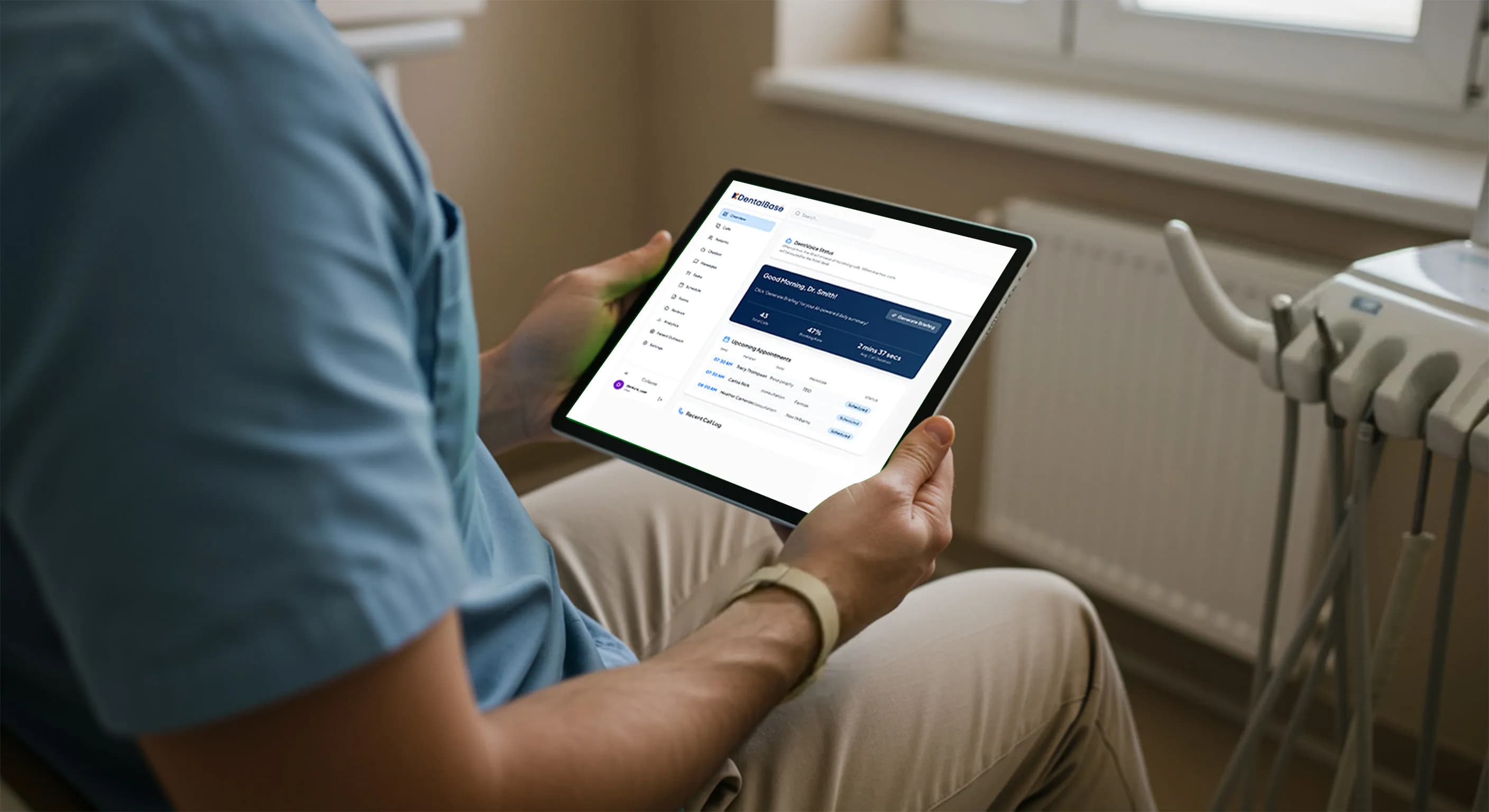
Scaling Dental Front Desks With AI: A DSO Playbook
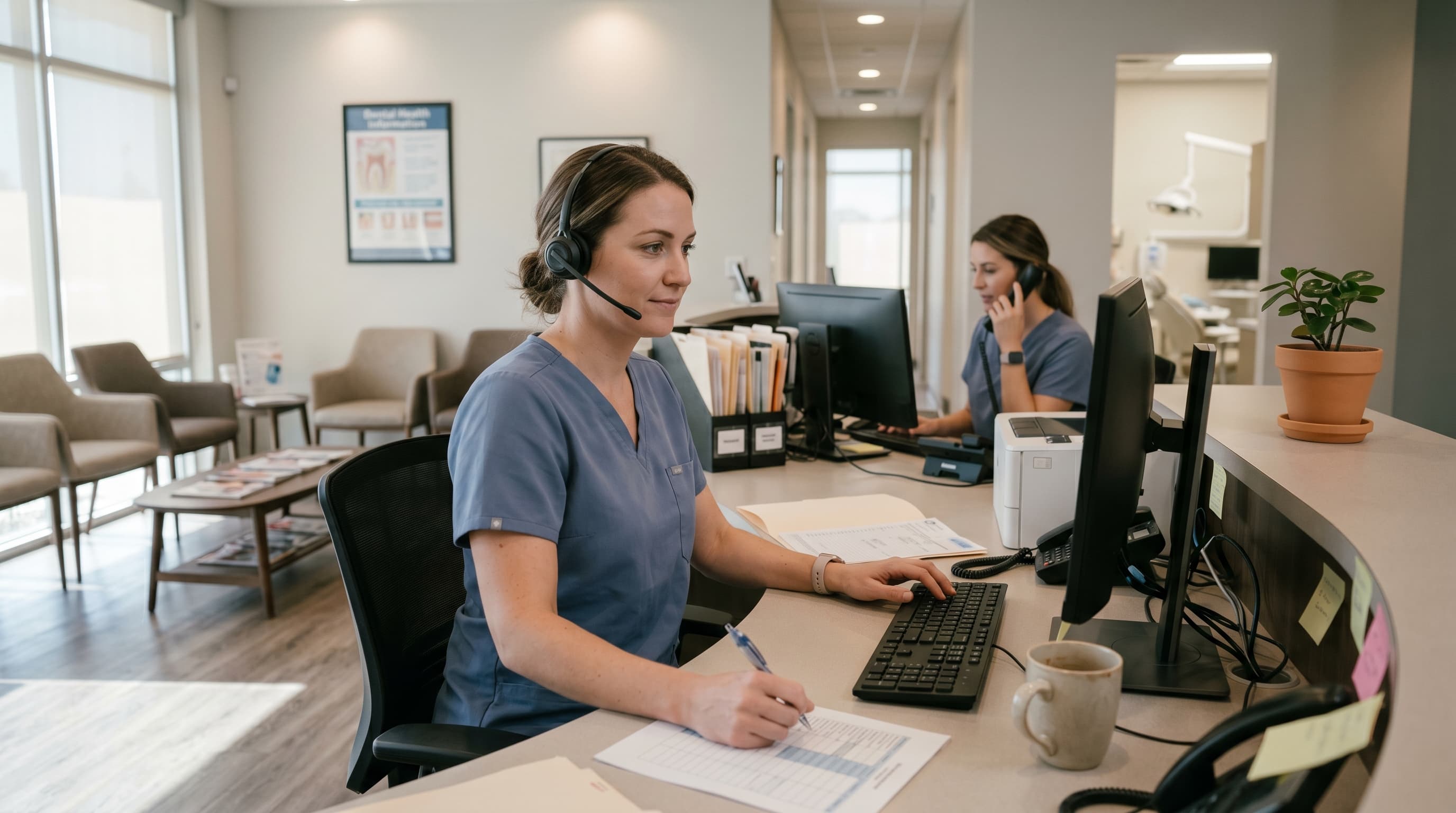
A practical playbook for DSOs scaling front-desk operations with AI receptionists: routing, staffing, and consistent patient calls across every location.
Share:
Table of contents
An AI receptionist for DSOs sits between your patients and your front desk, handling routine call volume across every location so your team can focus on the work in front of them. For most groups, that one shift fixes more operational headaches than a new hire would.
The pressure on multi-location groups is real. The American Dental Association's Health Policy Institute has tracked tightening labor markets and wage pressure across dental teams for years, with the 2023 Economic Outlook reporting that more than 90% of practice owners cited recruiting and retaining staff as a top business challenge. Adding people in every office is slow and expensive. Adding capacity at the phone layer is faster.
This guide walks through what the technology actually does, the front desk problems DSOs deal with at scale, what to ask vendors, and how to pilot it without betting the whole organization on the rollout.
Why Are DSOs Looking at AI Reception Right Now?
DSOs are looking at AI reception because the math on traditional staffing is breaking. Every new location needs front desk coverage, but the labor pool is shrinking, wages are rising, and turnover keeps gaps open for weeks. AI fills the routine call layer so human teams can handle what only humans should.
Phones are the bottleneck. A DSO with 12 locations gets a wildly different call volume than a single practice, but the front desk in each office is still answering one call at a time. When the receptionist is on the phone, the next caller hears a ring, then voicemail, then nothing. Most don't call back.
And the segment isn't shrinking. ADA News reporting on Health Policy Institute data documents the share of U.S. dentists affiliated with DSOs rising from 8.8% in 2017 to 13% in 2022, with even higher concentration among early-career dentists. More groups, more locations, and the same front desk math at every door.
That's where capacity matters more than headcount. The ADA Health Policy Institute has documented persistent staffing shortages in dental practices, and the front desk role is one of the hardest to fill and retain. You can't always solve a labor problem with more labor. Sometimes you have to change what the labor is doing.
For groups already stretched, this is worth reading next: DSO call management: 7 ways to reduce missed calls across locations.
Stop losing calls across your locations.
DentiVoice answers every call, books appointments into your existing PMS, and sends complex calls to your team. Same voice, every office.
See a DentiVoice demo →What Does an AI Receptionist for DSOs Actually Do?
An AI receptionist for DSOs answers inbound calls, books appointments directly into your practice management system, sends reminders, handles FAQs, and routes anything complex to a human. It works across every location with one shared brand voice and location-specific rules underneath.
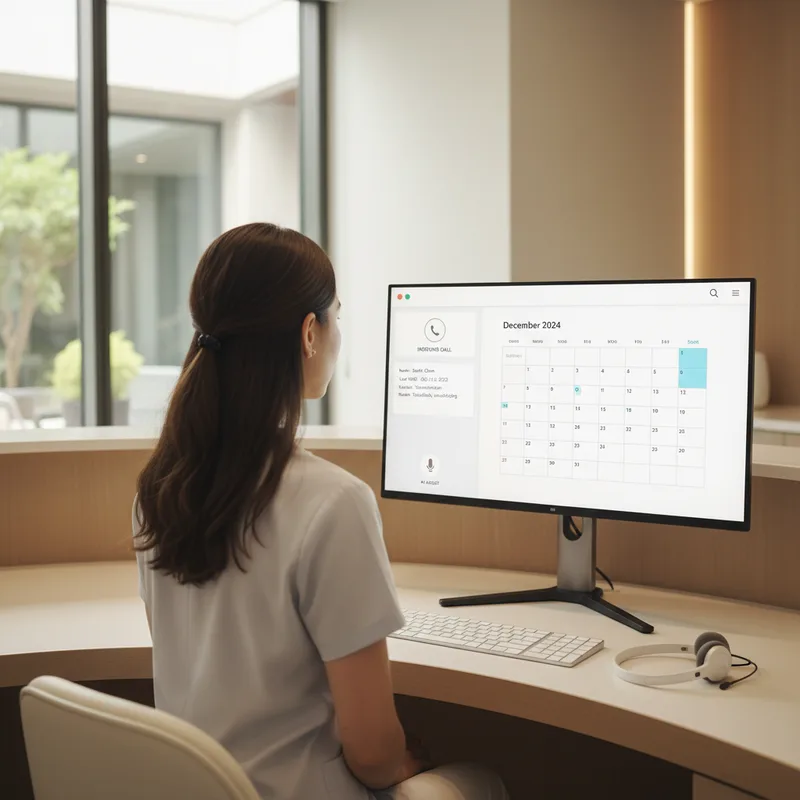
It's not a chatbot. It's a real-time voice system trained on dental terminology, your office's hours, your providers, and your scheduling rules. When a patient calls Location A asking about a same-day cleaning, the AI checks Location A's calendar, offers an actual open slot, and writes the appointment back into the PMS. When the call is messy, an angry patient, a clinical question, an emergency, it transfers to your team.
If you want a deeper look at the workflow side, see how an AI receptionist books appointments into your dental software.
Core functions in a multi-location setting
At minimum, a serious platform handles new patient intake, appointment booking and confirmation, basic insurance questions, after-hours coverage, recall and reactivation calls, and waitlist outreach. You should be able to configure each per location: different hours, different providers, different scheduling logic, different scripts.
What you should not expect from any AI receptionist: clinical advice, complex insurance disputes, or empathy in genuinely difficult moments. Those go to your team. The point of automation is to give your team room to do that well.
How it works alongside your team
The right mental model is layered, not replacement. AI takes the first pass at every call. Routine bookings, confirmations, and FAQs close on the spot. Anything that needs judgment, an escalation, a special accommodation, a frustrated patient, gets transferred to a human with full context already collected. Your team starts the conversation 90 seconds in, not from scratch.
What Front Desk Challenges Do DSOs Face at Scale?
The front desk problems that frustrate solo practices compound across DSOs. Call volume, staffing variability, and inconsistent service quality stop being annoyances and start showing up in the financial reports. Three patterns are almost universal:
- Volume that outpaces headcount, especially at peak hours and during lunch coverage gaps.
- Staffing variability across markets, where pay, hiring pools, and turnover all move differently by location.
- Inconsistent service quality across the brand, with each office quietly developing its own phone habits over time.
Call volume that human teams can't physically absorb
A 10-location DSO can take 1,500+ inbound calls a week during peak season. Industry reporting on dental phone performance has consistently put missed-call rates at busy practices in the 25 to 35% range, and that number rises sharply during lunch and after-hours windows. Even with two receptionists per office, peak hours create simultaneous calls that get dropped to voicemail. Lunch breaks compound it. Sick days cripple it. The result is a missed-call rate that nobody on the leadership team sees because the calls were never logged.
For a deeper read on the symptom, here's why your dental office phone is always busy and how to fix it.
Staffing that varies wildly across markets
Your office in a major metro pays differently, hires from a different pool, and trains differently than your office in a smaller town. Becker's Dental + DSO Review regularly reports on staffing turbulence across the DSO segment, with annual front desk turnover commonly cited above 30% in multi-location groups. Operations leaders consistently flag front desk variability as a top retention and quality risk. One office runs a 5-star phone experience. The next is a coin flip. Patients notice.
Inconsistent service quality across the brand
This is the one that costs the most and is the hardest to spot in a dashboard. Every office develops its own phone habits over time. One says "I'll have to call you back" too often. Another sends new patients to the wrong location because nobody trained them on the group's geographic split. The brand promise breaks at the receptionist.
How Does an AI Receptionist for DSOs Support Operations?
AI reception supports DSO operations in three concrete ways: it expands phone capacity without adding headcount, it standardizes the patient experience across every location, and it gives leadership real call data to act on. None of that requires removing the human staff you already have.
The first job is coverage. The second is consistency. The third is visibility, and that one is underrated.
Better call coverage and faster response
An AI receptionist answers in one ring, every time, including 7pm on a Sunday. After-hours bookings stop landing in voicemail and start landing on Monday's schedule. For groups that haven't measured this, the after-hours opportunity is usually larger than expected. For more on the after-hours angle, see how to answer dental calls after hours without hiring.
A standardized patient experience across locations
Every patient hears the same greeting, gets the same basic info, and goes through the same booking flow, regardless of which office they called. That's worth more than it sounds. Brand consistency is one of the few real moats in a multi-location group, and the front desk is where it lives or dies.
Related: Want to measure whether AI reception is actually working? Here's how to measure AI receptionist success with KPIs and ROI.
Less administrative load on your in-office team
When the AI handles confirmations, reminders, FAQs, and routine bookings, your front desk gets time back. Dental Economics has covered the front office burnout pattern extensively, and the through-line is consistent: people don't burn out from hard work, they burn out from constant interruptions. AI absorbs the interruptions.
What Compliance and Security Considerations Should DSOs Care About?
The non-negotiables are HIPAA compliance, signed Business Associate Agreements, encrypted call data, and clear vendor accountability. Everything else, integrations, voice quality, scheduling logic, is secondary if these aren't airtight. A DSO carries breach exposure across every location at once.

HIPAA, BAAs, and patient data handling
Any AI vendor handling patient calls is a Business Associate under HIPAA. Department of Health and Human Services (HHS) HIPAA guidance is clear on what that requires: a signed BAA, administrative and technical safeguards, breach notification procedures, and access controls. If a vendor pushes back on signing a BAA, that's not a negotiation, that's a no.
Beyond the BAA, ask for: encryption in transit and at rest, audit logs you can actually access, role-based access controls for your team, and a documented incident response process. Get it in writing.
The right vendor questions to ask
Before any pilot, push for direct answers on these:
- Where is patient data stored, and is it isolated per practice or pooled?
- Who at the vendor has access to call recordings and transcripts?
- What is your breach notification SLA, and what does the postmortem look like?
- How long are call recordings retained, and can we configure that per state?
- What integrations have you actually run in production with our PMS?
If the answers are vague, the vendor isn't ready for a DSO. If the answers are specific, you're talking to a real partner.
How Should a DSO Pilot AI Reception Before a Full Rollout?
Pilot it in 1 or 2 locations for 60 to 90 days, set 3 or 4 specific success metrics up front, and only expand once the pilot moves those numbers. Group-wide rollouts that skip the pilot stage are the most expensive way to find out a vendor isn't a fit.
Picking the right pilot locations
Don't pilot at your best office. Pilot where you have phone problems. Pick a location with a documented missed-call issue, or one carrying after-hours leakage, or one where the front desk is short-staffed. If the pilot doesn't solve a real problem, you'll never know whether the platform works.
The metrics that actually tell you it's working
Before launch, set numerical baselines. After 60 to 90 days, you should be measuring:
| Metric | What it tells you | Source |
|---|---|---|
| Missed-call rate | Whether AI is actually catching what your team was missing | VoIP / call platform |
| Booking conversion rate | Whether captured calls are turning into appointments | PMS |
| After-hours bookings | Pure incremental revenue your team couldn't have captured | PMS / AI dashboard |
| Front desk sentiment | Whether the team feels supported or replaced | Short staff survey |
The fourth one matters more than people think. McKinsey's healthcare research on operational technology adoption is consistent on one point: tools succeed when staff sees them as backup and fail when they see them as threat. Lead the rollout that way.
For the fundamentals behind this model, see what a dental support organization is and how DSOs scale growth. For groups further along in their rollout, see how larger organizations are standardizing patient calls across DSOs with 50 or more dental offices.
Run a real pilot, not a demo.
DentiVoice runs 60 to 90 day pilots with multi-location groups. We help you pick the metrics, set the baselines, and decide what comes next.
Talk to DentiVoice →Using AI to Strengthen, Not Replace, Your Front Desk
The DSOs that get the most out of an AI receptionist treat it as a capacity layer, not a cost-cutting move. The phone work that was crushing your team gets absorbed. The work that needs a human, treatment coordination, complex insurance, the patient who's nervous about a procedure, gets the attention it deserves. Both your team and your patients feel the difference.
The technology will keep getting better. The DSOs that already have a working pilot, real metrics, and trained staff will be the ones positioned to scale it. The ones still debating whether AI reception belongs in dentistry will be talking to candidates that don't exist.
If you're ready to look at what AI reception would actually do in your group, the next step is a working pilot, not another vendor pitch.
See DentiVoice in your DSO.
We'll walk through how DentiVoice handles your call volume, integrates with your PMS, and pilots in 1 or 2 locations before any group-wide rollout.
Book a demo →Frequently Asked Questions
An AI receptionist for DSOs is a voice and chat platform that answers patient calls across all your locations. It books appointments, sends reminders, answers common questions, and routes complex calls to your in-office team. It works alongside human staff, not as a replacement.
No. The point is to take routine volume off your team so they can focus on in-office patients, insurance, and treatment coordination. Human staff still handle complex calls, sensitive conversations, and anything the AI escalates. Most DSOs use it as a hybrid layer, not a replacement.
It can be, but compliance lives with the vendor, not the technology itself. Ask for a signed Business Associate Agreement, encryption details, audit log access, and a clear breach response process. If a vendor cannot answer those questions in writing, walk away.
Each office gets its own configuration: hours, providers, services, scheduling rules, and routing logic. Patients calling location A are routed to location A's calendar, but the brand voice, scripts, and KPIs stay consistent across the group. That is the operational win.
Pricing varies by call volume and number of locations, but most DSOs pay per location or per minute. The cost question worth asking is opportunity cost: how much new patient revenue are you losing to missed calls every month, across every office?
Pick 1 or 2 locations that already have phone problems. Run a 60 to 90 day pilot. Track missed-call rate, after-hours booking rate, average handle time, and staff sentiment. If the pilot moves those numbers, expand. If not, the vendor is wrong, not the strategy.
DSOs dental groups face the same front desk pressure at every location, multiplied across the whole portfolio. Many dso dental groups now add AI reception so calls are answered consistently across sites, which protects new patient revenue without hiring a receptionist for each office.
Sources & References
- 1
- 2
- 3
- 4
- 5
Was this article helpful?
Written by
DentalBase Team
Expert dental industry content from the DentalBase team. We provide insights on practice management, marketing, compliance, and growth strategies for dental professionals.