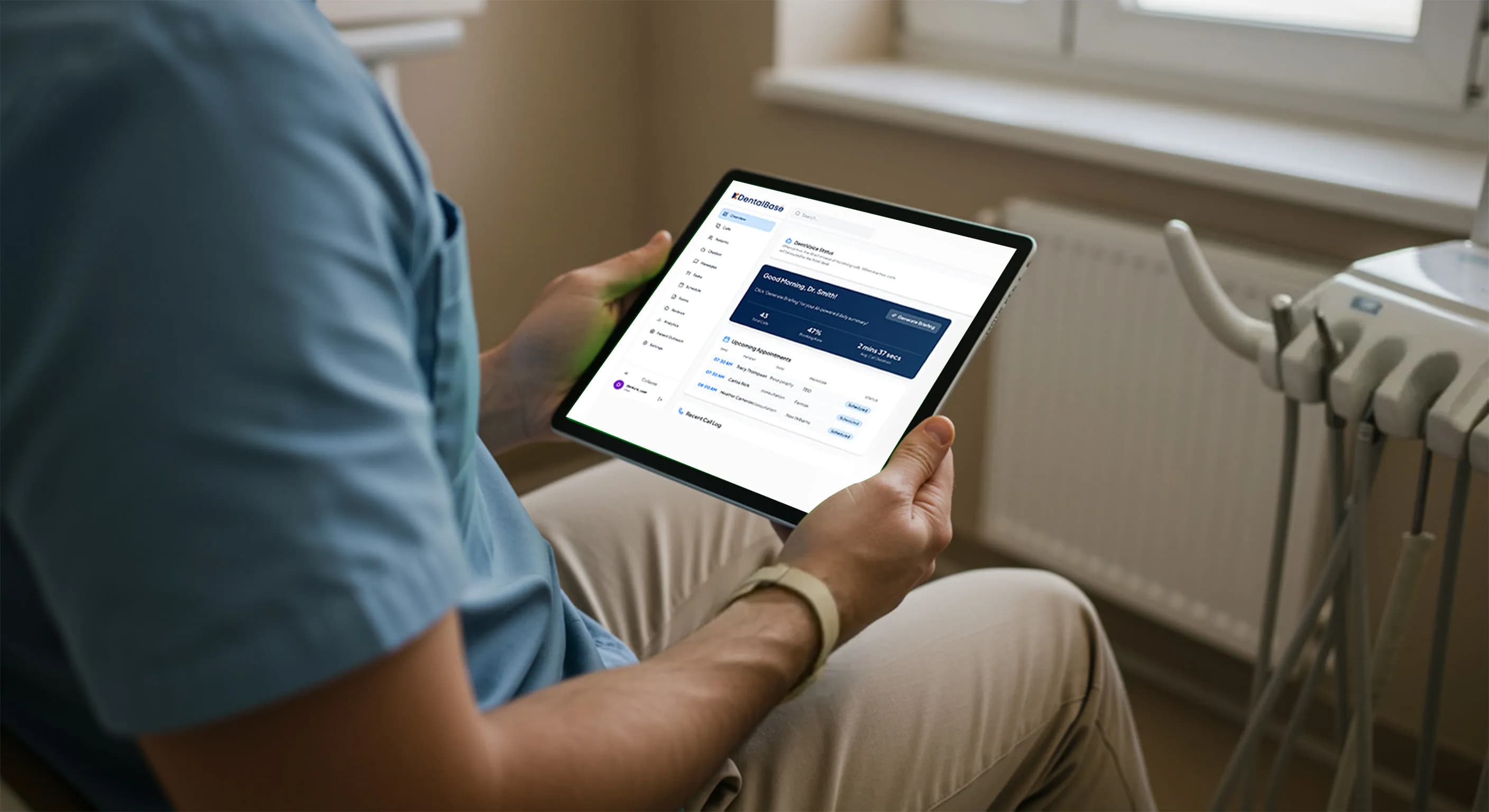
AI Dental Receptionist Denticon Integration Guide (2026)

See how an AI dental receptionist Denticon integration works: real-time booking, patient lookup, and call handling synced to your schedule.
Share:
Table of contents
Introduction: AI Receptionists in Modern Dental Practices
An AI dental receptionist for Denticon answers calls, books visits, and updates patient records without replacing your front desk team. Denticon already handles scheduling, billing, and patient files for thousands of practices. Adding an AI layer on top means fewer calls go to voicemail, especially after hours, when a solo front desk simply can't keep up.
The AI doesn't take over. It handles the routine stuff: appointment requests, office-hours questions, basic intake. Your staff stays free for the calls that actually need a person, like a nervous new patient or an insurance dispute. That split matters more than it sounds. Practices that try to automate everything usually frustrate patients. Practices that automate the predictable parts usually don't.
This guide covers how the integration works with Denticon specifically, what it costs (typically $200-800 a month), and how to tell a legitimate vendor from a glorified answering service.
What Is an AI Dental Receptionist for Denticon?
It's software that handles front-desk phone and text conversations using natural language processing, not a scripted chatbot. It understands context, not just keywords, so a patient can ask a follow-up question and the system stays on topic instead of resetting.
Core Functions Explained
Most systems in this category cover the same core ground:
- Booking, rescheduling, and canceling appointments
- Answering FAQs about hours, location, and policies
- Collecting basic patient information for new callers
- Verifying insurance details before a visit
- Explaining common procedures in plain language
- Sending appointment reminders automatically
It runs 24/7. A patient calling at 9 p.m. gets the same booking options as one calling at 9 a.m.
That real-time PMS connection only helps if the call reaches the AI cleanly to begin with. How dental offices handle calls using VoIP receptionist software and PMS integration walks through that phone-system layer.
What AI Can and Cannot Do
The AI is good at structured, repeatable tasks: booking a cleaning, confirming an address, answering "are you open Saturdays." It's not good at judgment calls.
It can't handle a medical emergency. It can't give clinical advice. And it struggles with anything that needs empathy or a nuanced read on the caller, like a patient anxious about a procedure or unhappy about a bill. Knowing that line up front is what keeps implementation realistic instead of disappointing.
What Is a Dental AI Company and How Does DentiVoice Compare to Denticon?
A dental AI company builds software that talks to patients directly, answering calls, booking visits, and syncing that activity into records. Denticon is not one of these. Denticon is the practice management platform underneath: it stores schedules, patient files, and billing.
DentiVoice is the AI company piece. It plugs into Denticon through an API connection and handles the phone-based work Denticon itself doesn't do. The two aren't competitors. In most Denticon offices, they run as separate layers of the same workflow.
How a Dental AI Company Differs From a Generic Answering Service
A generic answering service takes a message. A dental AI company reads live Denticon availability, verifies patient identity, and books directly into the calendar. It knows dental terminology and procedure names instead of guessing at them.
A traditional service tells the patient someone will call back. A Denticon-connected AI company checks open chairs and finishes the booking in the same call. For more on how the voice system is trained on real patient conversations, see how to train an AI dental receptionist on practice FAQs.
How an AI Dental Receptionist Integrates With Denticon
An AI dental receptionist for Denticon connects through a secure API, not a manual data feed. That link keeps scheduling, patient records, and appointment availability in sync in both directions, and every exchange runs through HIPAA-compliant channels.

Integration Models
Under the hood, the AI queries Denticon's database through authenticated API calls. It checks availability, verifies patient details, and writes updates back, in real time. No batch uploads, no overnight sync jobs. Setup itself usually falls to your practice management team or IT support, who configure authentication and permission settings inside Denticon. Once that's done, the AI can reach only the data fields and calendars you've allowed. Nothing more.
Real-World Workflow Example
Here's what that looks like in practice. A patient calls at 9 p.m. wanting a cleaning. The AI answers, confirms identity against the Denticon record, and pulls up open slots. It books the appointment, writes it straight into Denticon, and sends confirmations to both patient and practice.
No double entry. No morning scramble to catch up on overnight voicemails. The AI reads the exact same scheduling data your staff would use, so nothing gets out of sync. Staff arrive the next morning, see the new booking already sitting in Denticon, and move on. It looks exactly as if a person had taken the call.
If you want to see what happens under the hood during that call, including slot lookups and double-booking checks, this walkthrough of how real-time AI booking syncs with your practice software covers the mechanics.
Key Benefits for Denticon-Based Practices
The measurable gains fall into two buckets: fewer wasted staff hours, and better access for patients. Most practices notice both within the first 30 to 60 days of going live, before the trial period even ends.
Operational Efficiency
Peak-hour call volume and after-hours coverage are where the AI earns its keep. It absorbs routine inquiries so staff aren't pulled off a checkout or a chairside conversation to answer the phone. Less interruption means less stress during the busiest stretches of the day.
Because the AI writes directly into Denticon, there's no separate log to reconcile later. Bookings and updates show up immediately, which keeps morning huddles and schedule reviews shorter, since nobody has to cross-check two systems by hand.
Patient Experience Improvements
Patients get the same accurate answer whether they call at noon or midnight. No hold music, no busy signal. That matters most for people who can only call outside business hours, like someone squeezing in a booking call on a lunch break.
The system also handles multiple calls at once, so nobody waits behind another caller during a rush. Patients still get the option to reach a human for anything more personal or complicated. They just aren't forced to.
Patients navigating dental phone accessibility needs, such as older callers or those requiring extra time to communicate, benefit from a system built to listen patiently rather than rush through a script. This guide to dental phone accessibility covers how AI voice systems adjust pacing for different callers.
| Benefit Category | Traditional Reception | AI-Enhanced Reception |
|---|---|---|
| After-Hours Availability | Voicemail Only | Full Service 24/7 |
| Peak Hour Coverage | Limited by Staff | Unlimited Capacity |
| Data Entry Accuracy | Human Error Risk | Automated Sync |
Which Denticon Practices Benefit Most From an AI Receptionist?
An AI dental receptionist for Denticon pays off fastest at practices with heavy after-hours volume, thin front-desk coverage, or several offices sharing one phone team. The common thread: more incoming calls than staff hours to answer them.
Practice Profiles With the Clearest Fit
- Solo and small-team practices where one or two front-desk staff already juggle checkout and phone volume.
- Multi-location Denticon groups that route overflow calls between offices and need consistent booking rules.
- Practices with heavy after-hours demand, such as offices near colleges or business districts.
- Growing practices onboarding patients quickly, where volume has outpaced available call-answering time.
Practice size isn't the only factor, though. A detailed breakdown of call volume and staffing ratios is available in this sizing guide for solo dental practices.
Practices outside these profiles can still benefit. The return is usually smaller, though, when call volume is already low and one staff member handles every call without a queue forming.
Cost, Pricing Models, and ROI Considerations
Pricing follows a fairly predictable pattern across vendors: mostly subscription-based, running $200 to $800 a month, with features scaled to practice size and call volume. A few charge per call instead, which changes the math for smaller offices.

Typical Pricing Structures
How much does a dental AI receptionist cost? Most services run $200 to $800 a month, depending on call volume and feature depth. Here's roughly how the tiers break down:
- Basic ($200-300/month): standard scheduling and FAQ responses
- Premium ($500-800+/month): insurance verification and complex workflow automation
- Setup fee ($500-2,000 one-time): Denticon integration and configuration
Some vendors charge per call instead, which can work out cheaper for smaller practices. Budget for training and customization on top of the subscription; most quotes don't include it upfront.
Evaluating Return on Investment
ROI comes from three places: staff time saved, calls that get answered instead of missed, and appointments booked that otherwise would have gone to a competitor. Even a handful of extra bookings a month tends to cover the subscription.
Track call answer rate, booking conversion, and staff time allocation for the first few months. Those three numbers tell you whether the investment is paying off, without needing to guess.
Practices unsure whether the monthly cost is worth it can start by calculating what missed calls are already costing in lost bookings. This missed-call cost calculator turns call volume and average patient value into a concrete number for comparison against a dental AI company's monthly fee.
What Should You Look for When Choosing a Dental AI Company?
Skip the marketing claims. What matters is a verified Denticon connection, a written data-handling policy, and a trial period of at least 30 days before you sign anything long-term. Everything else is negotiable.
Picking on price alone is the most common mistake. The cheapest option often lacks a real Denticon integration and just routes messages to a human operator by hand, which defeats the point of automating the front desk at all. A short trial exposes that gap fast: if bookings still need manual follow-up, the "integration" was never real.
A Five-Point Evaluation Checklist
- Confirm the vendor has an existing, tested Denticon API integration, not a generic phone system with Denticon added on request.
- Ask how call recordings and transcripts are reviewed, since call quality monitoring affects long-term accuracy.
- Request sample call recordings or a live demo using scenarios specific to your practice.
- Review contract terms for cancellation, data export, and call history if you switch providers.
- Check whether pricing scales with call volume or stays flat.
Run through this list before the first sales call, not after. Vendors who dodge a straight answer on any of these five points are telling you something, even if they don't say it directly.
Compliance, Security, and Legitimacy Concerns
Patient data security and regulatory compliance aren't optional extras here. They're the baseline for keeping patient trust and meeting healthcare standards, and regulators expect the same rigor from an AI vendor as from any staff member handling records.
HIPAA and Patient Data Protection
HIPAA compliance is the main concern when adding an AI dental receptionist for Denticon to the front desk. A reputable vendor covers the basics without you having to ask twice:
- A signed Business Associate Agreement (BAA)
- SOC 2 Type II certification
- Encrypted data transmission and secure authentication
- Audit trails for every access to patient information
- Role-based access, so the AI only sees what it needs
You may also need to update patient consent language to cover AI interaction with health information. Regular security reviews keep that compliance current rather than a one-time checkbox.
Data retention policies must align with both HIPAA requirements and your practice's information governance procedures. The AI provider should offer clear data deletion procedures and geographic data storage compliance if your practice operates under specific state regulations, as outlined in HIPAA compliance.
Is an AI Receptionist Legit?
Is AI receptionist legit? Yes, when it comes from an established vendor. Thousands of healthcare practices already use them. Look for transparent pricing, published customer references, and measurable service-level agreements, not just a slick demo.
Legitimate providers report on call handling, booking success rates, and system uptime without you having to ask. They keep human support on hand for troubleshooting. Test service quality during a trial period before signing a long-term contract.
How Do You Verify a Dental AI Company Protects Patient Data?
Request the Paperwork First
Start by asking for the Business Associate Agreement and a written summary of encryption and access-control practices. A vendor that won't put either in writing isn't ready to handle protected health information. That's a hard stop, not a negotiating point.
Ask About Verification and Retention
Beyond the paperwork, ask how the dental AI company confirms it is speaking with the correct patient before sharing or updating any Denticon record. This step matters as much as encryption, since verifying caller identity is what prevents one patient's information from reaching the wrong person over the phone.
It also helps to ask how long call transcripts are kept, where that data lives, and who inside the vendor's organization can access it. A vendor with a clear, documented answer to each question is easier to evaluate than one offering only general reassurances.
Ask for this in writing during evaluation, not after you've signed. A vendor that hesitates here usually hesitates on the BAA too, and both are dealbreakers, not details to sort out later.
How to Set Up an AI Dental Receptionist With Denticon
Setup runs 2 to 4 weeks from first consultation to full operation, most of it spent on customization and staff training rather than the technical connection itself. It's not instant, but it's not a heavy IT project either.

Pre-Implementation Checklist
How to set up an AI receptionist? Start by documenting current reception workflows: common patient questions, scheduling steps, and communication tone. That groundwork is what lets the AI sound like your practice instead of a generic script. Decide which staff member will oversee the system day to day.
Verify Denticon permissions and user credentials needed for API access. Have your system administrator review backup procedures and data security protocols before granting anything. Prepare a short patient communication about the new AI service, including how to reach a human if they'd rather.
Set baseline metrics before you launch: call answer rate, booking accuracy, patient satisfaction. Without a "before" number, you can't measure whether the AI actually helped.
Step-by-Step Setup Process
- Technical integration (3-5 business days): your AI provider walks IT or your practice administrator through authentication, permissions, and data field mapping.
- Customization: AI responses get tuned to your practice's policies, tone, and appointment types, plus escalation triggers for anything complex.
- Staff training: your team learns the monitoring tools, override options, and how to collect patient feedback.
- Gradual rollout: most practices start with after-hours coverage, then expand to peak hours once it's proven out.
Ongoing maintenance is light: monitor call logs, tweak responses based on what patients actually ask, and check in on Denticon sync performance now and then. Most providers include technical support as part of the package.
A day-by-day breakdown of this process is available in this AI dental receptionist setup checklist, with day-to-day operating guidance in how to operate an AI voice receptionist.
Conclusion: Using AI to Support, Not Replace, Your Front Desk
A well-integrated AI dental receptionist for Denticon doesn't replace your team. It takes the repetitive calls off their plate so they can focus on the patients in front of them.
The practices that get the most out of this treat it as a complement, not a substitute. AI handles the predictable volume, after-hours calls, and routine questions. Staff keep the empathy and clinical judgment that no software replicates.
Success still depends on picking a reputable vendor, confirming real HIPAA compliance, and setting clear boundaries between what the AI handles and what gets routed to a person.
Ready to move forward? Start by mapping your current call volume against staff hours, then talk to a couple of Denticon-experienced vendors and compare trial periods before committing to anything long-term.
Related Reading
- how insurance clearinghouse integration lets your AI receptionist verify eligibility in real time, what to ask vendors before connecting eligibility checks.
- a complete overview of what an AI dental receptionist does, what it handles and how to evaluate it.
- what HIPAA compliance requires from an AI receptionist vendor, a signed BAA, encrypted transcripts, and verified caller identity.
Running Dentrix instead of Denticon? See how the same AI receptionist approach works with a Dentrix-based front desk.
Frequently Asked Questions
AI dental receptionists typically cost between $200-800 per month depending on features and call volume. Most providers offer tiered pricing based on the number of calls handled, with basic plans starting around $200-300 monthly. Enterprise solutions with advanced integrations like Denticon can range $500-800+. The investment often pays for itself through reduced staffing costs, fewer missed calls, and improved appointment booking efficiency.
Yes, AI receptionists are legitimate business tools used by thousands of healthcare practices. They're HIPAA-compliant, use advanced natural language processing, and integrate with established practice management systems like Denticon. Reputable providers offer transparent pricing, security certifications, and proven track records. However, choose established vendors with healthcare experience and proper compliance measures rather than generic chatbot services.
AI receptionists can handle appointment scheduling, cancellations, and rescheduling through Denticon integration. They answer common patient questions, collect insurance information, send appointment reminders, and provide practice information 24/7. Advanced systems can handle multi-turn conversations, transfer complex calls to human staff, and update patient records automatically. They cannot perform clinical consultations or handle emergency situations requiring immediate human intervention.
Setting up an AI receptionist involves choosing a provider, configuring Denticon API integration, training the system with your practice's information, and testing call flows. The process typically takes 1-2 weeks including provider onboarding, system customization, staff training, and gradual rollout. Most providers offer setup assistance, training materials, and ongoing support to ensure smooth implementation and optimal performance.
No, an AI dental receptionist is not equipped to handle medical or dental emergencies. Its role is to manage routine tasks like scheduling. Reputable AI systems are programmed to recognize keywords related to emergencies (e.g., 'pain,' 'swelling,' 'bleeding') and immediately escalate the call to a human staff member or provide instructions to call 911 or an emergency line.
A dental AI company builds AI software that interacts with patients directly, most often by phone, to schedule appointments and answer questions. DentiVoice is an example that connects to practice management systems like Denticon so the AI can read and update real scheduling data.
DentiVoice is a dental AI company whose product connects to Denticon rather than a feature built inside Denticon itself. It operates as a separate voice layer that reads and writes Denticon data through an API connection, working alongside the practice management system.
Compare dental AI companies by confirming each has a tested Denticon integration, requesting a live demo with your own scheduling scenarios, and reviewing contract terms for data export and cancellation. Ask for a Business Associate Agreement before evaluating price.
Sources & References
- 1
- 2
- 3
- 4
- 5
Was this article helpful?
Written by
DentalBase Team
Expert dental industry content from the DentalBase team. We provide insights on practice management, marketing, compliance, and growth strategies for dental professionals.