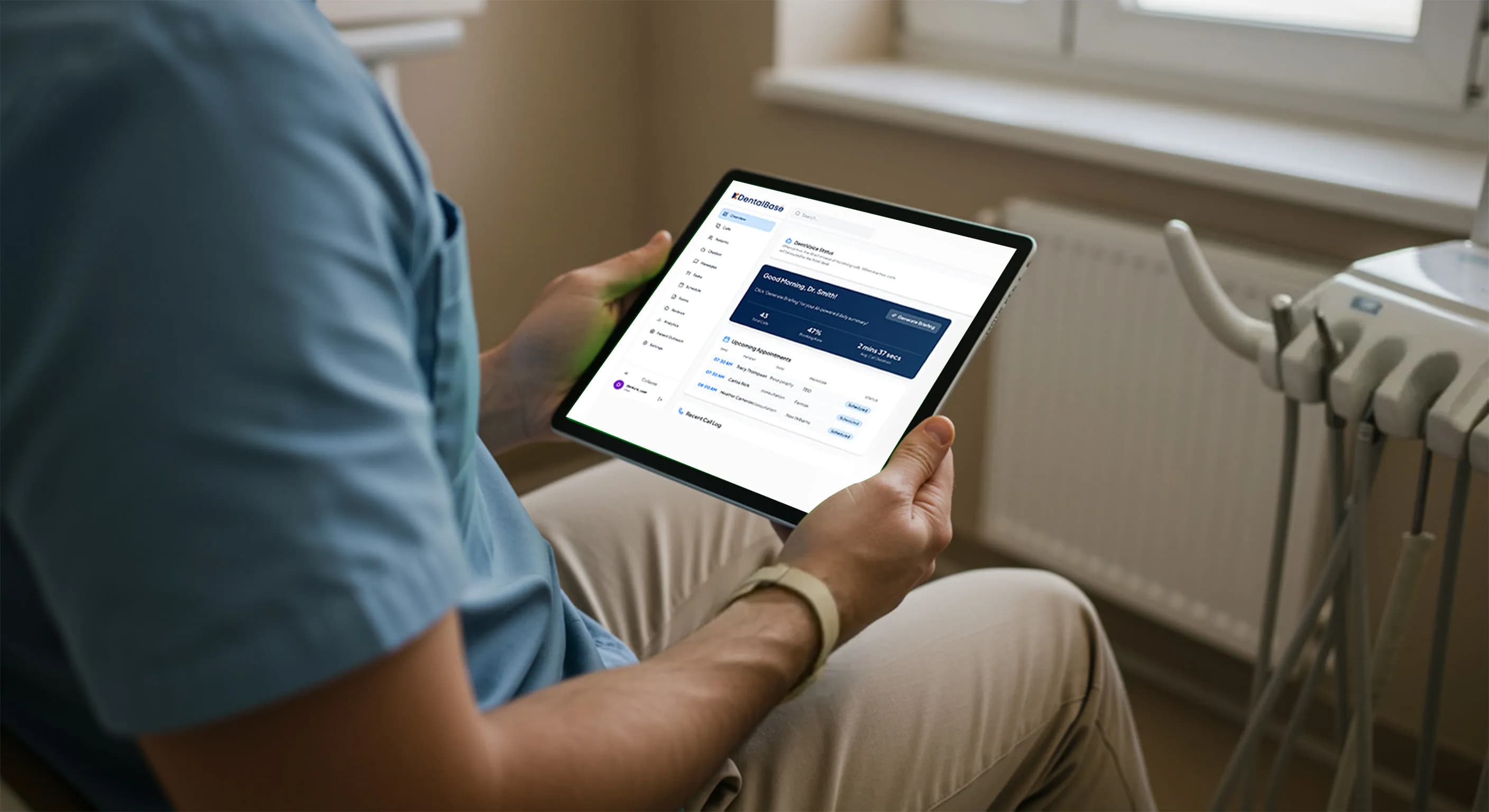
Do Patients Like AI Receptionists? What Data Shows

Do patients like AI receptionist calls? Real data shows comfort splits by task, not simple preference. See the stats, objections, and fixes that work.
Share:
Table of contents
Do patients like AI receptionist calls, or do they just tolerate them? The honest answer is mixed, and the split matters for how you deploy one. National customer service data shows most people still reach for a human first, yet the same data shows a real and growing minority who would rather skip the hold music entirely. For dental practices weighing an AI receptionist, that split is the whole story.
This matters because the wrong assumption in either direction costs you patients. Assume everyone loves AI and you'll ignore the callers who hang up the second a robotic voice answers. Assume everyone hates it and you'll keep losing after-hours calls to voicemail. Neither is accurate. What follows is what the actual research says, where the objections come from, and how to design around both.
Do Patients Like AI Receptionist Calls?
Patients are split, and the answer depends on the task. Many now prefer an automated system for quick, low-stakes calls like confirming an appointment, rather than waiting on hold. A widely cited Statista survey found that 82% of consumers would use a chatbot instead of waiting for a live representative.

That same survey found 96% of respondents believe more companies should offer an automated option, which signals a real shift in expectations. Still, that is general customer service data, not dental-specific data, and dentistry carries more emotional weight than a retail return. Fear, pain, and cost anxiety show up on dental calls in a way they rarely do on a shipping inquiry. That is exactly why task type matters so much here. A patient confirming a Tuesday cleaning and a patient calling about a cracked molar are not the same caller, and they should not get treated like one.
Part of why this question even comes up is staffing pressure. ADA Health Policy Institute data shows most practices struggle to keep front desk and hygiene roles staffed, which is exactly the gap AI reception is being asked to fill. Practices that get the best results treat AI reception as a tool for the routine 80% of calls, not a blanket replacement for every conversation. That framing alone changes how patients react to it. Our guide on what makes a natural AI voice patients trust covers the specific design choices that separate a voice patients tolerate from one they actually prefer.
What Does the Research Actually Say About Patient Trust in AI?
The research says trust is task-dependent, not universal. Comfort is high for scheduling and reminders, and low for anything involving diagnosis, emotional distress, or a sense that a real decision is being made about the patient's care. That gap shows up consistently across healthcare-adjacent surveys, not just dentistry.
One of the more surprising data points comes from a JAMA Internal Medicine study that McKinsey highlighted in its healthcare consumer research: licensed clinicians reviewing anonymized responses preferred the AI-written answer over the physician's answer 78.6% of the time, rating it both higher quality and more empathetic. That finding gets misused constantly. It does not mean patients prefer AI in general. It means well-written AI responses can outperform a rushed, distracted human response, which is a very different claim and a useful one for practices worried their AI receptionist will sound cold.
Here is how the general data lines up against what dental-specific sources report:
| Data Point | Finding | Source |
|---|---|---|
| Would use a bot over waiting on hold | 82% of consumers | Statista, 2024 |
| AI response preferred over physician response | 78.6% of clinician evaluators | JAMA Internal Medicine, via McKinsey |
| Dentists citing staffing as a top challenge | Majority of practices report hiring difficulty | ADA Health Policy Institute |
| Patients wary of AI in dental care generally | Documented but shrinking as familiarity grows | Dental Economics |
See how staff and AI actually split the work
Our escalation workflow guide shows exactly which calls route to AI and which route straight to your front desk.
Read the escalation guide →Why Do Some Patients Push Back Against AI Receptionists?
Patients push back for three consistent reasons: they don't like feeling unheard, they don't trust the accuracy, and older phone-tree systems left a bad taste that a new voice AI now has to overcome. None of these objections are irrational. They're earned, mostly from decades of "press 1 for billing" systems that never actually solved anything.
Skeptical practice owners raise these same concerns in industry forums. One widely read Dentaltown discussion argued that some early AI receptionist deployments frustrated patients who felt unheard or misunderstood on the call. That criticism is worth taking seriously rather than dismissing, because it usually traces back to specific, fixable problems: a voice that sounds obviously synthetic, a script that can't handle an off-script question, or no visible way to reach a person.
Three objections show up again and again:
- "It won't understand me." Accents, background noise, and unusual phrasing broke older IVR systems constantly, and patients remember that.
- "It's just trying to save the practice money." Patients read cost-cutting AI as a downgrade in care unless the practice frames it as coverage, not replacement.
- "What if something goes wrong and no one is watching?" This is the trust objection, and it's the one that matters most for anything urgent.
That last worry deserves a straight answer rather than a dismissal. What actually happens when an AI receptionist gets something wrong is worth reading before you decide the fear is unfounded.
The fix for all three is the same: transparent design and a fast, visible path to a human. Practices that hide the AI or make escalation hard confirm every one of these fears.
Patients aren't wrong to ask that question, and it's worth answering directly rather than reassuring around it, which is the approach taken in a practical guide to what AI can and can't replace at the front desk.
It also helps to name the real alternative when patients ask. The choice in front of most practices is rarely AI versus a person at the desk. It is AI versus voicemail, or an after-hours operator taking a message that gets returned tomorrow. Seeing how AI reception stacks up against a traditional answering service makes that framing much easier for the front desk to explain in the moment.
Does Patient Age or Call Type Change the Preference?
Yes, call type matters more than age. Comfort with automation is highest for routine, low-emotion tasks like confirming an appointment or checking office hours, and drops sharply for anything involving pain, cost disputes, or a sense of urgency. This pattern holds across generations more consistently than most people assume.
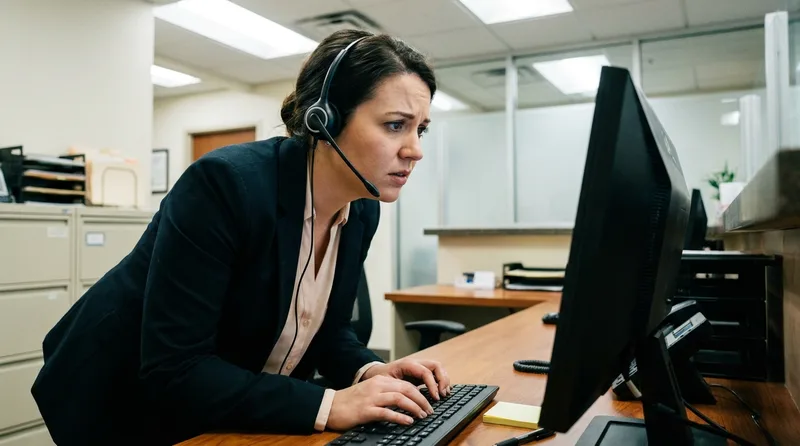
Industry-wide customer service research backs this up: consumers report far higher comfort with AI handling simple scheduling than with AI handling disputes, financial questions, or anything emotionally charged. Translate that to dentistry and the pattern is obvious. A patient rescheduling a routine cleaning barely notices whether they're talking to AI. A patient calling with facial swelling at 9pm needs to feel heard immediately, and that's a moment where tone and pacing carry more weight than efficiency.
- Routine tasks (confirmations, hours, directions): high acceptance, low risk if handled by AI.
- Scheduling changes (new patient booking, reschedules): generally accepted if the AI books correctly the first time.
- Billing and insurance questions: mixed acceptance, patients want a clear option to reach a person.
- Emergency or pain calls: lowest tolerance for automation, highest need for empathetic tone and fast human escalation.
Our guide on handling emergency dental calls breaks down exactly how tone and pacing should shift for that last category, since it's the one where getting it wrong costs you a patient permanently.
Service line shifts the picture as well. Patients calling about oral appliance therapy arrive with clinical history and coverage questions already attached, and how AI receptionists handle sleep dentistry calls shows why that call type needs a different script than a cleaning.
How Can a Dental Practice Make Patients More Comfortable With AI?
You make patients comfortable by being upfront that they're speaking with an assistant, keeping the voice natural instead of robotic, and making the handoff to a real person fast and obvious. Comfort with AI reception is a design outcome, not a fixed trait of the patient calling in.
The practices seeing the fewest complaints share a pattern: they don't try to disguise the AI as a human, and they don't bury the escalation path three menu options deep. Patients tend to forgive an obviously-AI voice a lot faster than they forgive feeling tricked into thinking they were talking to a person the whole time. Disclosure builds trust. Deception destroys it, even when the deception was well-intentioned. Those first few seconds set the tone for the entire call, which is exactly what our piece on the first seven seconds of a dental phone greeting covers in more depth.
Practical steps that move the needle:
- Open the call with a clear, brief statement that the patient is speaking with an AI assistant.
- Use natural pacing and pauses instead of rapid-fire scripted delivery.
- Offer a one-word or one-phrase escape hatch, like "just say 'staff' anytime," from the first sentence.
- Train the assistant on your actual practice FAQs so it doesn't stumble on basic, specific questions.
That last point is where a lot of early deployments fail. See our walkthrough on training your AI receptionist on practice FAQs for the exact process. Patient comfort with the AI also tends to mirror staff comfort with it. Our plan for introducing an AI receptionist to your dental staff looks at that connection from the team's side of the phone.
What Privacy Concerns Do Patients Have About AI Phone Systems?
Patients worry most about who has access to what they say on the call and whether that data is stored or shared. This concern runs higher in healthcare than in almost any other industry, because the information at stake includes symptoms, medications, and sometimes financial hardship. The same expectations carry over to written data collection, so the safeguards that apply to automated dental patient intake are the ones patients judge you on.

Any AI receptionist handling patient calls at a dental practice needs to operate within the same HIPAA privacy protections that apply to a human front desk, covering call recordings, transcripts, and any data passed into the practice management system. Patients don't need to understand the technical architecture. They need a straightforward answer when they ask, and your team should be able to give one without hesitating. Building that kind of confidence takes real work, which is why Dental Economics frames patient trust in dental AI as something practices earn through transparency, not a default setting.
For the specific compliance points worth verifying with a vendor, see is your AI dental receptionist HIPAA compliant.
Being able to say plainly how a call is recorded, stored, and protected removes one of the biggest silent objections before it ever gets voiced. Silence on this point reads as evasiveness, even when nothing is actually wrong.
How Do You Know If Patients Are Accepting Your AI Receptionist?
You know patients are accepting it when escalation requests stay low, call completion rates stay high, and you stop hearing complaints about feeling unheard. These three signals together tell you more than any single metric on its own.
Watch the escalation rate closely during the first 60 to 90 days. A high or rising rate of patients asking for a human usually means the AI is mishandling something specific, not that patients categorically reject the concept. Pull the actual call recordings behind spikes and you'll usually find one recurring failure point, like mispronouncing a provider's name or fumbling insurance terminology.
Track these signals monthly:
- Escalation rate: percentage of calls where the patient asks for or is routed to a person.
- Call completion rate: percentage of calls that reach a resolved outcome without hang-up.
- Repeat-question rate: how often the AI has to ask a patient to repeat themselves.
- Direct patient feedback: complaints or praise mentioning the phone experience specifically.
Our call quality monitoring guide lays out a repeatable review routine for exactly these signals, including how often to spot-check calls and what a healthy escalation rate actually looks like.
Acceptance signals are just one piece of the picture. Our guide to measuring AI receptionist success in dental offices covers the full set of KPIs, from patient acceptance to answer rate to ROI, worth tracking together.
Every patient still needs a way to reach a person
See how accessible design keeps every caller, including anxious or elderly patients, comfortable on the line.
See the accessibility guide →The data doesn't support "patients love AI" or "patients hate AI." It supports something more useful: patients accept AI reception readily for routine tasks and want a fast, visible path to a human for anything emotional, complex, or urgent. That's not a limitation to work around. It's the actual design brief.
Practices that answer "do patients like AI receptionist" calls correctly are the ones that stopped asking whether to use AI and started asking which calls it should handle. Start there, measure the escalation rate honestly, and let the data from your own patients refine the answer further.
See what a natural-sounding AI receptionist actually handles
Hear how DentiVoice greets callers, answers routine questions, and hands off the calls that need a person.
Hear a real DentiVoice call →Curious what patients hear on a well-designed call?
Read the patient phone experience breakdown →See how these satisfaction numbers connect to the full patient journey.
How technology improves the dental patient experience end to end →Frequently Asked Questions
Patients are split. Most accept AI receptionists for routine tasks like confirmations and rescheduling, but many still prefer a human for emotional, urgent, or complex calls. Acceptance depends far more on the call type than on the patient.
Yes, generally. Scheduling is one of the lowest-friction tasks for AI reception, since it's routine and low-stakes. Comfort drops only when the AI mishandles the booking or can't answer a basic follow-up question.
Upfront disclosure that they're speaking with an AI assistant, a natural speaking pace, and a fast, visible way to reach a person all build trust. Patients forgive an obviously-AI voice faster than they forgive feeling deceived.
Not as much as assumed. Call type predicts comfort more reliably than age does. A patient of any age tolerates AI well for a routine confirmation call and wants a human fast for an emergency or billing dispute.
Often, yes, especially with older or scripted systems. Modern conversational AI voices are harder to distinguish, but the safer approach is disclosing it upfront rather than trying to pass the AI off as a person.
A well-designed AI receptionist offers a fast, clear way to reach a staff member, often with a single word like staff or agent. Practices that hide this option see higher complaint rates and lower call completion.
It should be handled under the same HIPAA protections that apply to a human front desk, covering call recordings, transcripts, and any data passed into the practice management system. Ask your vendor directly how each is stored.
Sources & References
- 1
- 2
- 3
- 4
- 5
Topics
Was this article helpful?
Written by
DentalBase Team
Expert dental industry content from the DentalBase team. We provide insights on practice management, marketing, compliance, and growth strategies for dental professionals.