AI Receptionist Difficult Patient Calls: What Works
AI receptionist difficult patient calls need acknowledgment first, clear escalation triggers, and follow-up. See the scripts and checks that work.
Share:
Table of contents
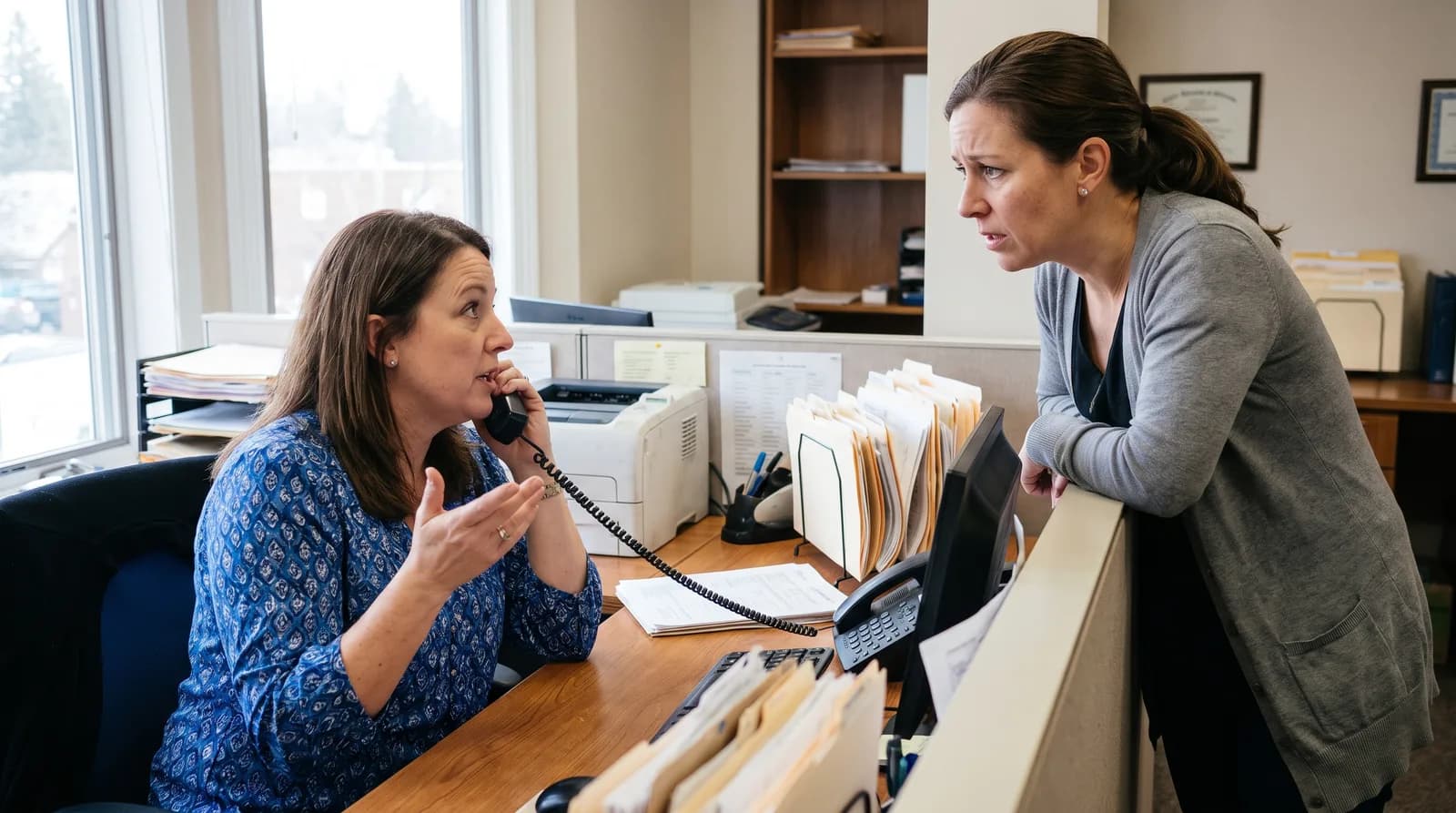
An AI receptionist difficult patient calls scenario looks something like this: a patient calls a dental office furious about a bill they didn't expect, and whoever answers has about ten seconds to keep that patient from hanging up angry.
Most practices lose a chunk of these calls to hold music, hurried staff, or a voicemail box nobody checks until Monday. That's the real cost of a bad first response, not just one lost patient, but a bad review that sits on Google for years.
This guide breaks down how an AI receptionist should actually handle an upset caller: acknowledge the frustration first, gather specifics, offer one concrete next step, and hand the call to a person the moment it needs human judgment. You'll also see where AI dental receptionist technology still needs a person in the loop, because it does, every time.
How Should an AI Receptionist Handle Difficult Patient Calls?
An AI receptionist should acknowledge the patient's frustration first, gather the specific details of the complaint second, and offer a concrete next step before the call ends. Skipping straight to solutions without acknowledging the emotion behind the call almost always backfires.
Why Acknowledgment Comes Before Policy
Dental Economics has documented this pattern directly: front desk teams that apologize and validate a concern immediately, before debating who's right, keep far more patients than teams that jump straight to logistics. Dental Economics notes that whether the patient is technically correct isn't the point in that first exchange. Being heard is.
An AI voice agent built for this has to be scripted the same way: open with acknowledgment, not with a policy explanation. That's also the moment where a good AI receptionist handoff patient experience either holds together or falls apart, since a clumsy transition undoes whatever goodwill the first ten seconds built.
- Acknowledge first: "I hear that this appointment mix-up is frustrating, and I want to help sort it out."
- Clarify the specifics: ask what happened, when, and what resolution the patient wants.
- State a next step: a callback time, a fee waiver review, or a transfer to staff.
- Never argue policy mid-call: that's a conversation for a human with authority to make exceptions.
These three steps only work if the tone underneath them is already right. What patients actually hear in the broader phone experience shapes whether an acknowledgment lands as sincere or scripted.
See how call handling actually sounds
DentiVoice answers every call with the same acknowledge-first approach, day or night, without a script sheet taped to the monitor.
See DentiVoice →What De-Escalation Techniques Actually Work on a Dental Phone Call?
The techniques that work reliably are slowing down, mirroring the patient's concern in your own words, and pausing before offering a fix. Rushing to a solution before the patient feels understood tends to make an angry caller louder, not calmer.
Acknowledge Before You Explain
A caller who's already worked up doesn't want a policy lecture. They want proof someone is actually listening. Restating the complaint back, "so the issue is the second reminder call came after you'd already rescheduled," does more to lower the temperature than any apology script. The American Dental Association frames this the same way for in-person conflict: understand the other person's point of view before responding, not after.
Slow Down Instead of Rushing to Solve
Speaking quickly reads as dismissive. Speaking too slowly can feel condescending. The right pace holds steady even when the caller is loud, and that steadiness is exactly what a well-built natural-sounding AI voice is designed to hold onto, since it never gets rattled or defensive the way a tired staff member might by their fourth difficult call of the day.
- Let the caller finish the first sentence without interrupting.
- Repeat the core complaint back in one sentence.
- Ask one clarifying question instead of five.
- State what happens next, specifically and with a timeframe.
- Confirm the patient agrees with that next step before ending the call.
When Should an AI Receptionist Escalate an Angry Caller to a Staff Member?
An AI receptionist should escalate immediately when a caller mentions a clinical emergency, threatens legal action, demands a refund or fee waiver, or repeats the same unresolved complaint twice. Those four triggers cover almost every call that genuinely needs a person's judgment, not a script.
Those triggers get harder to apply on calls complicated by heavy accents or noisy environments, where the AI may misjudge frustration it never actually understood.
Why the Line Matters
Below that threshold, plenty of frustration can be resolved without a human at all: a scheduling mix-up, a billing question with a clear answer, or confusion about a reminder text. Most AI receptionist difficult patient calls never need a person at all once the acknowledge-first habit is built in.
The line matters because over-escalating defeats the purpose of having phone coverage that doesn't burn out, and under-escalating risks a patient who needed a person getting stuck with a machine. A documented staff handoff workflow is what keeps that line consistent call after call, instead of depending on a judgment call made differently by whoever happens to be free.
Specialty service lines set their own escalation floor. A caller describing gasping awake or chest pain is not an angry caller, but the trigger has to fire just as fast. That is why escalation rules for sleep dentistry phone calls get written separately from general de-escalation scripting.
- Clinical urgency: pain, swelling, bleeding, or anything sounding like a dental emergency.
- Legal or safety language: mentions of a lawyer, a formal complaint, or a safety concern.
- Money decisions: refund requests, fee disputes, or anything requiring discretion staff control.
- Repeat frustration: the same complaint voiced twice with no resolution in sight.
Related: Emergency calls need a different reassurance script than a billing complaint does. See what patients need to hear →
What Should an AI Receptionist Never Say to a Frustrated Patient?
An AI receptionist should never dismiss a complaint, promise something it can't guarantee, or blame the patient for the mix-up. Those three habits turn a fixable frustration into a lost patient and, often, a public review.
Why Plain Language Matters
Plain, direct language matters more than most practices realize. The CDC's oral health communication guidance exists precisely because vague or jargon-heavy phrasing loses people who are already stressed.
An ADA News piece on difficult conversations makes a similar point: acknowledge the emotion first, then explain, and give the patient room to process before moving on. The table below shows what that looks like in practice.
| Situation | Avoid Saying | Say Instead |
|---|---|---|
| Billing surprise | "That's just our policy." | "I understand that's frustrating. Let me get someone who can review this with you." |
| Missed reminder | "You should have called us back." | "I see the reminder went out late. Let's find a time that works now." |
| Long hold or callback delay | "We've been really busy." | "I'm sorry you had to wait. Here's exactly what happens next." |
| Repeat complaint | "Like I already said..." | "I want to make sure this actually gets resolved, so let me bring in the team." |
AI Receptionist vs. Human Front Desk: Who Handles Upset Patients Better?
Neither one handles every upset call better on its own. An AI receptionist holds a consistent tone and never skips the escalation step, while a human front desk brings judgment an algorithm can't replicate for genuinely unusual situations.
Where Each Side Actually Wins
The honest comparison isn't AI versus staff, it's which parts of a difficult call benefit from consistency and which need a person's discretion. Data on how patients actually react to AI-handled calls backs this up: comfort splits by the type of task, not by a blanket preference for one over the other, according to patient survey data on AI receptionists.
Where AI tends to win is availability and consistency at 11pm on a Saturday. Where staff still win is the fee waiver decision that needs someone with the authority to actually make it.
| Factor | AI Receptionist | Human Front Desk |
|---|---|---|
| Availability | Answers every call, any hour | Limited to office hours and staffing |
| Tone consistency | Same calm pace every call | Varies with fatigue and workload |
| Discretionary decisions | Escalates to staff, doesn't decide | Can waive a fee or bend a policy |
| Documentation | Logs every call automatically | Depends on staff writing it down |
Both sides of that table can work together
DentiVoice handles the consistent first response and hands off cleanly the moment a call needs a person's judgment.
The deeper question behind all of this is how much of the front desk role an AI receptionist can take on in the first place, which is exactly what a practical breakdown of what AI can and can't take over at the front desk lays out call type by call type.
See how handoff works →How Do Practices Know Their AI Receptionist Is Handling Difficult Calls Well?
Practices know their AI receptionist is handling difficult calls well by reviewing call transcripts, tracking how often calls escalate correctly, and watching for repeat callers about the same issue. Guesswork isn't a monitoring strategy.
What a Regular Review Catches
A regular call quality review catches patterns a single bad call won't reveal on its own, like an escalation trigger that's set too loose or too tight, or a phrase the AI keeps using that patients respond poorly to.
The same discipline applies to human staff, and the ADA's guidance on building patient loyalty points at the same root idea: consistent follow-through after a rough interaction is what actually keeps a patient, not the apology alone. You can test that follow-through directly by running a mystery shopper phone call audit against your own front desk to see how a tense scenario gets handled in practice, not just in theory.
Monitoring Checklist for Difficult Calls
Check the items your practice already reviews monthly.
A monthly review of these four items catches most problems before a patient does.
What Happens After a Difficult Call Ends?
After a difficult call ends, the details need to be logged, flagged for staff review if unresolved, and followed up on within the timeframe promised on the call. A patient who was told "someone will call you back today" and doesn't hear back is often angrier the second time.
Where the Frustration Often Starts
Long hold times are one of the biggest reasons patients arrive at that first angry call in the first place. Practices that already struggle with hold time and abandoned calls tend to see more of these complaints stack up, since every unanswered call becomes a callback request layered on top of the next day's normal volume.
Closing the loop on a documented complaint, quickly and visibly, is what turns a frustrated caller back into a patient who keeps their next appointment.
Handling the hard calls well is one piece of a bigger picture. AI in patient communication: benefits and limits for practices covers the full range of what these systems do well, and where they still need a human touch.
A Small Practice Example
Consider a three-provider practice that logs even ten difficult calls a week. Without a shared record, the same complaint can land on three different desks before anyone notices a pattern, like a recurring scheduling conflict or a fee that keeps surprising patients. With a shared log, that pattern shows up after the second or third instance instead of the twentieth, and the fix happens before it becomes a habit patients start to expect.
- Log the complaint with enough detail that any staff member can pick it up.
- Flag calls that were escalated but not resolved same-day.
- Confirm the promised follow-up actually happened, don't assume it did.
- Note whether the root cause needs a policy fix, not just a one-time apology.
Handling upset patients well isn't about scripting away every hard conversation. It's about making sure the first response is calm and consistent, and that the handoff to a person happens before frustration turns into a lost patient. An AI receptionist difficult patient calls strategy that skips either half of that equation will look fine on paper and still cost practices patients in practice.
Start by mapping the four escalation triggers above against how your practice currently handles them, then measure the gap.
See DentiVoice Handle a Difficult Call
Listen to how an acknowledge-first, escalate-when-needed approach sounds on a real dental phone line.
See DentiVoice →See how de-escalation fits into the broader patient journey.
How technology improves the dental patient experience overall →Frequently Asked Questions
Yes. It works alongside your existing PMS rather than replacing it, syncing call notes and escalation flags with scheduling and patient records staff already use in systems like Dentrix, Open Dental, or Curve Dental.
A well-built AI voice holds a steady, natural pace even when a caller is loud or emotional, which is often more consistent than a rushed human response on back-to-back difficult calls late in the day.
Yes, for after-hours and overflow calls specifically. A solo practice often loses the same after-hours complaint calls a larger office would catch, since one dentist cannot staff a phone around the clock.
A strong front desk still cannot answer every call at 9pm or during lunch. AI receptionist difficult patient calls handled outside office hours catch complaints before they turn into a public review the next morning.
It should acknowledge the frustration in one sentence before explaining anything, for example: I hear that this is frustrating, and I want to help sort it out. Policy explanations always come second, not first.
Immediately for four triggers: a clinical emergency, mention of legal action, a refund or fee decision, or the same complaint repeated twice without resolution. Everything else can usually be handled without a person.
Sources & References
- 1
- 2
- 3
- 4
- 5
Topics
Was this article helpful?
Written by
DentalBase Team
Expert dental industry content from the DentalBase team. We provide insights on practice management, marketing, compliance, and growth strategies for dental professionals.