Dental Marketing Attribution: Trace Every Booked Call
Dental marketing attribution shows which ads book real patients. See how AI receptionist call data closes the phone reporting gap.
Share:
Table of contents
Dental marketing attribution is the work of tracing each new patient back to the ad, search result, or mailer that produced their first call. Most practices cannot do it. They know what they spend per channel, they know how many new patients arrived, and the line between those two numbers is guesswork.
That guesswork is getting expensive. Around one-third of dentists told the ADA Health Policy Institute in Q1 2026 that they were not busy enough, up from roughly one-quarter in Q1 2024. Paying for calls you cannot trace makes an open chair much harder to fix.
This guide covers what attribution actually measures, why the phone breaks almost every dental marketing report, how AI receptionist call data closes that gap, and how to write source data into your practice management software. If you are also weighing the spend side of this, the payback math is covered in our AI receptionist ROI guide.
What is dental marketing attribution, and why is it so hard for dental practices?
Dental marketing attribution links every new patient to the specific channel, campaign, or keyword that produced their first contact. It is hard in dentistry because most first contacts happen by phone, and a phone call leaves almost no digital trail unless something on the call itself records the source.
Think about what your reporting stack can actually see. Your ad platform sees clicks. Your website analytics sees sessions and taps on the phone number. Your practice management software sees an appointment. Nothing in that chain sees the ninety seconds where a patient decided to book, which is the only moment that matters.
The three questions attribution has to answer
- Which channel produced the contact? Not the last click before the call. The thing that actually caused the patient to pick up the phone.
- Did the contact convert? A call is not a patient. Attribution that stops at call volume rewards the channels that generate noise.
- What was that patient worth? A hygiene recall and an implant consult are not the same outcome, and channel mix differs sharply between them.
Answer all three and budget decisions stop being arguments. Answer only the first and you have a traffic report wearing a marketing report's clothing.
Why do phone calls break most dental marketing reports?
Phone calls break dental reporting because the conversion happens outside every system that measures marketing. Analytics tools follow a patient through the browser and then lose them at the moment of the tap. Everything after that, including whether anyone answered, is invisible to the platform that charged you for the click.
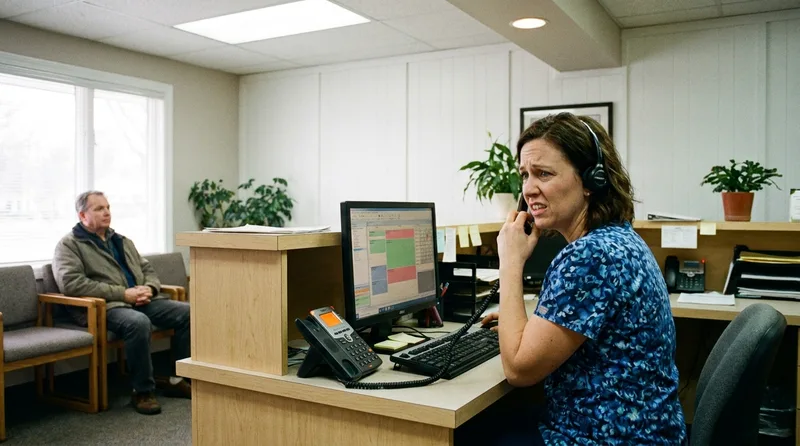
Dental Economics makes a related point in its guidance on dental practice marketing metrics, noting that a new-patient phone call is a lead. It cautions against endless debate over which touchpoint deserves credit and recommends a simpler routine: use call tracking numbers, tag new-patient callers, tag the calls that went to voicemail, then total leads by type and by source.
Here is the part practices underestimate. The gap is not only a measurement problem, it is a revenue problem, because the calls your report cannot see are usually the same calls nobody answered. Missed calls and missing data have identical root causes. Closing that gap is the same work covered in how AI recovers lost dental revenue from missed calls.
Three ways one phone call disappears from your report
- Unanswered: The call rings out or hits voicemail, so nothing records who called or why.
- Answered but untagged: Someone helps the patient, books them, and never notes where they heard about you.
- Tagged wrong: The source is entered as "Google" or "internet", and your report merges several channels into one.
Not sure how many calls your practice is losing?
Abandoned and unanswered calls distort every marketing report you run, because the channel gets blamed for a front desk bottleneck.
Read why patients abandon calls →What are the main reasons dental practices ignore analytics tools?
The main reasons dental practices ignore analytics tools are that the reports stop at the click, nobody owns them, and the numbers never connect to a booked patient. A dashboard that can't answer whether a call booked gets opened twice and then abandoned.
- The report stops at the phone. Clicks and sessions look healthy, but the booking happens in a call the tool never sees.
- Nobody owns it. A report sent to the whole team belongs to no one, so it gets read for two months and then skipped.
- It counts activity, not patients. Sessions and call volume don't tell you who booked, so the numbers feel disconnected from the schedule.
- The front desk has no time to feed it. Source tagging is the first task dropped when the phones are busy.
- The agency grades its own work. Reports built by the people being measured tend to lead with traffic, which breeds distrust.
Most of these reasons are about missing data and missing ownership, not weak software. Both are fixable once the source is captured on the call and written to the patient record, which is what the rest of this guide sets up.
How does an AI receptionist capture attribution data a busy front desk cannot?
An AI receptionist captures attribution data because it treats every call as a structured record instead of a conversation someone might remember later. Source, intent, outcome, and booking status are logged on all calls, including the ones that arrive at 7pm on a Saturday when nobody is at the desk.
None of this is a criticism of front desk teams. Asking a coordinator to note the referral source while a patient in pain is on hold and two people wait at the counter is a workflow problem, not a discipline problem. The data gets skipped because something more urgent is always happening.
What gets recorded on every call
The attribution chain
Four links. Every one of them has to hold.
Source
A tracking number identifies the channel before anyone picks up the phone.
Intent
New patient, recall, emergency, or a billing question that was never a lead.
Outcome
Booked, transferred to your team, or a callback the patient is still waiting on.
Record · most skipped
The source is written to the patient chart, not just the call log.
Break any link in this chain and the channel report goes back to guesswork.
Step four is the one most setups skip. A call log that lives only in a phone system tells you a call came from paid search. It does not tell you that the patient showed up, accepted treatment, and returned nine months later.
Which dental marketing attribution metrics should you actually track?
Track four numbers per channel and ignore the rest: inbound calls, booked appointments, booking rate, and cost per booked patient. Volume alone flatters the noisiest channel. Booking rate is where a channel proves it sends patients who intend to schedule rather than people comparison shopping on price.
The channel scorecard
| Metric | What it tells you | What it hides |
|---|---|---|
| Inbound calls | Reach and demand by channel | Wrong numbers, vendors, existing patients |
| Booked appointments | Real conversion, not intent | Cancellations and no-shows |
| Booking rate | Call quality by channel | Whether the loss was channel or handling |
| Cost per booked patient | True channel efficiency | Lifetime value and case mix |
Booking rate is also the number that rewards a habit of reviewing recorded calls rather than trusting a dashboard. Cost per booked patient is the number that ends debates, and it is also the number most affected by local market conditions. Semrush data published through Statista showed dental cost per click was highest in Arizona and lowest in Vermont in the first half of 2019. The figures are dated, so treat them as an illustration of how much local markets differ rather than a current benchmark.
Booking rate and cost per booked patient are also two of the core numbers in our broader guide to measuring AI receptionist success in dental offices, which ties attribution data into a practice-wide KPI scorecard.
How do you connect call attribution to your practice management software?
Connect attribution by writing the source into the patient record at the moment the appointment is created. Every major practice management system has a field for it. In Open Dental, the Referred From field records where a patient came from, including options like internet or mailing, so income can be tracked by source.

Once the source lives in the chart rather than a phone dashboard, your reporting changes shape. You can pull production by referral source. You can compare six-month retention between a paid search patient and a word-of-mouth patient. That is a different class of question than what your ad platform reports.
Where the handoff usually breaks
- Nobody owns the field. If source entry is optional, it gets left blank on the busy days, which are the days with the most calls.
- The picklist is a free-text box. "Google", "google ads", and "internet" become three separate channels in your report.
- The AI books the appointment but writes nothing to the chart. The booking works, the reporting does not, and nobody notices for a quarter.
Related: Source data only helps if it lands in the chart when the booking is made. See how AI receptionists book appointments directly in dental practice software →
What does dental marketing attribution change about your budget?
Attribution changes budgets by exposing spread, not averages. Practices assume each channel contributes roughly in proportion to its cost. In reality the gap between a strong channel and a weak one can be wide, as the worked example below shows, and reallocating toward the strong one costs nothing extra.
A worked example
Consider a three-provider general practice spending $4,500 a month across four channels. The numbers below are a modeled scenario, not a client result, but the shape will look familiar to anyone who has run this exercise.
| Channel | Monthly spend | Calls | Booked | Cost per booked patient |
|---|---|---|---|---|
| Paid search | $2,000 | 62 | 21 | $95 |
| Organic and local search | $1,200 | 48 | 24 | $50 |
| Social | $800 | 29 | 5 | $160 |
| Direct mail | $500 | 14 | 4 | $125 |
Look at the booking rates rather than the call counts. Paid search produced more calls than organic but fewer bookings, a 34% booking rate against 50%. Social generated 29 calls and 5 patients. Without attribution, the practice sees 153 calls and 54 new patients and concludes everything is working.
The obvious move is shifting budget from social toward local search. The less obvious move is asking why paid search converts sixteen points worse, which is usually a landing page or call handling issue rather than a targeting one.
Where does call attribution usually go wrong?
Call attribution goes wrong in predictable places, and almost all of them involve credit landing on the wrong channel rather than data going missing entirely. A report that is confidently wrong does more damage than no report, because it moves real money in the wrong direction.
The six common failures
- One number everywhere. The same phone number on your website, your ads, and your mailer collapses every channel into "direct". This is the most common failure and the easiest to fix.
- Counting calls as patients. Twenty calls and six bookings is a booking rate problem, not a marketing win.
- Ignoring after-hours. Evening and weekend calls skew toward urgent need. If those hours go unanswered, whichever channel drives them looks weak.
- Last-click thinking. A patient who found you through organic search, read reviews, then clicked a retargeting ad is not a retargeting patient.
- Forgetting outbound. Reactivation and recall campaigns book patients too, and outbound call programs deserve their own source code.
- No baseline. Without a pre-change month, you cannot separate the effect of the new system from ordinary seasonal movement.
Only 45% of the U.S. population had a dental visit in the preceding twelve months as of 2022, according to the ADA Health Policy Institute, and among the reasons adults give for staying away is not being able to find a convenient appointment time. That is a booking-availability problem your channel report will quietly mislabel as weak demand.
How do you set up dental marketing attribution in 30 days?
Set it up in four weekly stages rather than one large project. Attribution fails more often from partial rollouts than from technical difficulty, because a half-instrumented system produces numbers that look complete and are not. Fix the plumbing first, then start reading the report.

- Week one: assign tracking numbers. One per channel, minimum. Paid search, organic and Google Business Profile, social, print or mail, and referrals. Keep your main practice number untouched.
- Week two: define the source picklist. Lock it to a fixed list in your practice management software. No free text. Train whoever books appointments on the exact values.
- Week three: connect call outcomes. Make sure every answered call ends with a recorded outcome and that the source writes through to the chart, not only to the phone report.
- Week four: baseline and review. Pull calls, bookings, booking rate, and cost per booked patient for each channel. Do not act yet. You are establishing the starting line.
Then wait. Give it 60 days before you move budget, because a single month of dental call volume is far too small a sample for a solo or three-provider office to compare channels honestly.
Who should own it
One person, reviewing monthly, with authority to change spend. Attribution reporting that goes to everyone and belongs to no one gets read for two months and then quietly ignored. Your office manager is usually the right owner, not your marketing agency, because the agency is being measured by the report.
Why is attribution becoming table stakes in 2026?
Attribution is becoming standard because the practices you compete with are already instrumenting their phones. Call-level reporting that once belonged to large groups now reaches single-location offices at a fraction of the old cost.
What changed for single-location practices
Scale groups have always been able to answer the channel question, because they built central reporting to do it. What changed is cost. The call-level data that used to need a dedicated marketing analyst now arrives as a byproduct of answering the phone, which puts a single-location practice on comparable footing.
Patient need isn't the constraint here either. The National Institute of Dental and Craniofacial Research still describes tooth decay as the most common chronic disease among both children and adults in the United States, so the question is which channel reaches those patients, not whether they exist.
Consumer dental spending has kept rising modestly, up roughly 11% from pre-pandemic levels per ADA Health Policy Institute reporting, while dentist busyness has drifted the other way. When demand is steady but distribution is tightening, knowing which channel actually fills chairs stops being a reporting nicety.
Why is attribution really an operations problem?
The uncomfortable insight in all of this is that dental marketing attribution is mostly not a marketing problem. It is an operations problem wearing a marketing label. The data goes missing at the front desk, on nights and weekends, and in a blank field on a patient chart.
Which means the fix starts with the phone, not the ad account. Instrument the call, write the source to the record, then let two months of clean data tell you where your budget belongs. For a sense of the scale, review how much revenue unanswered dental calls put at risk.
Start with one thing this week: put a distinct tracking number on your highest-spend channel and note today's date. That single change gives you something to compare against 60 days from now.
See which channels are actually driving your booked calls
Every call logged with its source, intent, and outcome, including the ones that arrive after your team goes home. Start with the cost and payback numbers.
See 2026 pricing and payback →Frequently Asked Questions
Dental marketing attribution is the process of matching each new patient to the marketing source that produced their first contact. Instead of reporting that your website got 900 visits, it reports that organic search booked 11 patients last month and paid search booked 14.
Analytics platforms track behavior inside the browser. They record the click, the page view, and the tap on your phone number. Once the call connects, the session ends and the booking happens somewhere analytics cannot see.
Usually yes. Tracking numbers identify the channel before the call is answered, which is how you separate paid search from organic and direct mail. The AI receptionist then records what happened on that call and whether it booked.
Most practices need 60 to 90 days. A single month of call volume is too small to compare channels fairly, especially for a solo office. Seasonality, holidays, and one large campaign can distort any 30-day snapshot.
Yes, provided each location has its own tracking numbers and its own reporting view. Multi-location groups run into trouble when calls roll into one central number, because the channel signal and the location signal collapse into each other.
There is no single benchmark, because fee schedules, competition, and case mix vary too much by market. The useful comparison is internal: measure your own cost per booked patient by channel, then track whether it improves quarter over quarter.
It can, if source data and patient identifiers are handled carelessly in marketing platforms. Keep protected health information inside systems covered by a business associate agreement, and send only aggregate counts to ad platforms and dashboards. This is general information, not legal advice, so confirm specifics with your compliance officer or counsel.
The most common reasons dental practices ignore analytics tools are that reports stop at the click, nobody owns them, and the data never shows whether a call became a booked patient. Fixing ownership and capturing the source on the call usually brings the numbers back into use.
Sources & References
- 1
- 2
- 3
- 4
- 5
- 6
Topics
Was this article helpful?
Written by
DentalBase Team
Expert dental industry content from the DentalBase team. We provide insights on practice management, marketing, compliance, and growth strategies for dental professionals.