AI Receptionist ROI: How Long Until It Pays for Itself?

AI receptionist ROI for dental practices: real missed-call math, a 5-step payback formula, and 30 to 90 day timelines backed by industry data.
Share:
Table of contents
AI receptionist ROI is the math every dental practice owner runs before signing a contract, and the honest answer is that most practices reach payback in 30 to 90 days, not years. That's a different timeline than a new hygiene chair or a CBCT unit, both of which can take a year or more to earn their keep. The reason is simple: an AI receptionist doesn't wait for a slow season to start paying you back. It works on every call, starting the day it goes live.
Here's the problem practices are actually solving. Front desks are understaffed, phones ring during patient check-ins, and the sticker price of an AI receptionist is the first thing an office manager compares against a stack of missed-call reports. What almost nobody compares it against is the cost of doing nothing. This article walks through the real payback math, using industry data rather than vendor claims, so you can build your own number instead of trusting someone else's slide deck.
How Long Does It Take for an AI Receptionist to Pay for Itself?
Most dental practices recover the full cost of an AI receptionist within 30 to 90 days. Payback speed depends mainly on call volume and how many calls the practice was previously losing to voicemail or hold time. A busy multi-provider practice recovers cost faster than a slow solo practice simply because it has more calls to save.
Payback as a Ratio, Not a Fixed Number
Payback period isn't a fixed number. It's a ratio: recovered revenue divided by monthly cost. A practice that answers 300 calls a month and was previously missing a third of them has a much bigger pool of recoverable revenue than a practice answering 80 calls a month with a tight-knit front desk that rarely drops a call. That's why "how long until it pays for itself" always deserves the follow-up question: pays for itself compared to what baseline?
The Three Numbers You Need First
Before you can estimate your own timeline, you need three numbers: your average missed-call rate, your average new-patient value, and the monthly cost of the system. Get those three right and the payback math takes five minutes. If you want a shortcut, a dedicated missed-call cost calculator will run these numbers for you before you build the full payback formula below.
What Does a Missed Call Actually Cost Your Practice?
A missed call costs a practice far more than one lost appointment. According to the American Dental Association, a patient's average annual expenditure runs $514 at a general practice and $1,755 at a specialist, and that's just the first year, before referrals or repeat visits are counted.
How Fast Do Missed-Call Losses Add Up?
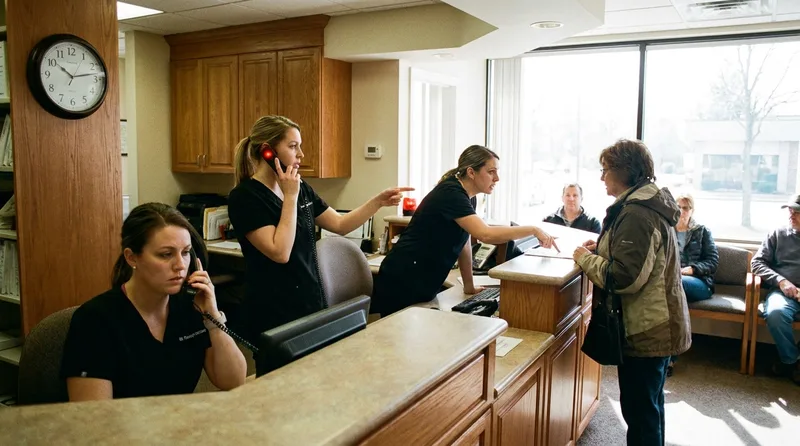
Run that math across a normal week and the number gets uncomfortable fast. Missing just 10 inbound calls, a realistic total for a practice with a busy front desk, can represent thousands of dollars in lost first-year revenue once you multiply by average patient value. That's not a rare worst-case scenario. It's a Tuesday. See how missed calls translate directly into recoverable dental revenue to size the loss for your own schedule. For the full anatomy of what a missed call costs a practice, beyond just the phone bill, see the true cost of missed dental calls. It also helps explain what is pushing dental practices toward AI receptionists right now.
The next question is what you would otherwise spend to catch those calls. A live answering service also picks up after hours, but it bills on a different basis and it does not always book the appointment, which changes the payback math before you start. Weighing AI reception against a traditional dental answering service gives you a fair baseline cost to run the calculation against.
Hold time adds another layer of loss. Dental Economics reports that poor phone handling, being put on hold, not being greeted properly, or getting bounced to voicemail, can cost a practice 15% to 22% of new patients before the front desk even books an appointment. Add a chronic no-show problem to the mix, where a single missed appointment per day can cost $20,000 to $70,000 a year, and you start to see why the phone line is the most valuable part of the practice nobody budgets for. If you want the deeper breakdown, this piece on hold time and patient loss covers exactly where those callers drop off.
The Three Biggest Cost Drivers
- New-patient calls carry the highest cost per miss, since a first-year patient value of $514 to $1,755 compounds into a multi-year relationship if the practice keeps them.
- Hold-time abandonment quietly removes 15% to 22% of new patients before a human even finishes the greeting.
- Existing-patient no-shows caused by missed confirmation calls stack an extra $20,000 to $70,000 a year on top of new-patient losses.
See what your own missed calls are costing you
Before you can size your payback period, you need a real missed-call number for your own practice, not an industry average.
Talk to DentiVoice →How Do You Calculate Your Practice's Payback Period?
Payback period equals monthly AI receptionist cost divided by monthly recovered revenue, expressed in months. If the system costs less per month than the revenue it recovers, payback happens inside that same month. If it costs more, you're still in the red until recovered revenue catches up.
What Counts as Recovered Revenue?
Understanding AI receptionist ROI starts with recovered revenue, which has two components, and most practices only think about the first one. There's the direct recovery: calls that used to go to voicemail and now get answered and booked. And there's the indirect recovery: staff hours freed up from phone duty that get redirected toward insurance verification, treatment plan follow-up, or hygiene recall, all of which also generate revenue. That same freed-up time often goes toward better handling the financing and payment questions that can make or break a treatment plan's acceptance.
Both components depend on how much of the phone workload the system can actually absorb. This guide to AI dental receptionist functions lays out that workload task by task.
The 5-Step Payback Formula
Here's a simple version of the formula, adaptable to a spreadsheet:
- Estimate your current missed-call rate (pull it from your phone system report if you have one, or track it manually for two weeks).
- Multiply missed calls per month by the share that are genuine new-patient inquiries, typically a quarter to a third of total call volume.
- Multiply that number by your practice's average first-year patient value.
- Subtract the monthly cost of the AI receptionist from that recovered-revenue figure.
- If the result is positive, you've already paid for the system in month one.
Most practices skip step one entirely and guess. Don't. A two-week manual tally, having the front desk log every call it can't reach, gives you a real number instead of a hopeful one. Some of those "missed" calls actually get answered and still don't convert, which is a separate leak worth reading about in this breakdown of booking friction and call abandonment.
What Does a Realistic Payback Timeline Look Like?
A realistic payback timeline runs 30 to 90 days for most general practices, based on typical missed-call rates and average patient values reported across the industry. Faster timelines belong to higher-volume, higher-missed-call practices. Slower timelines belong to practices that were already answering most of their calls well.
Here's a worked example using the industry figures already cited above rather than invented numbers. It's illustrative math, not a client case study, but it's built entirely from the same real data any practice can pull from its own phone reports.
A Worked Example With Real Numbers
| Input | Conservative estimate | Source basis |
|---|---|---|
| Missed calls recovered per month | 8 to 10 calls | Practice-level manual call tally |
| Average general-practice patient value | $514 in year one | ADA average annual expenditure |
| Estimated monthly recovered revenue | Roughly $4,000 to $5,100 | 8 to 10 calls x $514 |
| Result | Payback inside the first month for most monthly pricing tiers | Compare against your actual monthly cost from your vendor quote |
Notice what this table doesn't include: emergency calls, hold-time abandonment, or no-show reduction from better confirmation handling. Those are real but harder to isolate in month one, so a conservative model leaves them out and still clears payback quickly.
Which Practices Reach Payback the Fastest?
AI receptionist ROI moves fastest where high call volume meets a high existing miss rate. A single-location general practice fielding 200 or more calls a month, with a front desk that's already stretched thin, sees returns faster than a slow-volume specialty office with excess phone capacity.
Why After-Hours Coverage Speeds Up Payback
After-hours and weekend gaps matter more than most owners expect. A practice open only during business hours misses every emergency call, every after-work parent trying to book a kid's cleaning, and every Saturday morning caller. Closing that gap alone can shift a payback estimate from 90 days down to 30, since those calls were previously worth zero and now convert directly into booked visits. Building a real after-hours coverage strategy is usually the fastest single change a practice can make to its payback timeline.
Multi-provider and multi-location practices see compounding returns, since call volume scales with location count while the monthly cost per line often drops. A three-location DSO recovering the same 8 to 10 missed calls per location per month triples its recovered revenue while adding only marginal cost per site.
For a fuller picture of how this compounding math plays out at scale, see our complete breakdown of AI receptionist ROI for Georgia DSOs operating across multiple locations. The payback case gets even stronger in a market with sharper seasonal swings. Florida's fast-growing dental support organizations recover missed-call revenue twice over, once from the baseline multi-location effect and again from the winter call surge that a fixed-headcount front desk cannot absorb.
High-value service lines shorten the timeline further. A single oral appliance case is worth several routine hygiene visits, and building an AI receptionist pathway for sleep dentistry calls covers where those inquiries are quietly lost today.
Who Sees the Fastest Returns
- High call volume practices (200+ calls monthly) recover cost fastest, since a larger raw number of calls means more recoverable revenue. See how overflow handling works without adding staff.
- Practices with real after-hours demand (urban, family-heavy patient bases) convert previously unanswerable calls into new revenue immediately.
- Multi-location groups compound the return, since per-location cost often falls as the group scales.
What Does AI Receptionist ROI Look Like After the Break-Even Point?
ROI after break-even compounds month over month, since the AI receptionist keeps answering the same volume of calls without additional labor cost. Once the system has paid for itself, every recovered call afterward is close to pure margin, minus the flat monthly fee.

Why ROI Compounds After Break-Even
This is where AI receptionist ROI starts to look different from a one-time equipment purchase. A CBCT machine depreciates. A new hire's productivity plateaus and their salary rises with tenure. An AI receptionist's marginal cost per additional call stays flat whether it answers 300 calls a month or 500, so ROI actually improves as the practice grows and call volume increases.
What Industry Data Shows About the Labor Gap
The ADA's Q1 2026 dental economy report notes that average hourly wages for dental office staff have stayed flat once inflation is factored in, even as recruitment challenges persist industry-wide. That combination, flat wages and a tight labor pool, is part of why call coverage keeps showing up as a fixable gap instead of a staffing problem. Dental Economics has traced a similar pattern back to communication breakdowns more broadly: roughly a third of appointments are lost to miscommunication, a gap that compounds every month the phone line goes unaddressed.
Payback is only the starting line
See how ongoing call coverage compounds savings as your practice adds providers or locations.
See the scaling guide →Which Metrics Prove the ROI to Your Team?
Answer rate, booked-appointment rate, and after-hours call capture are the three metrics that prove ROI to a skeptical office manager or partner dentist. Track these monthly and compare against your pre-AI baseline, not against a vendor's marketing claim.
Answer rate is the simplest to track and the easiest to sell internally. If your practice used to answer 65% of inbound calls and now answers 98%, that gap is the raw material for every other ROI calculation. Booked-appointment rate takes it one step further: not every answered call converts, so tracking how many answered calls turn into scheduled visits tells you whether the system is actually driving revenue or just picking up the phone politely.
After-hours capture deserves its own line item. It's the easiest ROI to demonstrate because the baseline is zero. Every call answered outside business hours used to go to voicemail or a competitor. Now it doesn't. That's the exact dynamic behind why so many practices are quietly losing patients simply because nobody answers after hours.
The Four Metrics to Track Monthly
- Answer rate: total calls answered divided by total inbound calls, tracked weekly for the first quarter.
- Booked-appointment rate: answered calls that convert into a scheduled visit.
- After-hours capture: calls answered and booked outside standard business hours, previously an automatic loss.
- Recovered production: dollar value of booked appointments traced back to calls that would have gone unanswered.
Pull these numbers quarterly and put them next to the monthly invoice. That comparison, not a vendor's ROI slide, is what actually convinces a partner dentist the payback period claim was real. Pairing these metrics with regular call quality reviews catches small problems before they show up as a revenue dip. Those same metrics are worth raising up front, and how to vet dental AI receptionist software before you buy lists the demo questions that expose weak ROI claims.
For the full scorecard, including how to weight these numbers into one monthly report, see our guide to measuring AI receptionist success in dental offices.
How Should You Set Expectations With Your Team?
Set expectations by framing the AI receptionist as call coverage, not a staff replacement. Front desk teams who understand the system exists to catch overflow and after-hours calls, not to take over their job, adopt it faster and use the freed-up time more productively.
That framing, coverage rather than replacement, is worth unpacking further in our full look at whether AI can actually replace a dental receptionist.

Where to Reassign Freed-Up Front Desk Time
Practices that introduce the change well typically reassign recovered front-desk hours toward tasks the phone used to crowd out: insurance verification, treatment plan follow-up calls, and recall outreach. Each of those tasks has its own revenue impact, and stacking them on top of the direct call-recovery number is how the full ROI picture comes together over a full quarter, not just the first 30 days.
Each of those reassigned tasks can be automated in its own right. Our guide to automation ROI beyond the front desk phone compares scheduling, insurance, and billing returns.
How to Train Staff for Smooth Handoffs
Training staff to hand off complex calls smoothly matters just as much as the technology itself. A system that escalates cleanly to a human for anything outside its scope keeps patients confident and keeps the front desk in control of the relationship. A clean first-week setup process shortens the time it takes staff to trust the system, which shortens the payback timeline too.
Related: A clean handoff process is what keeps patients confident when a call needs a human touch. Read the escalation workflow guide →
The payback period on an AI receptionist is rarely the hard part of this decision. The math above shows most practices recover the cost within one to three months using nothing but public, verifiable industry data. The harder part is committing to track the right numbers afterward so the ROI story doesn't fade into anecdote. Start with a two-week manual call tally this month, run the five-step formula against your own patient value, and you'll know your real payback number before your next billing cycle closes.
Ready to see your own payback number?
Talk to DentiVoice about your call volume and get a straight answer on what recovery looks like for your practice.
Get your ROI estimate →Want the full cost breakdown first?
See AI receptionist pricing for 2026 →Related Reading
Frequently Asked Questions
Most dental practices see full payback within 30 to 90 days. Higher call volume and a higher existing missed-call rate both shorten the timeline, since there is simply more recoverable revenue for the system to capture each month.
Recovered revenue includes previously missed calls that now get answered and booked, plus indirect gains from freed-up front desk hours redirected to insurance verification, recall outreach, and treatment plan follow-up calls.
No. A two-week manual tally, where your front desk logs every call it cannot reach, gives you a usable missed-call estimate. Dedicated call tracking helps later but is not required to run the initial payback math.
Yes. The marginal cost per additional call stays flat as call volume rises, so multi-provider and multi-location practices often see ROI compound faster than a single, lower-volume office.
Guessing the missed-call rate instead of measuring it. Practices that skip a real two-week call tally tend to either overestimate savings or dismiss the technology based on a number that was never accurate.
A new hire's salary rises with tenure and their productivity plateaus, while an AI receptionist's monthly cost stays flat regardless of call volume, which is why ROI tends to compound rather than flatten over time.
Yes, though payback takes longer. A practice with fewer missed calls has less recoverable revenue per month, but after-hours and emergency call capture can still produce meaningful returns even at lower overall call volume.
Sources & References
- 1
- 2
- 3
- 4
- 5
Topics
Was this article helpful?
Written by
DentalBase Team
Expert dental industry content from the DentalBase team. We provide insights on practice management, marketing, compliance, and growth strategies for dental professionals.