Dental Patient Phone Verification: Confirm Without Friction

How dental patient phone verification works: a PMS lookup plus a second factor to confirm caller identity, with rules for minors and authorized reps.
Share:
Table of contents
Dental patient phone verification is the step that decides whether your front desk, or your AI receptionist, can safely say anything about an appointment, a balance, or a treatment plan. Get it wrong and you risk handing protected information to the wrong person. Get it right and the call moves fast without friction for the real patient.
For years the default was simple: ask for a name and a date of birth. That is no longer enough. Both are easy to find, easy to guess, and offer no real proof that the voice on the line belongs to the patient on the record.
This guide breaks down how AI call handling verifies callers using a practice management system lookup plus a second factor, and how to handle the tricky cases: minors, spouses, and authorized representatives. You will get a clear verification flow you can apply on every inbound call.
Why are name and date of birth no longer enough for dental patient phone verification?
Name and date of birth are no longer enough because both are easy to find, guess, or share, so they say little about who is actually on the line. HIPAA requires a practice to verify the identity of an unknown requester before releasing protected health information, which means adding a second factor.
Why is a birthday not proof of identity?
A caller can know a patient's birthday without being that patient. HIPAA expects reasonable verification before disclosure, and a single guessable detail rarely meets that bar.
Think about how much of this information already circulates. Birthdays appear on social media. Names sit in public records. A family member, an ex-partner, or someone who simply found a wallet could repeat both correctly.

What does HIPAA require, and what do the numbers show?
HHS sets the standard. Its verification guidance says covered entities under the HIPAA Privacy Rule must confirm the identity and authority of anyone they don't know before granting access to protected health information, and the check can usually be oral or written.
The 2024 breach report from the Office for Civil Rights shows why it matters:
- Unauthorized access or disclosure made up 94% of the 74,299 reports of breaches affecting fewer than 500 people.
- Health care providers filed 93% of those small-breach reports.
- Providers also filed 76% of the 663 larger breach reports.
- Hacking drove 81% of those larger reports, so phone checks are one layer, not the whole defense.
- OCR closed 12 breach investigations with agreements, settlements, or penalties totaling $7,813,831. One was a $1,190,000 civil money penalty against Gulf Coast Pain Management Consultants.
Phone verification is only one piece of the broader picture. See is your AI dental receptionist HIPAA compliant for the full compliance checklist.
How does a second factor close the gap?
The fix is not to make verification longer. It is to make it stronger with a second, harder-to-fake factor. That is exactly what a structured phone identity check does, whether a human or an AI handles the call.
Related: DentiVoice covers how the system decides which calls are urgent and where each one should go in our guide to AI call routing and triage →
How does AI call handling verify a caller's identity?
AI call handling verifies identity by matching what the caller says against the patient record in your practice management system, then confirming a second factor. The primary lookup uses name and date of birth. The secondary factor confirms the match with a detail only the real patient would readily know.
The live PMS lookup
The first step is a live lookup. When the caller gives a name and date of birth, the AI queries the connected PMS and finds the matching record, the same way a trained receptionist would pull up a chart. This is where a tight integration with your dental software matters, because the verification is only as good as the data it checks against.
The same logic applies whether the record lives in Dentrix, Eaglesoft, Open Dental, or Denticon: the system matches against what is already in the chart.
For practices on Denticon, this AI dental receptionist Denticon integration guide shows how that live patient lookup is set up against a Denticon schedule specifically.
Identity Verification Flow
How a verified phone interaction moves from greeting to disclosure.
Caller reaches the practice
AI receptionist answers and greets the caller before any patient detail is shared.
Primary lookup against the PMS
Caller states name and date of birth. The system matches it to the patient record.
Secondary factor check
A second identifier confirms the match: last visit date, treating provider, or phone on file.
Identity confirmed or escalated
Verified callers proceed. Mismatches route to staff or get a callback to the number on file.
The second-factor check
If the primary match is clean, the system asks for one more identifier. It might confirm the date of the last visit, the treating provider, or the phone number the caller is using. Only after both checks pass does the AI move on to scheduling, balances, or anything tied to the patient's record.
What counts as a strong second factor for dental patient phone verification?
A strong second factor is specific to the patient and hard for an outsider to know or guess. The strongest options combine something the caller knows with something already tied to the record, such as the calling phone number or the date of a recent appointment.
Not every identifier carries equal weight. Recent, specific details, like the date of the last visit or the provider seen, are hardest to fake and don't depend on the phone line at all. Caller ID is a useful passive signal, but it can be spoofed. Call authentication frameworks such as STIR/SHAKEN, which the Federal Communications Commission requires carriers to implement, reduce that risk without removing it.
Three kinds of proof to combine
Something the patient knows
Date of birth, home address, or ZIP code. Easy to ask, but knowable by others, so it works as a starting point, not proof on its own.
Something tied to the record
The phone number the caller is dialing from, matched against the number on file. A useful passive signal that needs no extra question, though caller ID can be spoofed, so never rely on it alone.
Something recent and specific
Last appointment date or the provider seen. Hard to guess, easy for the real patient to confirm.
How should you rank and choose your factors?
Pick factors that fit your patient base. A practice with many shared family phone lines may lean on appointment history instead of caller ID. The point is layering: one weak factor plus the primary lookup is far safer than name and date of birth alone.
- Strongest: the date of the last visit or the provider seen, confirmed by the caller before the system says either one.
- Moderate: caller ID matched to the number on file (useful, but spoofable) or an outstanding balance the caller states.
- Weakest: home ZIP code, which household members and others may also know.
Verification should be fast, not a phone interrogation
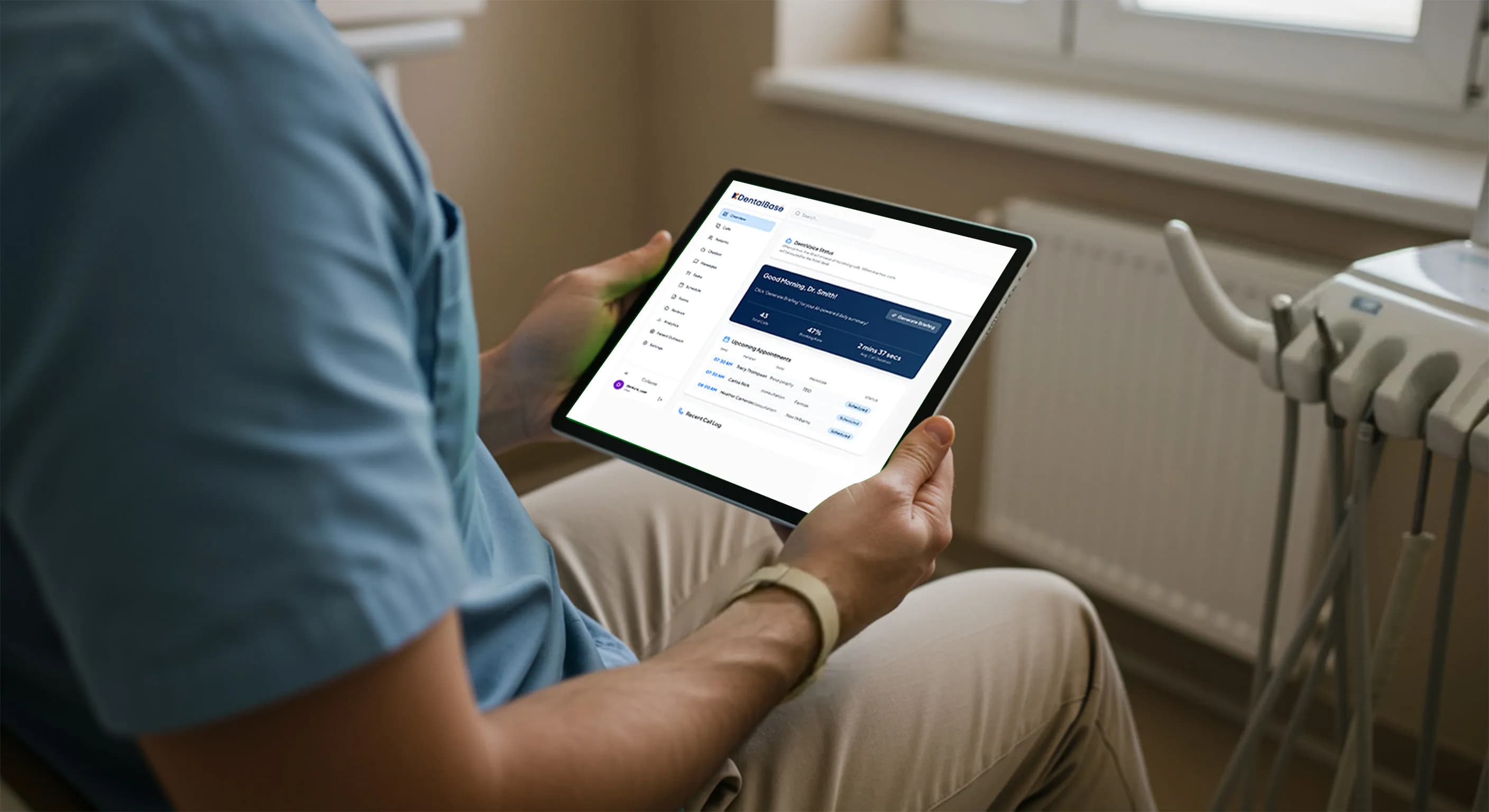
DentiVoice runs the PMS lookup and a second-factor check in the background so verified patients move straight to booking. See how caller context appears on screen the moment a call connects.
See caller ID screen pop →How should AI handle minors, spouses, and authorized representatives?
Calls about minors, spouses, and third parties need an extra check: confirm the caller is authorized on that specific record before sharing anything. A parent on a child's chart can usually receive the child's details. A spouse should receive details only when the patient has listed them or agreed.
Why do front desks slip on calls from family?
This is where many front desks slip, often out of politeness. A caring spouse asking about an appointment feels harmless. But the record belongs to the patient, and authorization is the deciding factor, not the relationship. AI call handling helps here because it applies the same rule every time, without the social pressure a human feels to just be helpful.
What does HIPAA allow for spouses and family?
HIPAA does let a practice share relevant information with a spouse or family member involved in a patient's care when the patient agrees or doesn't object, according to guidance from the U.S. Department of Health and Human Services on disclosures to family and friends. Requiring a listed contact is therefore a practice policy, not a federal minimum, and it is the safer choice on a phone line where you can't see who is calling.
Who can receive what?
| Who is calling | Verification needed | What can be shared |
|---|---|---|
| New patient, no record yet | No PMS match exists | Collect details to create a record. Share only general info (hours, location, pricing ranges), never another patient's data. |
| The patient themselves | Name + DOB matches, plus one secondary factor | Their own appointments, balance, and treatment details, limited to what they ask about. |
| Parent calling for a minor | Caller verified as the guardian on the minor's record | Disclosure allowed for the minor. Confirm the caller is the listed guardian, not just any adult. State minor-consent laws can limit what a parent sees, so check your state rules. |
| Spouse or family member | Listed as an authorized contact on the record | Practice policy: share only if the patient listed that person or agreed. HIPAA allows limited sharing with family involved in care. |
| Unconfirmed third party | No authorization on file | No protected detail. Offer to leave a message or have the patient call back. |

What does the system do when authorization is unclear?
For minors, the system confirms the caller is the guardian listed on the record, not simply an adult who knows the child's birthday. When authorization cannot be confirmed, the safe move is consistent: share nothing protected, and offer a message or a callback to the number on file.
One rule, applied on every single call
A busy front desk gets pulled in a dozen directions and can be talked into exceptions. DentiVoice applies your verification policy the same way at 2 p.m. and 2 a.m., on the first call and the four-hundredth. Calls about children are where exceptions creep in most.
See who can call about a minor →What happens when verification fails or a caller can't confirm their identity?
When verification fails, the call should never default to disclosure. The system either escalates to a staff member, offers to call the patient back at the number on file, or limits the conversation to general, non-protected information like office hours and location.
Is a failed check always a bad actor?
A failed check is not always a bad actor. People forget which phone number is on file, give a nickname instead of a legal name, or call about a family member without realizing the rules. A good flow handles all of this gracefully. It can still help with general questions while protecting anything tied to a specific record.
What are the fallback options when a caller can't verify?
- Escalate to a staff member. A team member can ask different questions or check the chart directly.
- Call back the number on file. Reaching the patient at their registered number closes the loop safely.
- Stay general. Share only hours, location, and new-patient information until identity is confirmed.
When is the callback the right move?
Use the callback whenever staff can't confirm the caller live. If the caller really is the patient, reaching them at their own registered number resolves it. If they aren't, the protected information never leaves the practice.
How do you build a dental patient phone verification policy your whole team follows?
Build a written verification policy that defines the primary lookup, the accepted second factors, and the exact handling for minors and third parties. Then make sure both your staff and your AI receptionist apply it identically, so a patient gets the same experience on every call.
Start with a written policy
Start by writing down what you already do well, then close the gaps. Decide which secondary factors you will accept and in what order. Document the minor and authorized-representative rules so a new hire is not guessing. Have your compliance lead or attorney review it against your state's rules, and treat the legal minimum as the floor, not the ceiling.
Which outside references belong next to your policy?
Two outside references are worth keeping next to your written policy: the American Dental Association's HIPAA questions and answers for dental practices and the CDC's overview of HIPAA. Neither replaces legal advice. Assign one owner, such as your HIPAA Privacy Official, to keep the policy current and to review it after any incident.
Written policy is only half the job; the other half is documenting how the practice as a whole handles PHI on the phone. The broader HIPAA compliance guide for AI receptionists is the natural companion document to the verification policy itself.
What belongs on a one-screen checklist?
- Primary lookup: name and date of birth matched to the PMS record.
- Second factor: at least one of last visit date, treating provider, or a balance the caller states. Caller ID or ZIP only as a supporting signal.
- Minors: confirm the caller is the listed guardian before any disclosure.
- Third parties: disclose only if the person is an authorized contact on the record.
- On failure: escalate, call back the number on file, or stay general.

Why does software help the policy stick?
The advantage of running this through an AI receptionist is consistency. A documented policy only protects you if it is followed on every call, and software follows the script even when the lobby is full and three lines are ringing.
Related: Verification is only one piece of the front-desk load. See how the right setup handles insurance checks on the same call in our guide to AI dental insurance verification calls →
What should you change on your next inbound call?
Strong dental patient phone verification comes down to one shift: stop treating a name and a date of birth as proof, and start confirming a second factor before you share anything. That single change closes the most common gap in front-desk security.
How can you test your own front desk today?
Here's a quick test. Call your own front desk with a colleague's name and birth date, and listen for what gets shared before anyone asks a second question. Wherever that call gives something away, that's your first gap to close. Then write down which second factors you'll accept and how minors, spouses, and unconfirmed callers get handled. Whether a human or an AI answers, consistency is what keeps protected information with the people who own it.
Want the full picture on how an AI receptionist handles patient calls?
DentiVoice handles inbound dental calls with a PMS lookup and second-factor identity check built in, so verified patients move straight to scheduling while protected information stays protected.
Read the AI receptionist FAQ →Frequently Asked Questions
Dental patient phone verification is the process of confirming a caller's identity before sharing protected health information. It pairs a primary lookup of name and date of birth against the patient record with a second, harder-to-fake identifier.
Both are widely available and easy to guess, so they offer no real proof the caller is the patient. HIPAA expects reasonable verification before disclosure, which usually means adding a second factor the caller would have to know specifically.
Strong second factors include the date of the patient's last visit and the treating provider. Caller ID matched to the number on file helps but can be spoofed, and a ZIP code is the weakest option. Recent details are hardest for an outsider to fake.
Yes. AI call handling queries the connected practice management system, matches the caller to a record, and confirms a second factor before moving to scheduling. Verified patients proceed without extra friction while unconfirmed callers are limited or escalated.
Confirm the caller is the guardian listed on the minor's record, not just an adult who knows the child's birthday. Once verified, disclosure about the minor is generally allowed, though state minor-consent laws can limit it; otherwise share nothing protected.
Most practices require the patient to list the spouse as an authorized contact first. HIPAA does allow limited sharing with family involved in a patient's care when the patient agrees, but the relationship alone is not enough. Without that on file, keep the call general.
The call should never default to disclosure. The system escalates to a staff member, offers a callback to the number on file, or limits the conversation to general details like hours and location until identity can be confirmed.
Sources & References
- 1
- 2
- 3
- 4
- 5
- 6
Topics
Was this article helpful?
Written by
DentalBase Team
Expert dental industry content from the DentalBase team. We provide insights on practice management, marketing, compliance, and growth strategies for dental professionals.