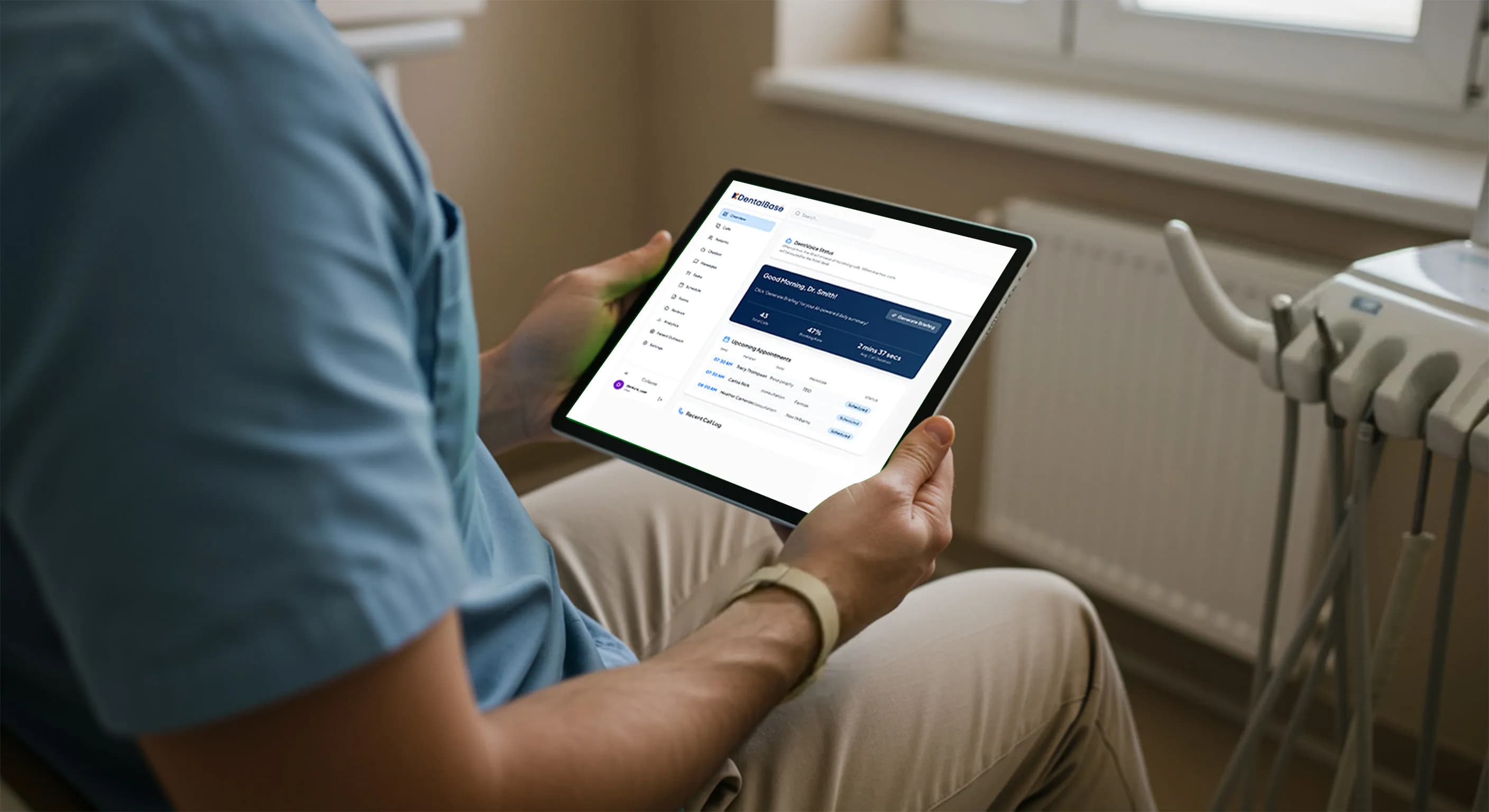
Voice AI vs Text AI Dental Receptionist: Which Books More?

Voice AI vs text AI dental receptionist: see why phone-first patients still decide new-patient bookings, where SMS fits, and how to choose the right mix.
Share:
Table of contents
Every new-patient call your dental practice receives is a decision point, and the technology that answers it shapes whether that caller becomes a booked appointment or a lost lead. As AI reception tools multiply, practice owners face a real fork in the road: a voice AI vs text AI dental receptionist choice that quietly determines how many callers actually reach a person, a booking, or a dead end. This guide breaks down where each approach wins, where it falls short, and how to build a phone-first system that protects new-patient revenue.
The short version is that text and voice are not interchangeable. A text-first tool that fires an SMS after a missed call is useful, but it assumes the caller will stop, switch channels, and type. A voice-first system answers the call live, in the moment the patient is already motivated. For a dental front desk weighing phone coverage models, that difference is the whole game.
What is the difference between voice AI and text AI dental receptionists?
A voice AI dental receptionist answers phone calls live and holds a spoken conversation, while a text AI receptionist responds over SMS or chat, usually after a call is missed. Voice AI meets the caller in real time; text AI shifts the patient to a second channel and asks them to type instead of talk.
Both approaches sit inside a broader set of front desk jobs. If you are still getting oriented, read what an AI dental receptionist does day to day before choosing between voice and text.
That distinction matters because dental scheduling is time-sensitive and emotional. A patient with a cracked tooth or a swollen jaw is not looking to start a text thread. They want a voice, a booking, and reassurance. Text-first automation shines for reminders, confirmations, and simple follow-ups, but it treats the phone call as a fallback rather than the primary path to a booked chair.
How does each system handle a live inbound call?
Voice AI picks up on the first or second ring and begins triaging: new patient or existing, emergency or routine, insurance questions or scheduling. Text-first tools typically let the call ring out to voicemail, then send a "Sorry we missed you" SMS. One path keeps the patient engaged; the other hopes they re-engage on their own terms.
For a full breakdown of how AI handles a dental call from start to finish, see what happens after that first triage moment.
What Voice AI Checks in the First Few Seconds
- Whether the caller is a new or existing patient.
- Whether the call is an emergency or a routine request.
- Whether the question is about insurance, scheduling, or something else entirely.
Why do phone calls still decide new-patient bookings in dentistry?
Phone calls still decide most new-patient bookings because dental scheduling is high-intent, high-anxiety, and time-sensitive, and callers overwhelmingly prefer speaking to typing. When someone in pain picks up the phone, they are ready to book now, and any friction that pushes them to another channel risks losing them to the next practice on their list.

New-patient calls carry outsized value. A single new patient can represent thousands of dollars in lifetime treatment, so a call that goes unanswered is not a minor slip. It is a direct hit to production. When a caller reaches voicemail or a bot that cannot actually book, many simply hang up and dial a competitor. That is the core reason missed dental calls carry a measurable cost that compounds month over month.
Voice remains the default because it removes steps. There is no app to download, no link to tap, no thread to monitor. The patient speaks, gets an answer, and books. Research tracked by the ADA Health Policy Institute underscores that patient access and continuity of care are central to a healthy practice, and nothing supports access more directly than answering the phone the moment a patient calls.
What happens when a new patient hits voicemail instead of a voice?
Most callers who reach voicemail do not leave a message and do not call back. They move on. A text-back reply may recover a fraction of them, but it competes with every other notification on the patient's phone. A live voice that books the appointment in that first call sidesteps the entire recovery problem. That first-call booking is the heart of automated appointment booking for dental practices, where the AI offers open slots and confirms the visit before the patient hangs up.
None of that works without the underlying phone infrastructure routing the call correctly first. How dental offices handle calls using VoIP phone systems and practice management software explains what that setup looks like.
For a closer look at what happens after the call ends, see how AI receptionists book appointments directly into dental practice software.
- Most voicemail callers do not leave a message at all.
- Of those who do, few call back a second time if the first attempt goes unanswered.
- A text-back reply competes with every other notification already on the patient's phone.
What are the strengths and limits of text-first AI receptionists?
Text-first AI receptionists are strong at asynchronous, low-urgency communication and weak at capturing high-intent callers in the moment. SMS is excellent for confirmations, reminders, review requests, and quick clarifications, but it depends on the patient choosing to respond on a channel they did not originally reach for.

Text automation has genuine advantages worth naming plainly:
- Reminders and confirmations: Automated texts reduce no-shows and keep the schedule tight without staff effort.
- Documentation: A written thread gives both patient and practice a record of what was agreed.
- Convenience for simple asks: A patient confirming a time or asking about parking can do so in seconds.
- After-the-fact recovery: A missed-call text-back can re-open a conversation that otherwise ended in silence.
The limits show up precisely where revenue is highest. A text-first tool cannot reassure a frightened emergency caller with tone of voice. It cannot read hesitation and slow down. And it moves the burden onto the patient, who must stop what they are doing and type. For practices already fighting booking friction that drives call abandonment, adding a channel switch is friction, not a fix. A closer look at AI's role in patient communication covers where that tradeoff shows up across channels, not just voice versus text.
When is text the right tool for a dental practice?
Text is the right tool for confirmations, reminders, review requests, and follow-ups where speed of response is not critical. It works best as a support layer around a voice-first core, not as the front door. Used that way, SMS complements the phone instead of quietly replacing the highest-converting channel.
Channel choice aside, the bigger question most practices eventually ask is whether AI belongs at the front desk at all, a question this practical guide on whether AI can replace a dental receptionist answers in more depth.
What are the strengths and limits of voice-first AI receptionists?
Voice-first AI receptionists excel at capturing high-intent callers instantly and booking them without a channel switch, and their main limit is that they must sound natural enough to earn patient trust. A voice system answers every call, triages the reason, and can complete a booking in the same conversation the patient started.
The advantages line up with how dental patients actually behave. Voice handles emergencies with reassurance, answers insurance and scheduling questions on the spot, and never sends a motivated caller off to a second channel. It also covers nights, weekends, and lunch breaks when the front desk cannot pick up, which is why many practices layer it into their call overflow strategy.
The limits are real and worth stating. A voice system that sounds robotic, mishears names, or cannot escalate to a human erodes trust fast. That is why the quality bar is so high: the value of voice-first reception depends heavily on how natural and conversational the AI voice sounds. A poor voice experience can do more damage than a simple text auto-reply.
How does voice handle the first seconds of a call?
The opening seconds set the tone for the entire interaction. A warm, clear greeting signals competence and care before a single question is asked, which is why the first seconds of a dental phone greeting carry so much weight. Voice-first systems are built to nail that moment; a text auto-reply never gets the chance to.
What a Strong Opening Includes
- An immediate, warm greeting with no dead air.
- Recognition of urgency if the caller sounds anxious or in pain.
- A clear next question that moves the call toward a booking, not a menu.
Voice AI vs text AI dental receptionist: how do they compare on booking outcomes?
Voice AI generally converts high-intent inbound calls at a higher rate because it books in the moment, while text AI recovers a portion of missed contacts after the fact. The two are not rivals so much as different tools for different points in the patient journey, but for new-patient acquisition, voice sits closest to the money. For existing patients rather than new callers, that same combination of channels is what powers two-way AI outreach that re-engages patients who've gone silent.
The table below maps the two approaches against the moments that decide whether a caller becomes a patient.
| Scenario | Voice-First AI | Text-First AI |
|---|---|---|
| New-patient inbound call | Answers live, books in the same call | Sends SMS after the call is missed |
| Dental emergency | Reassures with tone, triages urgency | Delays contact to a typed reply |
| Appointment reminder | Optional, but voice is overkill | Ideal, fast and low-effort |
| After-hours coverage | Answers and books 24/7 | Queues a reply for later |
| Simple confirmation | Works, but text is lighter | Excellent, instant and logged |
Read down the "new-patient" and "emergency" rows and the pattern is clear. The moments with the most revenue and the most emotion are the ones voice handles best. Text earns its place in the low-urgency rows, which is exactly why the smartest setups use both.
How should a dental practice choose the right mix of voice and text?
Most dental practices should lead with voice-first reception and layer text on top for reminders, confirmations, and recovery, rather than choosing one channel and abandoning the other. The voice AI vs text AI dental receptionist decision is not really voice or text, but which channel owns the first touch and which supports the follow-up.
Whichever channel wins the first touch, it still needs to share a calendar with your website widget. See AI receptionist online booking integration for how to keep phone and widget bookings in sync.
A practical way to decide is to sort your call volume by intent, then assign the channel that fits:
- Map your inbound calls: Separate high-intent new-patient and emergency calls from routine confirmations and questions.
- Assign voice to high intent: Any call where a patient is ready to book or is anxious should be answered live by voice.
- Assign text to low urgency: Reminders, review requests, and simple confirmations run well over SMS with no staff effort.
- Cover the gaps: Use voice-first coverage for nights, weekends, lunch, and overflow so no motivated caller hits voicemail.
- Measure the handoffs: Track how often each channel actually produces a booked appointment, not just a reply.
Set against public health context, the stakes are easy to see. According to the CDC, roughly 26% of adults in the United States have untreated tooth decay, which the NIDCR documents as one of the most common chronic conditions. The NIDCR also reports that about 47% of adults aged 30 and older show signs of gum disease. Those figures mean the patients calling your practice often need timely care, not a delayed text thread. A voice-first core makes sure those callers reach help on the first try, while text keeps the relationship warm between visits. Any patient data moving across either channel should also follow HIPAA safeguards enforced by the U.S. Department of Health and Human Services.
Does adding voice AI mean replacing your front desk?
No. Voice AI is designed to extend front-desk capacity, not remove it, by answering overflow, after-hours, and simultaneous calls your team physically cannot reach. Your staff stays focused on in-office patients and complex conversations while the AI catches the calls that would otherwise ring out. The goal is a stronger patient phone experience, not a smaller team.
- Staff stay focused on in-office patients and complex conversations.
- The AI catches overflow, after-hours, and simultaneous calls the team can't physically answer.
- No motivated caller hits voicemail just because every line is busy.
What should you look for when evaluating a phone-first AI receptionist?
When evaluating a phone-first AI receptionist, prioritize natural voice quality, real booking capability, reliable human escalation, and dental-specific understanding over surface features. A tool that answers but cannot actually book, or that traps callers with no path to a person, will cost you more than it saves.
Use these criteria as a checklist as you compare options:
- Natural, conversational voice: Patients should feel heard, not processed. Robotic tone breaks trust in seconds.
- True booking, not just messaging: The system must place appointments on the schedule, not only take a note.
- Human escalation: Complex or sensitive calls need a clean handoff to a real team member.
- Dental fluency: It should understand procedures, insurance basics, and emergency triage specific to dentistry.
- After-hours reliability: Coverage that holds up on nights and weekends, when many new patients call.
If your practice runs on Dentrix, how Dentrix integrates with a voice AI receptionist is a useful next read for confirming that a voice option actually writes appointments to your schedule rather than just logging a message.
To see these criteria applied to two real vendors, the DentiVoice vs Savvy Agents comparison walks through how a single focused voice agent stacks up against a bundled multi-agent workforce on cost, attribution, and escalation.
For a wider view of how DentiVoice stacks up across the category, this roundup of the top dental AI voice receptionist platforms in 2026 breaks down pricing, escalation handling, and attribution across the leading vendors.
Growing comfort with voice technology is not a dental-only trend. Patients across Google, Amazon Alexa, and Apple Siri ecosystems increasingly speak with capable automated systems every day, and that familiarity carries into how they expect a dental practice to answer. Public efforts like the ADA's Action for Dental Health emphasize expanding timely access to care, which a phone-first system directly supports. For a dental practice, the winning setup keeps voice at the front door, uses text where it genuinely helps, and never forces a high-intent caller to switch channels to get booked. That is how a phone-first strategy protects new-patient revenue while keeping long hold times from driving callers away.
Choosing between voice and text is really a subset of a bigger decision: whether AI reception makes sense for your front desk at all. Compare AI dental receptionists to traditional answering services in this 2026 guide.
Once you've decided AI reception is the right call, this step-by-step guide to implementing an AI receptionist in a dental office covers the rollout, from vendor setup to go-live.
Hear the difference for yourself
A booking decision often comes down to how the first call sounds. Listen to how DentiVoice answers, triages, and books a live dental call, then decide where voice belongs in your front-desk strategy.
Calculate the cost of your missed callsRelated Reading
Frequently Asked Questions
For new-patient acquisition, voice AI generally performs better because it answers high-intent calls live and books instantly. Text AI is stronger for reminders and follow-ups, so most practices benefit from using both together.
Some text-first tools can guide a patient toward booking over SMS, but they rely on the patient switching channels and typing. Voice-first systems book within the same call the patient already started, reducing drop-off.
No. An AI voice receptionist extends front-desk capacity by handling overflow, after-hours, and simultaneous calls. Your team stays focused on in-office patients while the AI catches calls that would otherwise go unanswered.
A well-built voice-first system escalates complex or sensitive calls to a human team member with a clean handoff. Reliable escalation is one of the most important features to confirm before choosing any AI receptionist.
Text automation makes the most sense for low-urgency communication like appointment reminders, confirmations, review requests, and simple questions. Used as a support layer around voice-first reception, it reduces no-shows without competing for high-intent calls.
Sources & References
- 1
- 2
- 3
- 4
- 5
Topics
Was this article helpful?
Written by
DentalBase Team
Expert dental industry content from the DentalBase team. We provide insights on practice management, marketing, compliance, and growth strategies for dental professionals.