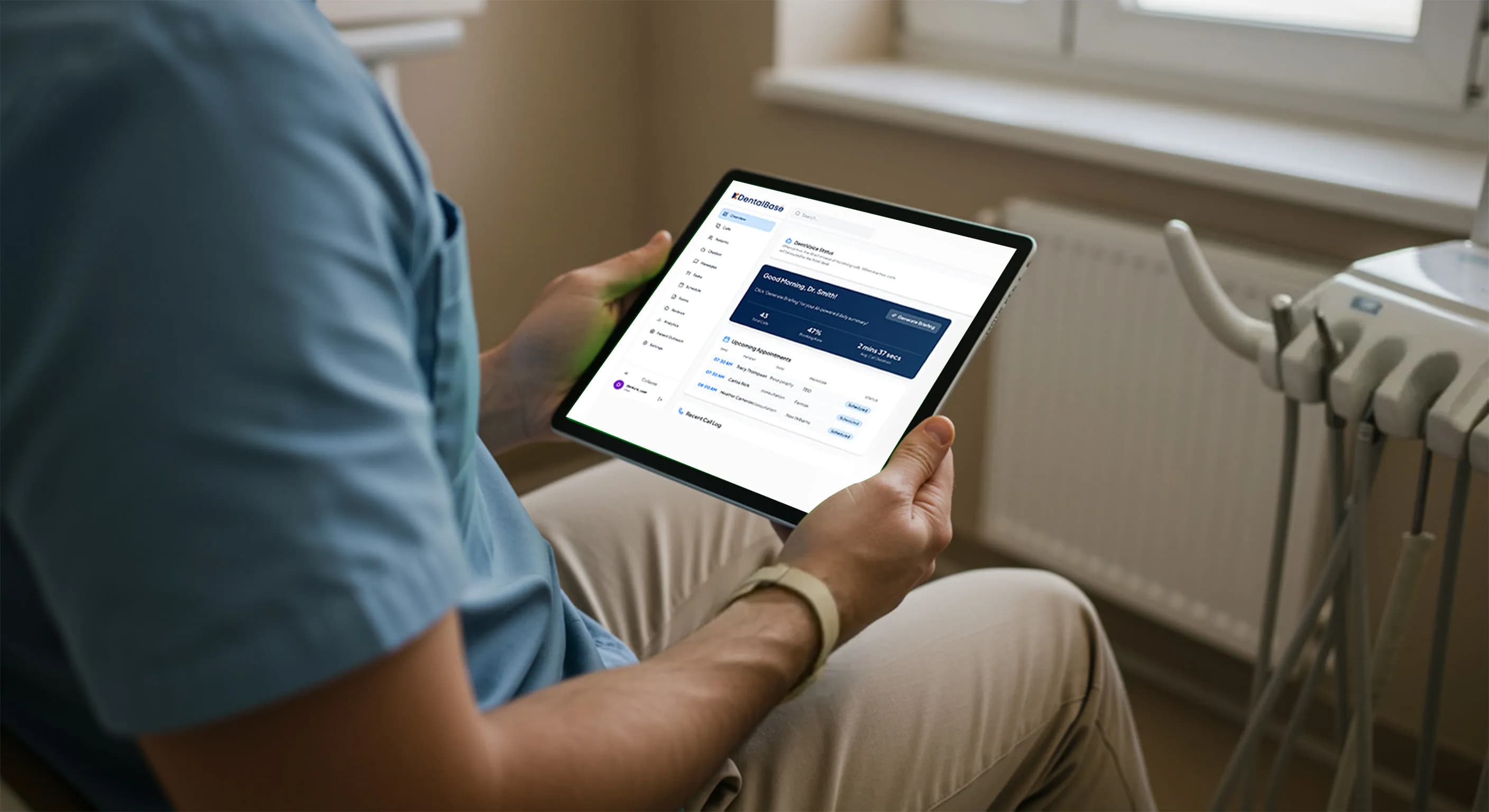
Top Dental AI Voice Receptionist Platforms in 2026

See how DentiVoice, Arini, TrueLark, and other top dental AI voice receptionist platforms compare on pricing, PMS integration, and compliance in 2026.
Share:
Table of contents
A dental AI voice receptionist picks up every call your front desk can't. That sounds simple enough, but the platforms behind it vary wildly in how they handle real-time scheduling, patient routing, and after-hours coverage. Choosing the wrong one means dropped calls that look "answered" in your reports but never convert to booked appointments.
The market for voice-first AI in dentistry has grown fast since 2024. Based on our experience working with hundreds of practices, most owners start shopping for a voice AI platform after realizing that 30-40% of their inbound calls go unanswered during peak hours. That's not a staffing problem you can hire your way out of. It's a capacity problem.
This guide breaks down what a dental AI voice receptionist actually does, which features separate serious platforms from marketing demos, how pricing works across the category, and how to evaluate HIPAA compliance before you sign anything.
What Is a Dental AI Voice Receptionist and How Does It Work?
A dental AI voice receptionist is a phone-based system that uses natural language processing to answer patient calls, book appointments directly into your practice management software, and route urgent requests to your team in real time. It's not a chatbot. It's not a voicemail tree. It's a voice-first AI that holds a live conversation with the caller.
The technology sits between your phone system (VoIP or landline with call forwarding) and your PMS. When a patient calls, the AI answers within one to two rings, identifies the reason for the call, and takes action. For a new patient wanting a cleaning, that means checking your schedule for open hygiene slots, confirming the time with the caller, and writing the appointment directly into Dentrix, Eaglesoft, Open Dental, or whichever system you use.
Here's the thing. Not every platform claiming "AI receptionist" actually handles voice calls. Some are text-only or webchat-only tools using the receptionist label for marketing purposes. A true voice platform processes speech in real time, manages interruptions and crosstalk, and responds with natural-sounding speech, not robotic text-to-speech from 2019.
Voice AI vs. Chatbots vs. Answering Services
The distinctions matter more than vendors want you to think. A chatbot handles typed messages on your website. An answering service puts a human on the line, usually reading from a script, at $1-3 per minute. A dental AI voice receptionist does what your strongest front desk team member does on the phone, but without hold times, lunch breaks, or the 4:45 PM productivity drop.
Traditional answering services can't book into your PMS. They take a message. You call back. By then, the patient has already booked somewhere else. According to Dental Economics, practices that respond to new patient inquiries within five minutes are significantly more likely to convert that caller into a booked visit compared to those responding after 30 minutes.
Related: Understand the full difference between AI and legacy call handling → AI Dental Receptionist vs Traditional Answering Services
What Features Should You Look for in a Dental AI Voice Platform?
The features that matter most in a dental AI voice receptionist are real-time PMS integration, HIPAA-compliant call handling, after-hours scheduling, multilingual support, and call-level marketing attribution. Without these, you're paying for a glorified voicemail system.
Not all features are equal, though. Some look impressive in a demo but don't hold up at scale. A platform might show you a slick booking flow for a single appointment type, but fall apart when a patient asks to reschedule a crown prep while also asking about their insurance coverage. Real-world calls are messy. Your AI needs to handle that mess.
The Non-Negotiable Feature List
PMS integration depth is the single biggest differentiator. Some platforms offer "integration" that really means they send you a notification to book manually. That's not integration. True integration means the AI reads your live schedule, checks provider availability, respects your block-out times, and writes the appointment record with the correct appointment type code. If it can't do that with your specific PMS, keep looking.
After-hours and overflow handling should be automatic. Based on our experience, roughly 35% of patient calls to dental practices arrive outside of business hours or when every line is already in use. A platform that only works during office hours is solving half the problem. Your AI should pick up every call your team can't answer, whether that's at 8 PM on a Tuesday or during the Monday morning rush.
Call-level marketing attribution connects every booked appointment back to the ad, search keyword, or campaign that drove the call. Without it, you're guessing which marketing dollars actually produce patients. This feature alone can change how you allocate your ad spend.
| Feature Category | What to Demand | Red Flag |
|---|---|---|
| PMS Integration | Real-time read/write to your specific PMS | Notification-only or "we'll add your PMS soon" |
| HIPAA Compliance | Signed BAA, encrypted storage, audit logs | No BAA offered or vague "we're HIPAA-friendly" |
| After-Hours Coverage | 24/7 with live booking, not just message-taking | After-hours = voicemail or "we'll call you back" |
| Marketing Attribution | Call-level source tracking tied to bookings | No attribution or only basic call logging |
| Language Support | Real-time multilingual (at minimum English + Spanish) | English-only with "multilingual coming soon" |
| Emergency Triage | Identifies emergencies and routes to on-call provider | Treats all calls identically regardless of urgency |
See How DentiVoice Handles These Features
DentiVoice integrates directly with Dentrix, Eaglesoft, Open Dental, and Curve for real-time appointment booking, after-hours coverage, and call-level marketing attribution.
Explore DentiVoice Features →How Do the Top Dental AI Voice Receptionist Platforms Compare?
The top AI voice receptionist platforms in 2026 differ most in three areas: PMS integration depth, voice quality and conversational intelligence, and whether they actually book appointments or just capture leads. These three factors determine whether the platform generates revenue or generates more work for your front desk.
You'll find platforms across a wide spectrum. On one end, there are simple auto-attendants with basic AI layered on top. They answer, they ask a few scripted questions, and they send you a text summary. On the other end, you'll find platforms that hold multi-turn conversations, handle rescheduling and cancellation flows, verify insurance eligibility mid-call, and confirm appointments with zero human involvement.
Evaluation Framework for Comparing Platforms
Rather than giving you a ranked list that goes stale in six months, here's the framework we recommend dental practice owners use when comparing any voice AI vendor:
- Ask for a live demo with your actual PMS. Not a sandbox. Not a slide deck. Your PMS, your schedule, your appointment types. If they can't demo against your system, their "integration" isn't real yet.
- Test the conversational flow with edge cases. Call the demo line and ask to reschedule, then change your mind mid-sentence. Ask about a procedure and an open Saturday in the same breath. Real patients do this constantly.
- Request call recordings from existing dental clients. Listen to how the AI handles confused callers, thick accents, and background noise. A demo in a quiet room proves nothing about Monday morning performance.
- Verify HIPAA documentation before the trial. Ask for the BAA, data retention policy, and where call recordings are stored. If the sales rep hesitates, that tells you everything. More detail on this in our guide to evaluating AI receptionist HIPAA compliance.
The American Dental Association hasn't published formal standards for AI voice systems in dental practices, but their existing guidelines on patient data handling and electronic communications provide a baseline you should expect every vendor to meet. Voice quality itself deserves its own evaluation lens, and this breakdown of how to evaluate AI receptionist voice customization covers what to test for.
Related: See the full breakdown of what a voice AI receptionist handles on every call → What Does an AI Dental Receptionist Do?
What Does a Dental AI Voice Receptionist Cost in 2026?
Dental AI voice receptionist pricing in 2026 typically falls between $299 and $899 per month for a single-location practice, depending on call volume, PMS integration requirements, and whether you need after-hours coverage included. Per-call and per-minute models also exist, though they can get expensive fast for high-volume offices.
Pricing structures vary more than the actual prices. Some platforms charge a flat monthly fee that includes everything. Others use a base fee plus per-call or per-minute charges above a threshold. A few charge per appointment booked, which sounds appealing until you realize you're paying $15-25 for each booking on calls you were already receiving for free before. Our full breakdown of how much an AI dental receptionist costs in 2026 works through each of these structures with the setup fees and per-call thresholds spelled out.
Pricing Models: What to Watch For
Flat monthly pricing works well for practices with predictable call volumes. You know what you're paying, and there's no surprise bill when your Google Ads campaign drives a spike in calls. The downside: you're paying the same rate during slow months.
Per-minute pricing ($0.50-1.50/minute is the typical range) can look cheap at first. But do the math. A practice handling 400 calls per month at an average of 3.5 minutes per call is looking at $700-2,100 monthly. That's before setup fees and PMS integration costs, which some vendors charge separately.
Per-appointment pricing aligns the vendor's incentive with yours, at least on the surface. But watch the fine print. Are you charged for rescheduled appointments? What about calls that don't result in a booking? Some platforms count "appointment intents" rather than actual confirmed bookings, inflating your bill.
Hidden Costs to Ask About
Setup and onboarding fees range from $0 to $2,000 depending on the platform. PMS integration may or may not be included. Custom call flows, like building a triage path for dental emergencies or adding a Spanish-language option, sometimes carry additional charges. And if you want to port a phone number or set up call forwarding from your existing system, ask if there's a per-line fee.
Based on our experience working with dental practices, the real cost comparison isn't AI vs. no AI. It's AI vs. the missed revenue from calls you're already dropping. A practice missing 30 calls per week where even 20% would have booked at an average new patient value of $700-1,200 is leaving $4,200-7,200 in monthly revenue on the table. That frame makes even the highest-priced platforms look reasonable. For the full math, see our breakdown of how AI recovers dental revenue from missed calls.
See DentiVoice Pricing for Your Practice
Flat monthly pricing with real-time PMS integration and after-hours coverage included. No per-call surprises.
Get a Custom Quote →How Do You Evaluate HIPAA Compliance for AI Voice Platforms?
Evaluating HIPAA compliance for a voice-based AI receptionist in dentistry requires checking three things: a signed Business Associate Agreement (BAA), encrypted call recording storage, and documented access controls with audit logs. If a vendor can't produce all three on request, they aren't compliant.
This isn't a nice-to-have. Every AI voice platform that handles patient calls is accessing protected health information (PHI). The patient's name, phone number, appointment reason, and insurance details all qualify as PHI under HIPAA regulations. Your practice is liable if that data is mishandled, even if the vendor is the one who dropped the ball.
The Five Questions to Ask Every Vendor
1. Will you sign a BAA before the trial starts? Not after. Not "upon request." Before. A vendor that wants you to trial their product with real patient calls before signing a BAA is asking you to accept HIPAA risk during the evaluation period. Don't.
2. Where are call recordings stored, and for how long? Acceptable answers include HIPAA-compliant cloud infrastructure (AWS GovCloud, Azure with BAA, Google Cloud with BAA). Unacceptable answers include "our own servers" without third-party audit documentation, or any storage location outside the U.S.
3. Who at your company can access call recordings? There should be role-based access controls. Not every support agent should be able to pull up patient call recordings. Ask for their access policy in writing.
4. Do you maintain audit logs? HIPAA requires that covered entities and their business associates track who accesses PHI and when. If the vendor doesn't log access to call recordings and patient data, they aren't meeting the Security Rule requirements outlined by the U.S. Department of Health and Human Services.
5. What happens to patient data if we cancel? There should be a documented data deletion policy. You don't want six months of patient call recordings sitting on a former vendor's servers with no clear destruction timeline.
We've written a deeper walkthrough on this exact process. If you're actively evaluating vendors, start with our guide on evaluating AI receptionist HIPAA compliance and our post on whether your current AI receptionist is truly HIPAA-compliant.
DentiVoice Is HIPAA-Compliant by Default
Every DentiVoice account includes a signed BAA, encrypted call storage, role-based access controls, and full audit logging from day one.
Learn About DentiVoice Security →When Is Your Practice Ready to Switch to an AI Voice Receptionist?
Your practice is ready for an AI voice receptionist when you're consistently missing more than 15-20% of inbound calls, when your front desk team is stretched across too many tasks during peak hours, or when after-hours calls are going straight to voicemail with no booking capability.
You don't need to be drowning to benefit from voice AI. But there are clear signals that the timing is right. If your Google Business Profile shows missed call notifications several times per week, that's a signal. If your front desk regularly asks patients to hold and some of them hang up, that's a signal. If you're running paid ads but can't tell which campaigns actually produce booked patients, that's a signal too.
The Volume Threshold
For most general practices with two to four providers, the tipping point lands around 150-250 inbound calls per week. Below that, a well-staffed front desk can usually keep up. Above it, the math shifts. Even with two full-time receptionists, peak-hour overlap means some calls will ring out. According to Dentistry Today, practices in the three-to-five provider range typically receive 40-60 calls per day, with the heaviest concentration between 8-10 AM and 1-3 PM.
The honest truth: an AI voice receptionist isn't replacing your front desk team. It's handling the calls they physically can't get to. That might be 20 calls a week. It might be 200. Either way, those are calls that currently end in voicemail, a busy signal, or a "please hold" that turns into a hang-up.
Implementation Timeline
Most platforms can go live in one to three weeks, depending on your PMS and how complex your scheduling rules are. A practice running Open Dental with straightforward appointment types might be live in five business days. A multi-location DSO on Dentrix Enterprise with custom operatory rules and provider-specific scheduling logic will take longer.
The implementation steps typically follow this path: phone system configuration (call forwarding or SIP setup), PMS connection and schedule mapping, appointment type mapping, call flow customization, testing with live calls in a shadow mode, and then full go-live. Our implementation guide walks through each step in detail.
Don't expect perfection in week one. Any honest vendor will tell you that the AI improves over the first 30-60 days as it learns your practice's specific patterns, provider names, and common patient requests. The top-tier platforms let you review call transcripts, flag issues, and refine the AI's responses during that ramp-up period.
Related: If you're specifically tracking how well your AI receptionist is performing, check our KPI guide → Measuring AI Receptionist Success: KPIs & ROI
The dental AI voice receptionist category is maturing fast, and practices that evaluate platforms carefully now will avoid the expensive mistake of switching vendors in six months. Focus on PMS integration depth, HIPAA documentation, and real-world call handling over demo-day polish. The platform that books real appointments into your real schedule, on the first call, without your front desk touching anything, is the one worth paying for.
Start by auditing your current missed-call rate and mapping your busiest call windows. That data gives you the baseline to measure any platform's actual impact once it's live.
Stop Losing Patients to Missed Calls
DentiVoice answers every call, books directly into your PMS, and shows you exactly which marketing channels drive real appointments.
Book a DentiVoice Demo →Ranking platforms is only half the decision. See the full framework for comparing dental AI receptionist competitors on criteria beyond the rankings.
Related reading: our guide to choosing the right AI receptionist for your office.
Related reading: how AI receptionists compare with human receptionists.
Want to see how DentiVoice works with your PMS?
See PMS Integration Details →Frequently Asked Questions
Most dental AI voice receptionist platforms charge $299 to $899 per month for a single location on a flat-rate plan. Per-minute pricing runs $0.50 to $1.50 per minute, which can add up to $700-2,100 monthly for practices handling 400 calls. Setup fees range from $0 to $2,000 depending on the vendor.
Yes, if the platform has true PMS integration. It reads your live schedule, checks provider availability, respects block-out times, and writes the appointment record directly into systems like Dentrix, Eaglesoft, or Open Dental. Platforms that only send notifications still require staff to manually book.
Not all of them. HIPAA compliance requires a signed Business Associate Agreement, encrypted call recording storage, role-based access controls, and audit logs. You should request these documents before starting any trial, since real patient calls contain protected health information.
Most platforms go live within one to three weeks. Simpler setups with standard PMS configurations can launch in five business days. Multi-location practices or those with complex scheduling rules may need additional time for appointment type mapping and call flow customization.
An AI voice receptionist holds a live conversation, books appointments directly into your PMS, and operates 24/7 at a fixed cost. Traditional answering services use human operators reading scripts who take messages but can't access your schedule. You still have to call patients back, and by then many have booked elsewhere.
Most voice AI platforms offer 24/7 coverage including after-hours, weekends, and holidays. The key difference is whether the platform can actually book appointments during those hours or just takes messages. Based on industry data, roughly 35% of dental patient calls come outside business hours or during peak overflow.
No. An AI voice receptionist handles the calls your team physically can't get to, whether that's during the Monday morning rush, lunch breaks, or after hours. It's a capacity solution that reduces missed calls and hold times without changing your existing staffing model.
Sources & References
- 1
Topics
Was this article helpful?
Written by
DentalBase Team
Expert dental industry content from the DentalBase team. We provide insights on practice management, marketing, compliance, and growth strategies for dental professionals.