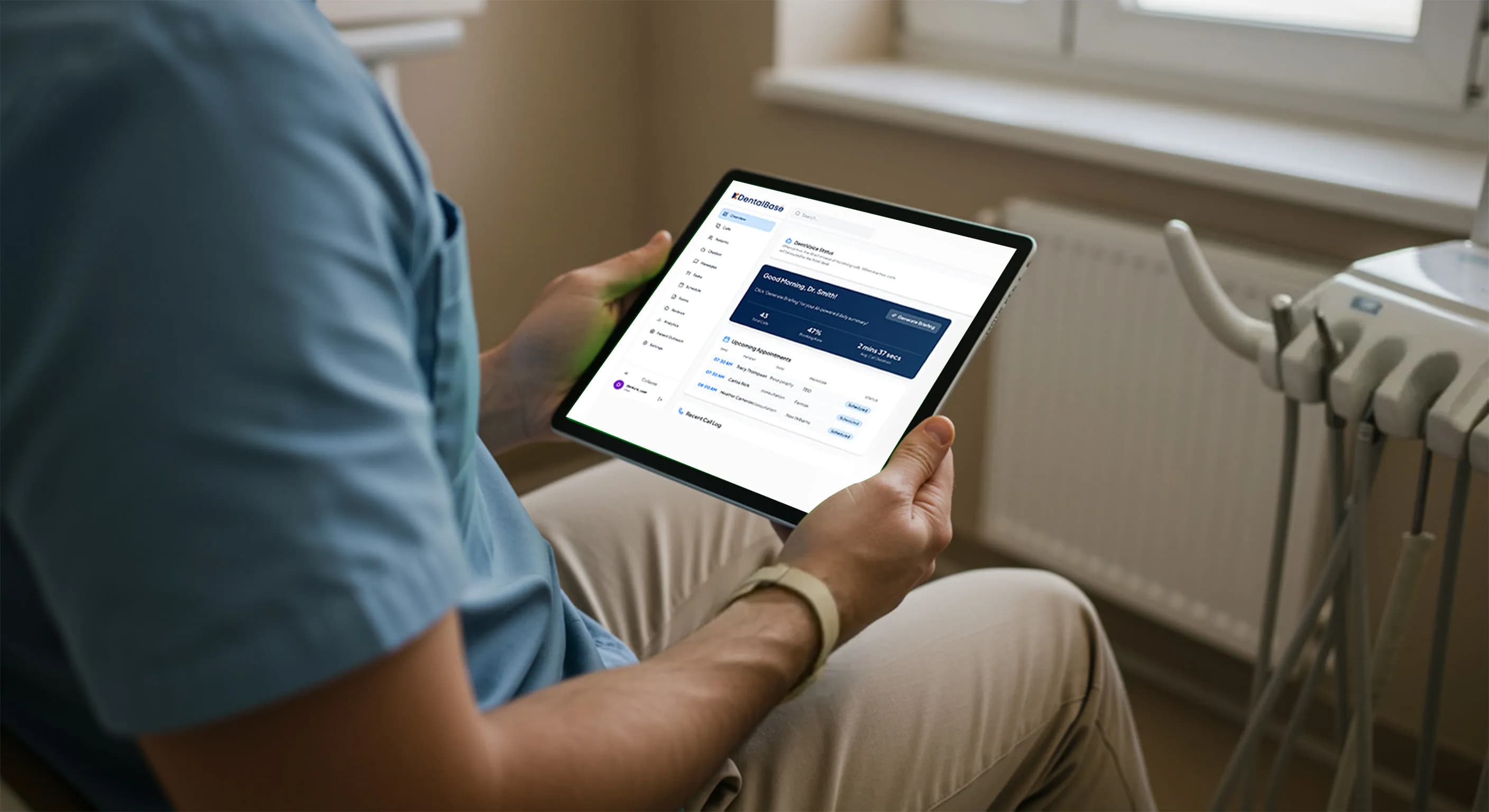
Standardizing Patient Calls for DSOs With 50+ Dental Offices

Voicify DSO locations scalability explained: how DSOs with 50+ dental offices standardize and enforce patient calls with one dental-trained AI system.
Share:
Table of contents
At a certain size, consistency becomes more valuable than speed. For Dental Support Organizations (DSOs) operating 50 or more locations, patient calls are no longer a front desk responsibility. They become a core operating system that directly influences revenue, patient experience, brand trust, acquisition integration, and long-term scalability. Understanding Voicify DSO locations scalability starts with that shift in how patient communication is governed.
At this level, standardizing patient calls stops being a training challenge and becomes a systems challenge. Human processes alone cannot reliably enforce consistency across dozens of offices, constant staffing changes, and ongoing growth.
This article explains why patient call standardization becomes unavoidable at scale, what effective standardization actually looks like, and why AI dental receptionists have emerged as the enforcement layer that makes it sustainable.
At enterprise scale, patient communication is no longer a people problem.
It is a systems problem.
Why Patient Call Standardization Becomes a Leadership Issue
In early growth stages, local autonomy works. Front desk teams move quickly, adapt to their communities, and solve problems in real time. That flexibility is often a competitive advantage.
As organizations grow past dozens of locations, the same flexibility begins to introduce risk. Leadership typically starts to see:
-
Large performance gaps between offices
-
Inconsistent patient experience under a single brand
-
Revenue volatility that cannot be explained by market differences
-
Increasing difficulty onboarding acquired practices
These issues are often misattributed to staffing or training. In reality, they are system failures. At enterprise scale, leadership needs predictability, and predictability only comes from standardization.
When outcomes vary across locations, the issue is rarely effort.
It is almost always the absence of a system that enforces consistency.
Patient Calls Sit at the Top of the Revenue System
Patient calls sit at the top of the dental revenue system because every appointment, recare visit, and treatment plan begins with a conversation. When that first interaction is inconsistent across offices, conversion and revenue become unpredictable at the group level.
Every dental revenue cycle begins with communication.
Inbound calls manage:
-
New patient inquiries
-
Emergency and pain calls
-
Recare scheduling and rescheduling
-
Insurance and financial questions
-
Treatment follow-ups
When call handling differs by office, revenue outcomes differ as well. Conversion rates fluctuate, opportunities are missed, and leadership loses visibility into what is actually driving performance. The compounding effect is easy to underestimate, which is why many operators run the true cost of missed dental calls across their full location count before committing to a fix.
High-performing DSOs treat patient calls as infrastructure, not labor. Infrastructure is designed once, governed centrally, and improved continuously. People operate within the system instead of recreating it at every location.
Every missed call is not just a missed conversation.
It is a missed opportunity to control the revenue system.
See what every location is costing you in missed calls
Before you standardize, quantify the gap. Understand which call types drive the most new-patient revenue across your offices.
See the top dental call types →The Hidden Cost of Letting Every Office Do It Differently
The hidden cost of office-by-office call handling is operational drag that never shows up as a single line item. It surfaces instead as uneven conversion, slower acquisition onboarding, and repeated mistakes that quietly compound across dozens of locations.
Localized call handling often feels empowering. At scale, it quietly creates drag.
When every office defines its own approach, organizations experience:
-
Training that never fully standardizes
-
Best practices that fail to spread beyond individual locations
-
Repeated mistakes with every new acquisition
-
No single source of truth for patient communication performance
These costs rarely appear as a clean line item. Instead, they surface as slower growth, inconsistent margins, and operational friction that compounds over time. Peak-hour spillover is one visible symptom, and handling dental call overflow without adding staff is often the first place leadership looks.
What Call Standardization Actually Means
Call standardization means defining how every call is answered, what intake questions are required, how urgency is judged, and when escalation happens. It standardizes logic and outcomes across locations while local teams keep their warmth and relationship-building.
Standardization does not mean rigid scripts or robotic conversations.
Mature DSOs standardize logic and outcomes, not personality. The system defines how calls are answered, what intake questions are required, how urgency is determined, and when escalation occurs. Local teams still bring warmth, empathy, and relationship-building into every conversation.
The goal is not to remove local context.
The goal is to remove randomness.
A Governance Model That Scales Across 50+ Offices
A governance model that scales separates decisions made once and enforced everywhere from decisions that stay local. Central leadership owns call logic and escalation, while offices keep provider schedules and community nuance, giving consistency without rigidity.
High-performing DSOs govern patient calls the same way they govern finance or compliance. Some decisions must be made once and enforced everywhere, while others should remain local.
Typically:
-
Central leadership governs call logic, intake requirements, escalation rules, and minimum coverage standards
-
Local offices retain control over provider schedules, office-specific details, and community nuances
This balance ensures consistency where it matters most while preserving flexibility where it actually adds value. Hours and holiday calendars are a good example of what stays local, which is why groups that span states need local-time call routing for multi-state DSOs.
Why Humans Alone Cannot Enforce Call Standards at Scale
This is where many organizations get stuck.
Even with scripts, training programs, and quality assurance, consistency erodes over time. Staff turnover resets behavior. New acquisitions introduce different habits. Busy offices take shortcuts. Tribal knowledge slowly replaces documented standards.
Humans excel at empathy and judgment. They are not built for perfect, repeatable enforcement across dozens of locations.
At enterprise scale, relying solely on people to enforce call standards guarantees drift. This is not a failure of effort. It is a limitation of the approach.
AI Dental Receptionists as the Enforcement Layer
AI dental receptionists act as the enforcement layer for patient communication at scale. Rather than hoping training holds, the system applies the same call logic and escalation rules to every interaction, so standards survive turnover, busy periods, and new acquisitions.
This is where AI dental receptionists fundamentally change the equation.
An AI dental receptionist is not just a productivity tool or an after-hours answering service. At scale, it becomes the enforcement layer for your patient communication system. It also closes the gaps that quietly erode trust, such as why dental voicemail loses patients when offices fall back on it during busy windows.
A dental-trained AI receptionist can:
-
Answer calls and messages 24/7
-
Follow standardized call logic without deviation
-
Apply triage and escalation rules consistently
-
Schedule appointments accurately
-
Escalate clinical or complex cases to human staff
-
Generate centralized reporting automatically
AI does not replace people.
It ensures the system is followed, regardless of staffing changes or growth.
One call standard. Every location. Every shift.
DentiVoice enforces the same dental-trained call logic across all your offices, with central reporting built in.
Read the dental phone coverage guide →How DSOs Compare Call Handling Approaches
As DSOs scale, they typically evaluate several options.
-
Local front desk teams provide strong relationships but struggle with consistency at scale
-
Centralized human call centers improve coverage but introduce cost and quality variability
-
General-purpose AI receptionists are fast to deploy but lack dental-specific nuance and safety guardrails
-
Hybrid models combining dental-specific AI with human oversight deliver both consistency and empathy
At enterprise scale, hybrid models anchored by dental-specific AI are becoming the standard. For a side-by-side breakdown of the trade-offs, see dental phone coverage models compared.
| Call Handling Approach | Consistency at 50+ Locations | 24/7 Coverage | Central Visibility | Best Fit |
|---|---|---|---|---|
| Local front desk teams | Low, drifts with turnover | No | Fragmented per office | Strong local relationships |
| Centralized human call center | Moderate, varies by agent | Partial, at higher cost | Centralized | Coverage with added overhead |
| General-purpose AI receptionist | High on logic, weak on nuance | Yes | Centralized | Fast deployment, generic intake |
| Dental-specific AI + human oversight | High, enforced every call | Yes | Enterprise-wide | Standardization at DSO scale |
At 50+ locations, patient communication is no longer a workflow to optimize.
It is infrastructure that must work every day, everywhere.
Why Dental-Specific AI Matters
Dental-specific AI matters because patient calls carry clinical urgency, insurance complexity, and regulatory weight that generic assistants are not trained to handle. A dental-trained system applies the right triage and escalation rules every time, which protects both patient safety and conversion.
Dental communication is not generic customer support. It involves clinical urgency, insurance complexity, treatment acceptance, and regulatory considerations.
General AI receptionists are built for many industries. Dental-specific AI platforms are trained on dental workflows, language, and escalation rules. That specialization directly impacts patient safety, conversion rates, and scalability, especially in how AI triages urgent versus routine calls the same way at every location.
Standardization as an Acquisition Advantage
Standardization becomes an acquisition advantage because a governed, enforced call system lets new locations reach the brand standard almost immediately. Onboarding is faster, staff transitions are smoother, and leadership gains visibility into performance from the first week.
For DSOs growing through acquisition, standardized patient communication becomes a competitive advantage.
When calls are governed and enforced consistently:
-
New locations onboard faster
-
Staff transitions are less disruptive
-
Performance stabilizes more quickly
-
Leadership gains immediate visibility
Without standardization, every acquisition reintroduces variability and increases operational risk.
Measuring What Matters at Enterprise Scale
Measuring what matters at enterprise scale becomes possible only after calls are standardized and captured consistently. With one data layer across regions, leadership can compare answer rates, conversion, and response times on equal footing instead of trusting anecdotes.
Once patient calls are standardized and enforced, leadership can focus on the metrics that actually matter, including:
-
Call answer rates
-
Missed call response times
-
New patient conversion rates
-
First-call resolution
-
Performance variance across regions
This shifts decision-making from anecdotes to data. Standardized capture is what makes dental call analytics that actually drive revenue possible across regions instead of one office at a time.
Standardization Is a Foundation, Not an Optimization
At enterprise scale, patient communication is no longer a workflow to fine-tune. It is a foundation.
The most effective DSOs treat call handling the same way they treat clinical protocols or financial systems. It must work reliably everywhere, every day.
That level of reliability requires systems designed for enforcement, not just guidance.
Voicify DSO Locations Scalability: How Enforcement Scales
Voicify supports DSO locations and scalability by enforcing one dental-trained call standard across every office while still scaling with acquisitions and seasonal volume. The same logic, intake, and escalation rules run at location one and location two hundred, so growth never resets call quality.
When DSOs evaluate Voicify DSO locations or scalability, the practical question is whether the system holds up as the org chart changes. Three properties tend to matter most at enterprise scale:
- Uniform enforcement. Voicify applies identical call logic to every location, so a newly acquired practice answers the phone the same way as a flagship office on day one.
- Elastic capacity. Because coverage is not tied to a single front desk, call volume can spike across regions without adding headcount or creating hold-time backlogs.
- Central visibility. Every interaction is captured in one reporting layer, giving leadership a single source of truth instead of stitching together dashboards from dozens of offices.
This is the difference between a tool that answers calls and a system built for Voicify DSO locations and scalability. The first helps one office. On the question of Voicify DSO locations scalability, the second lets a 50-, 100-, or 200-location group grow without patient communication becoming the bottleneck.
Is Your Patient Call System Ready to Scale?
Check each item your organization can confirm across every location.
Your score: count your checks out of 5. Four or fewer means enforcement still depends on people, not a system.
Where Dentivoice Fits
Dentivoice is built around this exact operating model.
It helps DSOs standardize patient calls across all locations, enforce governance through dental-specific AI, preserve local flexibility where it matters, and gain enterprise-level visibility without adding operational burden.
Dentivoice is designed for organizations that have outgrown manual enforcement and need patient communication to scale as reliably as the rest of their infrastructure.
For the fundamentals behind this model, see what a dental support organization is and how DSOs scale growth. Groups just starting to standardize call handling in a new region can also see this guide to AI receptionist adoption for DSOs operating in Georgia.
Make patient calls scale as reliably as the rest of your DSO
See how DentiVoice standardizes and enforces patient communication across 50+ locations without adding operational burden.
Read the patient communication software guide →Not sure where your org sits today?
Start with the AI receptionist sizing guide →Frequently Asked Questions
Patient call standardization means creating one consistent system for how patient calls are answered, routed, and resolved across all locations in a DSO. Instead of each office handling calls differently, leadership defines the call logic, intake questions, escalation rules, and coverage standards so patient experience and revenue outcomes are predictable at scale.
As DSOs expand past 20-50 locations, human-driven processes break down. Staff turnover, acquisitions, and varying local practices cause call handling to drift. Training alone cannot enforce consistency across dozens of offices, leading to missed calls, uneven conversion rates, and limited visibility for leadership.
An AI dental receptionist enforces standardized call logic automatically and consistently. Unlike call centers, which rely on human agents and scripts that can drift over time, AI follows the same rules for every call, provides 24/7 coverage, and generates centralized analytics without increasing headcount.
Yes. Dental-specific AI receptionists are trained on dental workflows, terminology, and patient scenarios. They can handle new patient inquiries, scheduling, insurance questions, and triage for urgent cases, while escalating complex or clinical situations to human staff when needed.
No. AI dental receptionists do not replace front desk teams. They handle repetitive, high-volume, and after-hours calls so staff can focus on in-office patient care, complex conversations, and relationship building. AI acts as an enforcement layer, not a replacement.
Sources & References
- 1
- 2
- 3
- 4
Was this article helpful?
Written by
DentalBase Team
Expert dental industry content from the DentalBase team. We provide insights on practice management, marketing, compliance, and growth strategies for dental professionals.