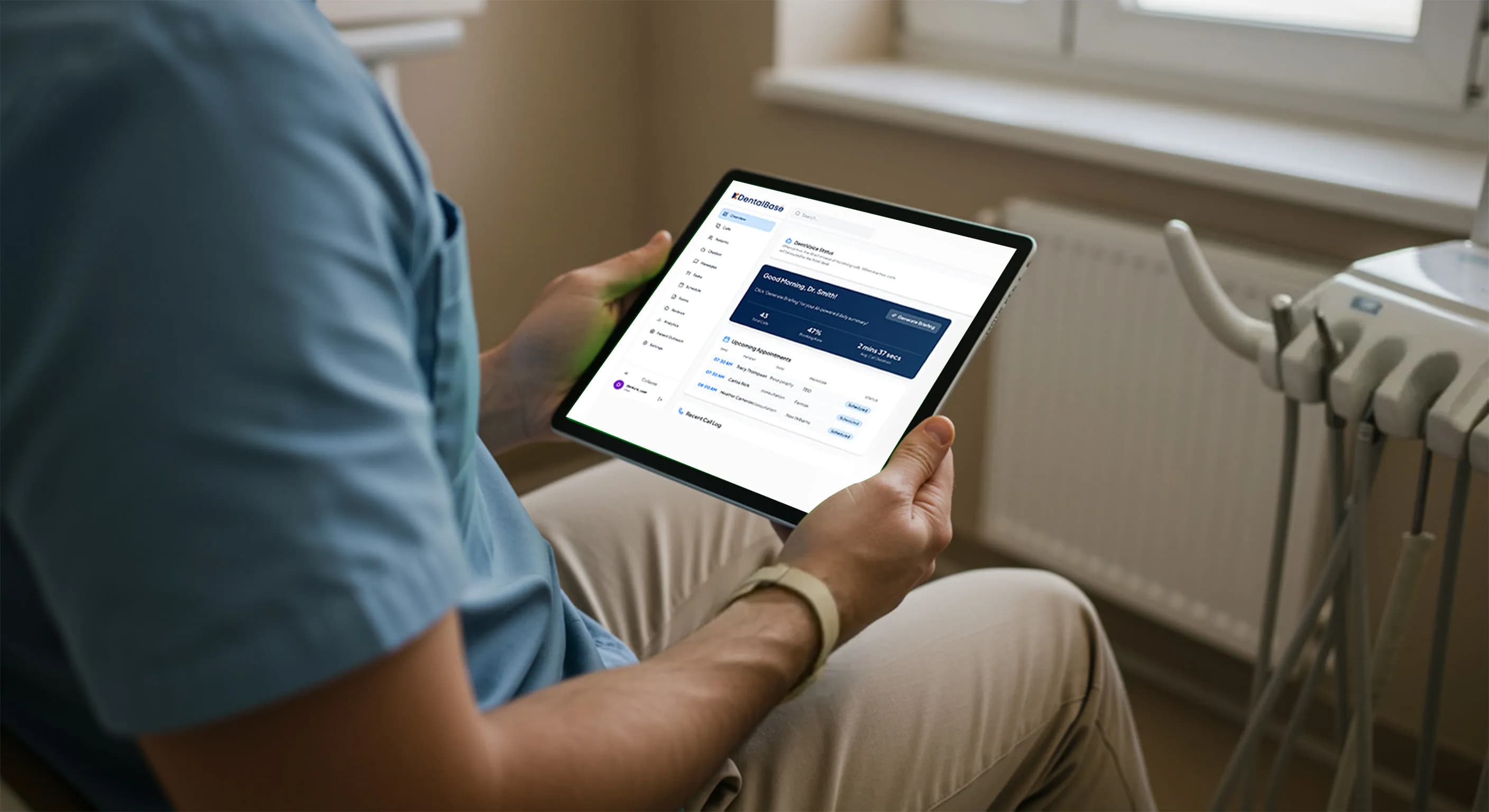
How Dentrix Works With an AI Dental Receptionist in 2026

See how an AI dental receptionist works with Dentrix to answer calls, support scheduling, and keep your front desk aligned, without replacing your PMS.
Share:
Table of contents
Dental practices across the United States are increasingly turning to AI dental receptionist software to handle high call volumes, reduce missed calls, and ease ongoing front-desk staffing challenges. For practices already using Dentrix, one of the most important considerations is how these AI tools integrate with existing scheduling and patient communication workflows.
This is where voice AI platforms like Dentivoice come into focus. Rather than replacing practice management systems, Dentivoice works alongside Dentrix to help automate call handling, appointment-related conversations, and routine patient inquiries, without disrupting established workflows.
This article explains how Dentrix integrations support voice AI software, what functions are commonly involved, and what dental practices should understand before adopting tools like Dentivoice. The emphasis is on real-world workflows and practical use cases, not technical jargon or marketing claims.
How Do Dentrix Integrations Work With Outside Tools?
Dentrix integrations work through permission-based access. An approved outside tool is granted a defined, limited view of scheduling and workflow data. It reads what it needs to hold a useful conversation. Dentrix keeps ownership of the records, the appointment book, and the clinical chart.
Dentrix allows approved third-party tools, including voice AI software, to securely access scheduling and patient workflow information. These connections let the software assist with front-desk tasks without replacing Dentrix as the primary practice management system.
For dental practices, this means scheduling activity, patient identification, and call documentation can stay aligned with existing Dentrix rules and data.
The word "permission" is doing real work in that sentence. Access is scoped. A vendor does not get a master key to your database because you signed up for phone coverage.
Dentrix is a Henry Schein One product and has been a fixture in American dental offices for decades. That longevity is exactly why practices resist replacing it. Years of patient history, provider preferences, and appointment conventions live inside it. A phone tool that demands migration is asking for the wrong trade. It also fits the longer story of how dental front desks moved from paper books to software and now AI.
So the integration question is narrow and practical. Which fields can the tool read? Which can it write? What happens when the connection drops mid-call? Ask those three before anything else.
Why Does Dentrix Compatibility Matter for an AI Dental Receptionist?
Dentrix compatibility matters because the voice assistant should reflect the same scheduling rules, providers, and office hours your front desk already relies on every day. When the two systems stay aligned, callers hear consistent answers, your team avoids duplicate data entry, and nothing has to change about how Dentrix is used.
For many practices, Dentrix is the daily backbone of the front office. Switching practice management systems just to adopt a new phone tool is rarely practical, so compatibility is usually the deciding factor. A platform that works alongside Dentrix lets a practice add call-handling support without retraining staff on new core software or migrating years of patient records. Dentrix support should sit near the top of your list when comparing dental AI receptionist software options.
Compatibility is one line on a longer evaluation list, and the wider criteria for comparing dental AI voice platforms, including PMS integrations shows how platforms are measured against it.
Compatibility also protects continuity. Because Dentrix remains the source of truth, the information a patient hears on a call, the times offered, the providers available, and the appointment types supported, mirrors what staff would say in person. That consistency is far easier to maintain than it is to rebuild inside a separate, disconnected system. Practices comparing options often review in-house, answering service, and AI phone coverage models side by side before deciding how the tool should fit around Dentrix.
Practices running Denticon instead face the same compatibility question, and this AI dental receptionist Denticon integration guide walks through how that sync works when Denticon, not Dentrix, is the system of record.
What Is an AI Dental Receptionist for Dental Offices?
An AI dental receptionist is voice software that answers practice calls and handles routine front-desk tasks. It picks up during clinic hours and after closing, works through scheduling questions, and passes anything needing judgment to your team. Dental vocabulary is built in.
An AI dental receptionist is a voice-based system designed specifically for dental practices to answer incoming calls and assist with routine front-desk tasks.
Dental offices commonly use these systems to:
-
Answer patient calls during and after office hours
-
Handle new patient inquiries
-
Assist with appointment requests
-
Respond to common questions about hours, location, and insurance
-
Capture call details for staff follow-up
Unlike general answering services, these platforms are trained on dental terminology and common patient scenarios, making them better suited for front-office communication.
That training difference matters more than it sounds. A general answering service hears "I chipped a veneer" and writes a message. Dental-specific software recognizes it as a restorative issue, checks the right appointment length, and knows it usually is not a same-day emergency. The voice delivering that recognition matters too, and this guide to judging AI receptionist voice customization options covers how to evaluate that side of the platform.
Vocabulary is only half of it. The other half is context about how dental offices actually run: hygiene columns, recall intervals, provider blocks, and the difference between a new patient exam and a limited exam. Generic tools miss all of it.
How Does an AI Receptionist Work With Dentrix?
Dentrix supports secure, permission-based access for approved third-party platforms. The software uses this access to reference scheduling information and office rules while Dentrix continues to manage patient records and appointments.
Rather than independently managing schedules, the voice assistant uses Dentrix data to guide conversations and capture accurate information for staff review.
If you want the vendor-neutral version of that workflow first, here is how call handling AI works from the first ring through the booking write-back → It covers the same stages before any specific practice management system enters the picture.
Think of it as two systems with clear jobs. The voice layer talks. Dentrix decides what is true.
During a call, the assistant queries availability against your live schedule instead of a cached copy. That distinction prevents the most common failure in phone automation, which is offering a slot that filled twenty minutes ago. When the caller agrees to a time, the details flow back for booking or for staff review, depending on how much authority you granted during setup.
Nothing about the Dentrix interface changes for your team. Staff open the same schedule they opened yesterday.
What Does Setup With Dentrix Involve?
Setup involves four things: confirming Dentrix access permissions, loading your office rules, defining which appointment types are in scope, and testing call flows before launch. Most practices finish initial configuration in a few weeks, depending on how many providers and appointment types are involved. That third step goes faster when you already define your appointment types and their time patterns as a written table rather than working them out during configuration.
Dental practices often ask what is involved when setting up a voice assistant with Dentrix. While the exact process varies, most implementations follow a structured onboarding approach. For the fuller picture beyond Dentrix specifics, this full walkthrough of implementing an AI receptionist in your practice covers the whole rollout from kickoff to go-live.
Typical setup steps include:
-
Verifying Dentrix access permissions
-
Configuring office hours, providers, and scheduling rules
-
Defining which appointment types the system can assist with
-
Testing call flows and scheduling behavior before launch
These platforms are typically configured to operate within defined boundaries rather than having unrestricted system access. This helps practices maintain control while still benefiting from automation.
Before that configuration step, many practices first put together a written scheduling rulebook covering appointment lengths and column assignments, so what gets typed into the setup screen already matches how the front desk actually books.Implementation timelines vary, but many practices complete initial setup within a few weeks, depending on complexity.
The step practices tend to rush is scope definition. It deserves the most attention.
Deciding what the system may not do is as important as deciding what it may. A practice that starts with scheduling questions and after-hours coverage, then adds booking authority once the logs look clean, ends up in a better place than one that switches everything on during week one. Confidence is earned through review, not through configuration.
What Does Setup Look Like Step by Step?
Setup typically moves through four stages: confirming Dentrix access, configuring office rules, testing call flows, and launching with a limited scope. Each stage keeps the practice firmly in control of what the system can and cannot do, so automation never gets ahead of the team's comfort level.
The sequence is deliberately incremental. Most practices begin with a narrow set of call types, such as answering common questions and capturing appointment requests for staff review, then widen the scope once they trust the results. This mirrors the gradual rollout described in our guide to answering dental calls after hours without hiring, where coverage starts small and expands with confidence.
How Does the Voice Assistant Use Dentrix for Scheduling?
The assistant reads Dentrix availability in real time, then offers only slots that genuinely exist. It follows your provider schedules, office hours, and appointment length rules. New and existing callers are identified separately, because the two need different questions and different visit lengths.
When connected to Dentrix, the voice assistant can support scheduling-related conversations by referencing real-time availability and predefined office rules.
Common capabilities include:
-
Checking appointment availability before offering time slots
-
Following provider schedules and office hours
-
Matching callers to appropriate appointment lengths
-
Identifying new versus existing patients
This approach helps keep scheduling activity consistent with how front-desk staff already use Dentrix.
Appointment length is where generic tools break down. A new patient exam, a crown seat, and a limited emergency visit occupy very different amounts of chair time. If the software offers a 30 minute slot for a 90 minute procedure, your day is now broken and someone has to call the patient back.
- The caller states what they need, in ordinary language.
- The system maps that to one of your configured appointment types.
- It pulls live openings for the providers qualified to do that work.
- It offers real times, then confirms the one the caller picks.
Every step in that chain depends on Dentrix holding accurate rules. Bad configuration produces bad bookings. The software is only as disciplined as the setup behind it.
If you are planning the broader rollout and not just the Dentrix connection, this practical roadmap for dental scheduling automation lays out the benefits, a software checklist, and the implementation steps.
How Does Scheduling Stay Aligned With Dentrix?
Alignment holds because the assistant never builds its own schedule. It follows Dentrix-defined availability and the same rules your front desk uses. When a slot fills, the next caller does not hear it offered. One source of truth, one answer.
Rather than creating schedules independently, the platform follows Dentrix-defined availability and scheduling rules. When configured correctly, the system references the same logic used by front-desk staff.
This alignment helps ensure that:
-
Offered appointment times reflect current availability
-
Scheduling follows provider and office constraints
-
Appointment types match expected visit lengths
The goal is consistent scheduling behavior across patient interactions, whether calls are handled by staff or by the software.
Collisions are the real test. Two callers can want the same Tuesday slot within seconds of each other, and a staff member might grab it in between. A well-built connection checks availability at the moment of confirmation, not at the start of the conversation.
Ask any vendor how they resolve that exact race. The vague answers are informative.
Which Front-Desk Workflows Does It Support?
Beyond scheduling, the assistant identifies new versus existing callers, answers office-rule questions, captures appointment requests when full booking is switched off, and logs call details for follow-up. Most practices begin with a narrow scope and widen it as staff get comfortable.
Beyond scheduling assistance, these systems support several everyday front-desk workflows when used with Dentrix.
Common use cases include:
-
Identifying new versus existing patients during calls
-
Answering scheduling-related questions using office rules
-
Capturing appointment requests for staff review when full booking is not enabled
-
Logging call details so staff can follow up as needed
Many practices start with limited functionality and expand usage over time as staff become comfortable with AI-assisted workflows.
Call documentation is the quietly valuable part. Every conversation produces a record: who called, what they wanted, what was promised. No more guessing at a sticky note during the morning huddle.
That record also settles disputes. When a patient insists they were told something different, you have the actual call rather than two conflicting memories. Front-desk teams tend to appreciate this faster than owners expect.
How Does Dentrix Voice Compare With Front-Office AI?
They solve different problems. Dentrix voice tools focus on clinical documentation at the chair, such as charting and perio entry. Front-office AI focuses on the inbound phone line. Neither replaces the other, and comparing them directly misreads what each is built to do.
Dentrix includes voice-enabled tools that are primarily focused on clinical documentation, while front-office voice AI is designed for inbound patient communication.
| Feature | Dentrix | AI Dental Receptionist |
|---|---|---|
| Primary focus | Clinical documentation | Front-desk call handling |
| Clinical charting | Yes | No |
| Perio exams | Yes | No |
| Answering patient phone calls | No | Yes |
| Appointment assistance | Limited | Yes |
| After-hours call coverage | No | Yes |
| Front-desk workload support | Partial | Primary focus |
These tools support different parts of the dental workflow. Dentrix AI and Voice improves chairside efficiency, while front-office voice AI supports inbound calls and appointment-related conversations.
Practices sometimes assume that buying one covers the other. It does not. A hygienist dictating perio depths and a stranger calling about a cracked molar at 7pm are unrelated problems that happen to both involve speech.
What Types of Calls Can an AI Dental Receptionist Handle Alongside Dentrix?
Working alongside Dentrix, it can handle routine inbound calls, new patient inquiries, appointment requests, and common questions about hours, location, and insurance. More complex or clinical conversations are routed to staff for follow-up, so patients always reach a person when judgment is needed.
Paperwork is the other half of a new patient's first contact, so it is worth reading how AI intake forms collect medical history and insurance details before a visit and what to ask a vendor about syncing that data into your PMS.
Call types vary by practice, but several patterns are common across dental offices. Understanding them helps a practice decide where automation adds the most value and where a human touch is still essential. Teams that map their most common dental call types first tend to configure their phone coverage far more effectively.
Dentrix handles the scheduling side of that equation, but the phone system still has to get the call there in the first place. How dental offices handle calls with VoIP phone systems and practice management software breaks down that connection in more detail.
- New patient questions about the practice
- Appointment requests and scheduling questions
- Hours, location, and parking inquiries
- After-hours calls that would otherwise reach voicemail
- Clinical or treatment-specific questions
- Billing disputes needing account review
- Urgent or emergency situations
- Sensitive conversations that benefit from a person
Routing matters because not every call should be automated. A well-configured system handles predictable volume, such as triaging urgent versus routine calls, and hands off anything that needs clinical judgment. This keeps the patient experience consistent while front-desk staff stay focused on in-office care. For offices weighing whether voicemail is quietly costing them patients, our look at why dental voicemail loses patients explains the trade-off in detail.
Why Do Dental Practices Add AI Call Coverage?
Practices add call coverage for four reasons: calls missed during busy clinic hours, after-hours requests going unanswered, front-desk burnout, and inconsistent call quality. Staffing pressure sits underneath all four, which is why hiring alone rarely fixes the phone.
Front-desk burnout in particular tends to compound once it starts. Our dental front office burnout prevention guide covers the warning signs and operational fixes practices use to get ahead of it.
Dental practices consider AI dental receptionist software to address common operational challenges such as:
-
Missed calls during busy clinic hours
-
After-hours appointment requests are going unanswered
-
Front-desk burnout and turnover
-
Inconsistent call handling
Commonly Reported Benefits
-
Improved call answer rates
-
Faster responses to new patient inquiries
-
Reduced administrative workload for staff
-
Better use of front-desk time
Actual results vary based on practice size, call volume, and configuration.
Staffing is the honest driver. The American Dental Association Health Policy Institute tracks recruitment difficulty across dental practices, and administrative roles are among the hardest to fill and keep. A front desk running short does not stop answering phones gradually. It stops abruptly, on the worst day.
Coverage is also about consistency, not just volume. The greeting a caller hears at 8am on a calm Monday should match the one they hear at 4:45pm on a chaotic Friday. People are not built for that. Software is.
Which Metrics Show the System Is Working?
Track missed call reduction, after-hours requests captured, front-desk workload, and response time to new patient inquiries. Measure all four for a few weeks before launch. Without that baseline you cannot separate real improvement from a naturally busy month. Once you have that baseline, this guide to measuring AI receptionist success in dental offices covers the KPIs worth tracking after go-live.
The impact of pairing a voice assistant with Dentrix depends on how the system is configured and how the practice manages incoming calls.
Practices commonly track:
-
Missed call reduction
-
Appointment requests captured after hours
-
Changes in front-desk workload
-
Response times to new patient inquiries
Tracking these indicators over time helps practices evaluate whether the AI receptionist supports daily operations.
The broader vendor-selection framework, not just the Dentrix-specific pieces, is covered in this guide to picking the right AI receptionist for a dental office.
Compare identical windows. Four weeks before, four weeks after, same hours, same definitions. Shorter comparisons mostly measure seasonality.
Watch the handoff rate too. A system that transfers a healthy share of calls to staff is behaving correctly, not failing. The number you actually care about is how many callers reached a resolution, by any route.
What Security and HIPAA Rules Apply?
Any vendor that hears or stores patient information is a business associate under HIPAA. That means a signed agreement, encryption, access controls, and audit logging before the first live call. Compliance is settled during vendor selection, not after go-live.
For U.S. dental practices, voice AI software must support HIPAA-aligned workflows.
Platforms designed to work with Dentrix typically support:
-
Encrypted data transmission
-
Permission-based access controls
-
Logged interactions for internal review
-
Responsible handling of patient information
Practices should confirm security and compliance details directly with vendors before implementation. A closer look at evaluating an AI receptionist for dental HIPAA compliance covers the specific questions to ask before signing a vendor contract.
The specifics are worth knowing. The HIPAA Security Rule, published by the 45 CFR Part 164, Subpart C, requires 3 categories of safeguards under 45 CFR Part 164: administrative, physical, and technical. The Breach Notification Rule allows up to 60 days to notify affected individuals once a breach is discovered.
Get the Business Associate Agreement signed before the pilot, not after it.
Call recording adds a second layer. Around 11 states, including California, Florida, Illinois, and Massachusetts, require all parties to consent before a call is recorded, which shapes the disclosure your system reads at the start of a call. Your Dentrix setup does not change that obligation. See the state-by-state call recording rules for dental practices →
How Do Practices Decide If an AI Dental Receptionist Fits Their Dentrix Setup?
Practices usually decide by reviewing call volume, after-hours demand, and front-desk workload, then confirming how the tool aligns with Dentrix. The strongest fit is a practice that loses calls during busy clinic hours or after closing while staff are already stretched thin between phones and chairside duties.
Practice size shapes the decision. A solo office and a multi-provider group have very different needs, which is why our sizing guide for solo dental practices walks through how scope should scale with the team. Specialty practices may also have unique call patterns, as covered in guides for orthodontic practices and pediatric dental practices.
Before committing, many teams quantify the problem they are trying to solve. Reviewing the true cost of missed dental calls gives a baseline, and tracking the call metrics that drive revenue after launch shows whether the tool is supporting daily operations as intended. If your front desk already shows signs of being overwhelmed, that is often the clearest signal that added call coverage is worth evaluating.
- Are calls going unanswered during clinic hours or after closing?
- Is the front desk stretched between phones and in-office patients?
- Does Dentrix already hold your scheduling rules and provider data?
- Do you want to keep Dentrix as the system of record?
Dentrix integration is one piece of the decision. If you are also weighing a single focused agent against a bundled multi-agent platform, the DentiVoice vs Savvy Agents comparison breaks down cost, marketing attribution, and staff escalation across both models.
Related Reading
- how Open Dental's open API supports AI receptionist integration, real-time reads, write-backs, and patient matching.
- a complete overview of what an AI dental receptionist does, what it handles and how to evaluate it.
- how a refill request gets logged back into Dentrix, the message capture step that happens before a dentist ever sees the call.
Curious what that booking step actually looks like once a call comes in? See how real-time booking syncs with your practice management software.
Where Does DentiVoice Fit With Dentrix?
DentiVoice is built specifically for dental front-desk workflows and is commonly configured to align with Dentrix-based scheduling and communication processes. Calls are answered, scheduling questions are handled, and anything needing judgment goes to your team.
By handling routine calls and appointment-related conversations, DentiVoice helps dental teams stay focused on in-office patient care while maintaining continuity with existing Dentrix workflows.
Practices already committed to Dentrix are the clearest fit. Nothing migrates, staff keep the software they know, and the phone line gets coverage it did not have before. The schedule stays where it has always been.
Keeping Dentrix workflows intact matters more as call volume grows. See how growing dental practices scale the front desk without overloading staff.
Before deciding between DentiVoice and staffing a call center, review the cost and coverage differences between an AI receptionist and a traditional answering service.
Frequently Asked Questions
No. Dentivoice is designed to work with Dentrix as well as other dental practice management systems. Dentrix is one example, but the platform is not limited to a single PMS.
No. An AI dental receptionist is typically used to support staff by handling routine calls, after-hours inquiries, and appointment requests. Your team remains responsible for patient care, in-office coordination, and final scheduling decisions when needed.
The practice does. Dentivoice is configured based on your office hours, provider schedules, appointment types, and call-handling preferences. You decide which tasks are automated and which are routed to staff for follow-up.
No. Dentrix continues to be used the same way your team uses it today. The AI receptionist works alongside Dentrix, referencing availability and rules while Dentrix remains the system of record.
AI dental receptionist platforms designed for U.S. dental practices typically support HIPAA-aligned workflows, including permission-based access, encrypted data handling, and call logging. Practices should confirm specific security details with vendors before implementation.
Sources & References
- 1
- 2
- 3
- 4
- 5
- 6
- 7
Topics
Was this article helpful?
Written by
DentalBase Team
Expert dental industry content from the DentalBase team. We provide insights on practice management, marketing, compliance, and growth strategies for dental professionals.