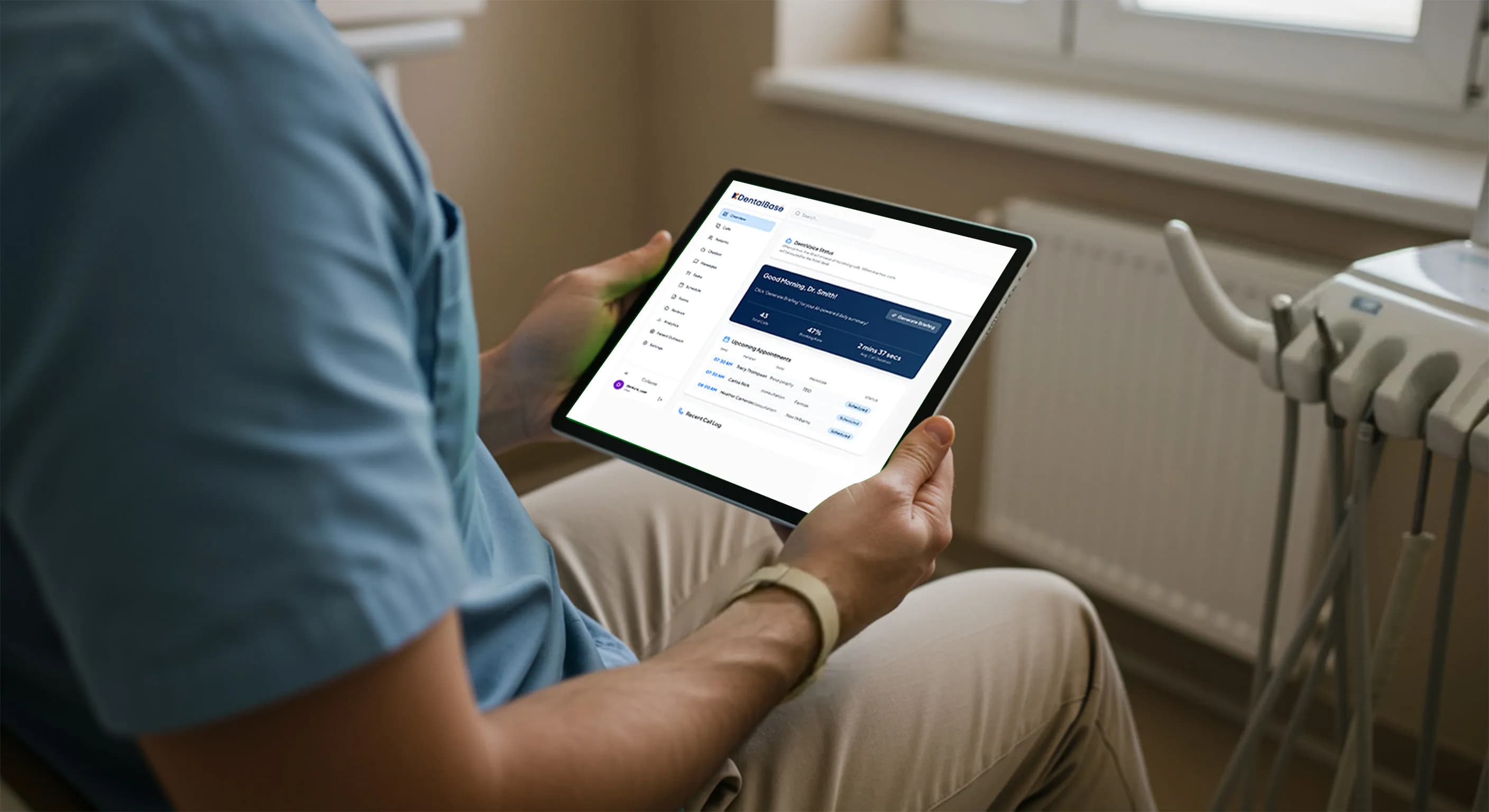
DentiVoice vs Savvy Agents: One Agent or an AI Workforce?

DentiVoice vs Savvy Agents compared on cost, marketing attribution, and staff escalation, so you can pick the right AI dental receptionist.
Share:
Table of contents
DentiVoice vs Savvy Agents is really a question about scope: one tuned voice agent built around scheduling and attribution, or a bundled four-agent AI workforce that also handles scribing, retention, and insurance calls. Practices researching AI dental receptionists keep running into this exact fork. A three-provider practice fielding 200 calls a week doesn't need the same stack as a six-location DSO managing insurance verification across every chair.
Savvy Agents markets its platform as an "AI workforce," pairing a reception agent with a scribe, a retention agent, and an insurance-verification agent under one contract. DentiVoice takes the opposite bet: one agent, tuned specifically for call answering, booking, and marketing attribution, without the added modules. This article breaks down what each model actually includes, what it costs to run, and which one fits your practice's call volume and staffing reality.
Access to care starts with a call that actually gets answered. The CDC's Oral Health program frames consistent care access as the front door to every other outcome. For a dental practice, that front door is the phone line both platforms compete to cover.
DentiVoice vs Savvy Agents: What Is the Core Difference?
DentiVoice runs a single voice agent focused on call answering, scheduling, and attribution reporting, while Savvy Agents sells four bundled agents covering reception, clinical scribing, patient retention, and insurance verification. That's the split practices need to evaluate first.
Depth vs. Breadth: What This Means for Your Front Desk
Think of it as a scalpel versus a toolkit. DentiVoice's single-agent design means every update, every training pass, and every integration effort goes toward one job: getting the phone answered correctly and tracking where the caller came from. Savvy Agents spreads its engineering across four distinct functions, which sounds efficient on paper but means each agent gets a smaller share of ongoing refinement. A front desk manager comparing the two isn't just picking a vendor. She's picking between depth and breadth.
How to Map Your Practice's Actual Pain Point First
Before scheduling a demo with either vendor, map your actual pain point. If missed calls and no-show follow-up are the problem, a focused agent solves it directly. If your practice already has staff handling retention and insurance but is drowning in call volume, the calculus changes. Whichever way you lean, what to test when a vendor promises a customizable AI voice gives you questions to ask before signing anything.
Not sure how much missed calls are costing you?
Run the numbers on your own call volume before you compare vendors, so the decision is based on your practice, not a vendor's case study.
Calculate your missed-call cost →What Does Savvy Agents' Multi-Agent AI Workforce Actually Include?
Savvy Agents bundles four separate AI agents under one subscription: a reception agent for call answering, a clinical scribe, a retention agent for reactivation outreach, and an insurance-verification agent. Each agent is marketed as replacing a specific staff task.

The Appeal (and Risk) of a Single-Vendor Bundle
The pitch is appealing on the surface. Instead of buying four point solutions, a practice gets one vendor relationship and, in theory, one integration to manage. But bundling four agents also means four separate workflows to configure, four sets of outputs to review, and four places something can go wrong during a busy week. Practices evaluating this model should ask how mature each individual agent is, not just the bundle as a whole. A scribe agent that's been refined for two years and an insurance-verification agent launched six months ago are not the same level of reliability, even under one brand name.
Why Agent-by-Agent Maturity Matters More Than the Bundle
Ask for agent-by-agent uptime and accuracy data, not a blended average across the whole workforce. That's the only way to know what you're actually buying. If your real gap is patient reactivation rather than call answering, it's worth comparing Savvy Agents' bundled retention agent against a dedicated outbound reactivation campaign built specifically for that job.
How Does DentiVoice's Single-Agent Model Work Instead?
DentiVoice runs one voice agent that answers calls, books and reschedules appointments, and logs which ad, page, or campaign generated each call. It does not bundle scribing or insurance verification into the same agent.
Why a Narrower Scope Can Mean a Sharper Agent
That narrower scope is the point. A single agent trained exclusively on front-desk call handling can be tuned against a much smaller set of failure modes: mispronounced names, insurance questions it should escalate, and scheduling conflicts across multiple providers. Practices that have tried broader "do everything" bots often report the opposite problem, an agent competent at five things but excellent at none. DentiVoice's bet is that call answering and attribution are the highest-leverage tasks to get right first, and that scribing or retention can stay with existing staff or dedicated tools.
What DentiVoice's Single-Agent Design Actually Covers
- One agent, one integration, one training cycle to monitor
- Built-in attribution tracing for every booked call
- Designed to hand off cleanly to staff, not replace the front desk entirely
Does a Multi-Agent Workforce Cost More Than One Focused Voice Agent?
Neither DentiVoice nor Savvy Agents publishes pricing publicly, so a direct dollar comparison isn't possible from marketing materials alone. Ask both vendors for a cost-per-booked-appointment estimate during your demo, not just a monthly subscription figure.
The Real Math Behind Bundled vs. Focused Pricing
Here's the practical math worth doing. A bundled four-agent workforce typically carries a higher base subscription because you're paying for scribing, retention, and insurance modules whether your practice uses all three heavily or not. A focused agent usually costs less on its own, but if your practice would have bought separate scribing or reactivation tools anyway, the bundle might net out cheaper overall. That's a real trade-off, not a marketing claim either vendor can settle for you.
What Industry Research Says About Adoption and Training Costs
According to McKinsey Healthcare research on care-team technology adoption, tools that solve one workflow well tend to see faster staff adoption than multi-function bundles, largely because training overhead stays lower. That's a useful data point when you're weighing depth against breadth.
The ADA Health Policy Institute tracks rising front-desk staffing costs across U.S. practices. That trend is a big part of why call automation, in any form, keeps drawing interest. Keep it in mind when a bundled workforce price looks steep next to one agent's fee.
Which Platform Gives You Better Marketing Call Attribution?
DentiVoice traces each booked call back to the specific ad, landing page, or campaign that generated it. Savvy Agents markets its reception agent primarily on call handling and hasn't published attribution reporting as a core feature.
Why Attribution Matters More When You're Running Paid Ads
For practices spending real money on Google or Meta ads, this distinction matters more than it might seem at first glance. Without call-level attribution, you're guessing which campaigns actually produce booked patients versus which ones just generate ringing phones. That guesswork gets expensive fast when a practice is running $3,000 to $8,000 a month in paid search. A three-location practice we'd expect to see in this research spends real budget testing creative and keywords; attribution data closes the loop between ad spend and chairs filled.
What the Research Says About First-Call Booking
NIDCR data on dental care utilization points to the same pattern reviewers describe anecdotally: patients who can't get a clear answer or booking on the first call rarely try a second time. That makes attribution less a nice-to-have and more a way to protect ad spend that's already working.
If your practice runs any paid advertising, ask both vendors directly whether call source data ties back to a specific campaign, not just a phone number.
See where your booked calls are actually coming from
DentiVoice ties every booked appointment back to the ad, page, or channel that produced the call.
See how DentiVoice tracks attribution →How Do DentiVoice and Savvy Agents Handle Staff Escalation?
Both platforms are designed to escalate complex calls to a human. DentiVoice hands off with a written call summary and reason for escalation, so front-desk staff aren't taking a cold transfer mid-conversation.
What a Good Handoff Actually Looks Like
What separates a good handoff from a frustrating one is context. A caller who's already explained their situation to an AI agent shouldn't have to repeat it to a staff member from scratch. That's the standard worth pressure-testing in a demo with either vendor: ask them to show you, live, what a staff member sees on screen the moment a call escalates. A vague answer here is a red flag regardless of which agent or agents handled the call before the handoff.
Why Escalation Rules Matter More as Call Volume Grows
Well-designed escalation triggers also matter more as call volume grows. A practice fielding 300+ calls a week needs consistent, predictable escalation rules, not case-by-case judgment calls from the AI.
Whichever platform a practice chooses, the underlying question is the same one covered in our practical guide on where AI can and can't stand in for front-desk staff.
Related: A clean handoff depends on what your staff sees the moment a call escalates. See the full staff handoff workflow guide →
Is a Multi-Agent Workforce Worth It for a Multi-Location DSO?
A multi-agent workforce can make sense for a DSO that lacks dedicated retention or insurance-verification staff across locations. For a DSO that already has centralized billing or a call center, a focused reception agent usually integrates more cleanly.

What to Ask About Rollout Sequencing
DSOs evaluating either model should look past the per-location price and ask about rollout sequencing. Standing up four agents across six locations at once multiplies the chance something breaks during go-live, missed insurance flags, retention calls sent to the wrong list, scheduling conflicts across shared provider calendars. A phased rollout, one agent or one location at a time, gives your team room to catch configuration errors before they touch every chair in the network.
Whichever model you choose, the agent still has to write clean data into your practice management system. Open Dental's scheduling documentation shows how appointment-type and provider-column setup affects booking accuracy. That's a configuration step worth budgeting time for, regardless of vendor.
DentiVoice vs Savvy Agents at a Glance
| Factor | DentiVoice | Savvy Agents |
|---|---|---|
| Agent model | Single focused voice agent | Four-agent bundled workforce |
| Core function | Call answering, booking, attribution | Reception, scribe, retention, insurance |
| Marketing attribution | Traces calls to ad or campaign source | Not published as a core feature |
| Rollout complexity | One agent, one integration | Four workflows to configure and monitor |
| Published pricing | Not public; ask for a demo estimate | Not public; ask for a demo estimate |
What Should You Ask Before Choosing Between DentiVoice and Savvy Agents?
Ask both vendors for agent-specific uptime data, a live demo of the staff escalation screen, a cost-per-booked-appointment estimate, and whether call attribution ties to specific ad campaigns. Their answers will tell you more than either company's marketing page.
How to Run a Fair Side-by-Side Evaluation
Run the same evaluation script against both platforms so any DentiVoice vs Savvy Agents comparison stays fair. Bring a real call scenario, an insurance question a patient might ask, a scheduling conflict across two providers, an after-hours emergency, and see how each agent, or set of agents, actually handles it.
Six Questions to Ask Both Vendors
- Does the agent trace booked calls back to a specific ad or campaign?
- What does the staff screen show at the moment of escalation?
- Is pricing per-agent, per-location, or a flat bundle rate?
- How mature is each individual agent, not just the bundle overall?
- Can you pilot with one location before a full rollout?
- What happens to existing staff roles handling retention or insurance today?
A well-run pilot, 30 to 60 days, one location, real call volume, beats any vendor's sales deck. Whichever platform you pilot first, a structured setup checklist keeps the rollout from stalling on greeting scripts and number forwarding.
The choice between DentiVoice and Savvy Agents ultimately comes down to how much you want one vendor doing. A focused voice agent tuned for call answering and attribution solves the highest-cost problem first, missed calls and unclear ad ROI. It does that without asking your practice to hand over scribing, retention, and insurance verification all at once. A multi-agent workforce can be worth the added complexity if your practice genuinely lacks staff for those functions today. Either way, don't decide from a features page. Ask for agent-level data, run a real pilot, and compare cost per booked appointment rather than the monthly subscription line. That's how a DentiVoice vs Savvy Agents decision should actually get made.
How Does This Comparison Fit Into the Broader Dental AI Companies Market?
DentiVoice and Savvy Agents are two of many dental ai companies selling automated call handling, but the real question isn't which brand sounds best. It's which agent design matches your practice's staffing gap: a single tuned agent, or a bundled multi-agent workforce, the same split this whole comparison turns on.
Search for any dental ai company today and you'll find dozens of near-identical landing pages promising fewer missed calls and faster booking. What separates a serious vendor from a rebranded call center script is whether the agent was actually trained on dental scheduling logic, insurance terminology, and emergency triage, not whether its homepage uses the word workforce or agent. Treat the DentiVoice vs Savvy Agents split as a template for evaluating any competitor in this space. For a side-by-side ranking of where DentiVoice and its rivals land, see our full lineup of dental AI voice receptionist platforms in 2026.
What Should You Look for in a Dental AI Company Beyond the Demo?
Look past the demo script and ask for agent-specific uptime, a real escalation transcript, and references from practices at your call volume. A polished demo tells you almost nothing about how an agent performs during a Monday morning call surge.
- Whether the agent was built for dental scheduling or adapted from a general call center product
- How escalations to staff actually work, not just how the sales team describes them
- Whether pricing scales per location, per agent, or as a flat bundle
Where Does AI Dental Marketing Fit Into the Decision?
AI dental marketing and AI reception are converging fast, since the same call data that books an appointment can also prove which ad or campaign paid for it. DentiVoice treats attribution as a core feature, while many competing dental ai companies still treat it as a reporting add-on, if they offer it at all.
Before signing with any vendor, compare how it fits your existing stack. A closer look at how to evaluate dental AI receptionist software and the top dental AI voice receptionist platforms for 2026 can help you build a shortlist that goes beyond DentiVoice and Savvy Agents alone.
See what one focused AI agent can replace
Book a demo and see how DentiVoice handles call answering, scheduling, and attribution in one agent, built specifically for dental practices.
Book a DentiVoice demo →Still comparing AI dental receptionist vendors?
Read DentiVoice vs Arini AI →Frequently Asked Questions
DentiVoice runs a single voice agent focused on call answering, booking, and marketing attribution. Savvy Agents bundles four agents, reception, scribe, retention, and insurance verification, under one subscription and one contract.
Yes, DentiVoice traces every booked call back to the specific ad, page, or campaign that generated it. Savvy Agents has not published attribution reporting as a core feature of its reception agent.
Neither company publishes pricing, so a direct comparison isn't possible from marketing materials alone. A bundled four-agent workforce typically carries a higher base subscription than a single focused agent, ask both for a demo quote.
It depends on existing staffing. A DSO without dedicated retention or insurance staff may benefit from Savvy Agents' bundle, while DSOs with centralized billing often prefer a focused reception agent like DentiVoice.
Both platforms escalate complex calls to a human. The quality difference is in the handoff: a written call summary lets staff pick up where the AI left off instead of taking a cold transfer.
Most solo and small group practices are better served by one focused agent solving the highest-cost problem, missed calls, before adding scribing, retention, or insurance modules they may not need yet.
Dozens of dental ai companies now sell AI receptionist agents, ranging from single-purpose call answering tools to bundled multi-agent workforces. The differences that matter are whether the agent is dental-specific, whether it reports marketing attribution, and how it escalates calls to staff, not the feature count on a pricing page.
Sources & References
- 1
- 2
- 3
- 4
- 5
Topics
Was this article helpful?
Written by
DentalBase Team
Expert dental industry content from the DentalBase team. We provide insights on practice management, marketing, compliance, and growth strategies for dental professionals.