Dental Phone Coverage Models: In-House vs Service vs AI

Compare dental phone coverage models (in-house, answering service, and AI) across cost, availability, and booking to choose the right mix.
Share:
Table of contents
Choosing between dental phone coverage models comes down to one question: where is your practice losing calls, and which model closes that specific gap? Every practice answers calls somehow. Few practices answer all of them.
A front desk that books treatment beautifully still goes dark at 5 p.m. An answering service that picks up at midnight often can't touch your schedule. The right choice is rarely one model. It's a deliberate mix.
This guide compares the three coverage models (in-house staff, answering services, and AI voice) across availability, booking ability, cost, and patient experience. You'll leave knowing which layer fills which gap, how each one is billed, and how to combine them without overpaying for coverage you don't need.
What are the three dental phone coverage models?
The three dental phone coverage models are an in-house front desk, a live answering service, and AI voice. Each answers calls differently. In-house staff handle complex, relationship-driven calls during office hours. Answering services extend reach after hours. AI voice provides an always-on first-answer layer.
Think of coverage as a system rather than a single hire. Picture three moments: a patient calling at 7 a.m. about a broken crown, a new mover searching at 9 p.m., and a hygiene patient rescheduling during your lunch break. No single model serves all of them well. This guide to dental phone coverage frames coverage as the sum of every gap a practice has to close.
Why are dental phone coverage models layers, not competitors?
The mistake is treating the models as competitors. They aren't. They're layers. A practice can run all three at once, each owning a different slice of the day. The real decision is which layer owns which hour, and which type of call.
How do you map when your calls arrive?
Start by mapping when your calls actually arrive. Most practices find a sharp morning spike, a lunchtime dip in coverage, and a long after-hours tail nobody answers. Once you can see the pattern, matching a model to each window becomes straightforward. The pattern, not the brand of tool, drives the right answer.
How does an in-house front desk handle phone coverage?
An in-house front desk handles coverage during office hours with full schedule access and deep patient knowledge. Your team can read the room, soothe an anxious patient, and book a complex treatment plan on the spot. That depth is the model's strength and its ceiling.
Where does a single front desk hit its limit?
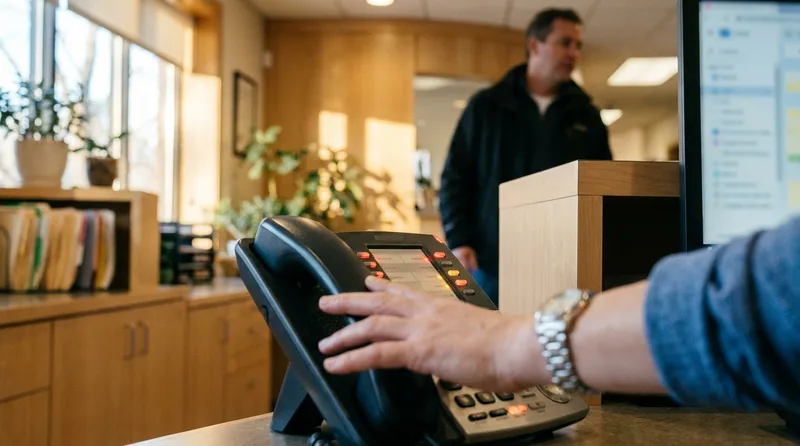
Here's the catch. One person answers one call at a time. When three lines ring during the 8 a.m. rush, two callers hear a busy tone or roll to voicemail. Industry benchmarks reported by Dental Economics put missed calls at 30 to 38% of incoming calls during business hours. Staffing makes it harder to fix: about 62% of dentists named staffing shortages as their biggest practice challenge for 2025, according to ADA Health Policy Institute polling. Turnover adds to the strain. Every departure means weeks of retraining, and retraining means more dropped calls while the new hire learns your schedule.
When does in-house coverage disappear?
Coverage also evaporates at predictable times. A single in-house line goes quiet during:
- Lunch and breaks, when the desk is unstaffed for 30 to 60 minutes a day.
- The morning and end-of-day rush, when calls stack faster than one person can answer.
- Evenings and weekends, the exact window when many new patients start searching.
- Sick days and vacations, which pull your most experienced voice off the phone.
If your dental office phone is always busy, the problem usually isn't effort. It's math. A single human cannot be in two conversations at once.
What does the front desk do better than any other model?
None of this means the front desk is the weak link. It's the opposite. Your team does the work no other model can: greeting patients in person, walking someone through a treatment estimate, calming a child before a procedure. The goal isn't to shrink that role. It's to stop asking two hands to cover ten ringing lines. Audit your busy-signal hours before assuming you need another hire.
Is your front desk drowning in calls?
Spot the warning signs of an overloaded front desk before they cost you patients, and see the fixes that actually work.
Read the front desk guide →What does a dental answering service actually cover?
A dental answering service covers calls a live operator can reach, usually after hours or during overflow. Most take a message and promise a callback. Some can book into a shared calendar. Very few have real-time access to your practice management system, which limits what they can finish.
Why does the booking gap matter?
That gap matters. A caller who reaches a generic operator at 9 p.m. and is told "the office will call you tomorrow" is a caller who may book elsewhere tonight. Dental decisions are time-sensitive, and a caller who hits a dead end tends to try the next practice. Dental Economics reports that nearly one third of all calls to a dental office are missed, which is why catching a message is only a partial fix.
Where does an answering service fit in the mix?
Answering services shine in one role: catching calls a human would otherwise miss entirely. A live voice beats a dead line. But operators read from a script, don't know your providers, and can rarely confirm a real appointment slot. They also charge by the minute or by the call, so a busy month can produce a bill that surprises you.
Treat the service as a safety net for message capture, not as your booking engine. It buys you a human voice when nobody else is available, which is worth something. Just don't expect it to fill your schedule or recognize a returning patient by name.
Related: A live voice always beats a voicemail box, and the data on why is worth knowing. See why dental voicemail loses patients →
How does AI voice fit into dental phone coverage?
AI voice fits as an always-on first-answer layer that books appointments around the clock without breaks or hold times. It picks up on the first ring, handles many calls at once, and writes confirmed appointments straight into your schedule. It supports your team rather than standing in for the work only people can do.

What makes AI voice consistent?
The model's edge is consistency. It never takes lunch, never calls in sick, and never puts a caller on hold during a rush. When several lines ring at 8 a.m., AI answers all of them in parallel. It can also handle call routing and triage, sending a true emergency to the on-call dentist while booking routine cleanings itself.
AI voice does not replace clinical judgment or the warmth of a familiar receptionist. A nervous patient, a delicate financial conversation, or a long-standing family patient all belong with your team. Use AI to catch the calls your staff can't reach: after hours, during overflow, and through the after-hours window. If you are still deciding how much of the phone to hand over, this breakdown of how AI reception and a human front desk compare on cost, capacity, and coverage works through the trade-offs.
That window carries more weight than most coverage decisions account for. See why after-hours dental calls matter more than you think before settling on a coverage model.
Which calls should AI voice handle?
What makes the layer work is scope. AI is strongest on the routine, repeatable calls that flood most front desks:
- New-patient bookings, captured and written to the schedule on the first call.
- Reschedules and cancellations, handled without pulling a staff member off another task.
- Hours, location, and insurance questions, answered instantly and consistently.
- After-hours and overflow calls, the ones that otherwise hit a busy signal or voicemail.
Everything outside that scope routes to a person. That division keeps your front desk free for high-value conversations while no call goes unanswered. The result isn't a smaller team. It's a team that finally stops chasing a ringing phone.
Where can you learn more?
- Choosing AI voice: if it is the layer you need, this guide to choosing dental AI receptionist software covers what separates a well-built agent from a rebranded call center script.
- Multi-site groups: consistency matters as much as coverage, and this guide to how DSOs standardize phone coverage across locations shows how groups handle it.
- Specialty practices: phone coverage for a referral-driven specialty practice weighs the same choice for a surgical office, where the busiest callers are other dental practices.
- Billing calls: the verification and escalation rules for billing and statement calls lay out what any coverage model can safely disclose on the spot.
- Lab calls: a dental lab communication workflow keeps case status and remake questions from competing with patients for the same line.
See which calls AI should answer for you
Compare the leading dental AI voice platforms and the features that matter for booking, routing, and after-hours coverage.
Compare AI voice platforms →How do the three coverage models compare on cost, availability, and booking?
The three models differ most on availability, booking ability, and cost structure. In-house staff cost a salary and cover office hours. Answering services bill per minute and mostly take messages. AI voice runs on a flat subscription and books 24/7. The table below lays out the trade-offs side by side. Before you compare a flat subscription against a salary or a per-minute bill, it helps to know the actual ranges, and our breakdown of what an AI dental receptionist costs in 2026 walks through the pricing tiers, setup fees, and per-call charges that make up that column.
How do the dental phone coverage models compare side by side?
When each model actually answers, across a full day
Office hours shown as 8am to 5pm with a midday lunch gap.
A front desk leaves predictable gaps at lunch and after hours. An answering service mainly fills the closed hours, with some overflow help. AI voice covers the full day.
| Factor | In-House Front Desk | Answering Service | AI Voice |
|---|---|---|---|
| Availability | Office hours only, minus lunch and breaks | Often 24/7, but human-dependent | 24/7, no breaks or hold times |
| Books appointments | Yes, full access to the schedule | Limited, usually takes a message | Yes, writes to the PMS in real time |
| Clinical context | High, knows patients and providers | Low, follows a generic script | Medium, trained on practice rules |
| Patient experience | Personal, relationship-driven | Generic, script-based | Fast and consistent, no hold times |
| Handles call spikes | No, one caller at a time | Sometimes, if staffed for it | Yes, many calls at once |
| Cost model | Salary, benefits, training | Per-minute or per-call fees | Flat monthly subscription |
| Ideal role | Complex, in-person, relationship work | Basic message capture overflow | Always-on first-answer layer |
Why do practices misjudge cost?
Cost is where practices misjudge the math. A missed new-patient call isn't a $0 event. It's the lifetime value of a patient who booked with the office down the street instead. Our missed-call cost calculator shows how quickly those losses outrun any coverage fee. The cheapest model on paper is often the most expensive in lost production. At a 35% miss rate, a practice taking 300 to 500 calls a month leaves 105 to 175 of them unanswered, according to the same Dental Economics analysis.
Why is availability a blind spot?
Availability is the second blind spot. A meaningful share of new-patient calls arrive outside standard office hours. Dental Economics notes that roughly one out of every four new-patient calls goes straight to voicemail, and it recommends auditing the lunch hour and the hour after you close to find the leak. A line that goes unanswered at 7 p.m. is a patient handed to a competitor.
Why is booking ability the tiebreaker?
Booking ability is the tiebreaker. A model that only takes a message creates a second task: someone has to call back, reach the patient, and hope they haven't booked elsewhere. A model that books in real time closes the loop on the first contact. Price the full stack across all three factors, not one line item in isolation.
How do you choose the right coverage mix for your practice?
Choose your coverage mix by call volume, hours of demand, and the type of calls you lose most. A solo practice with light after-hours demand needs a different stack than a busy group fielding hundreds of calls a week. Start with where calls leak, then layer models to plug each gap.

How do you audit your call gaps?
Run a simple audit first. Pull a week of call logs. Count missed calls by hour, by day, and by reason. If most misses cluster at lunch and after 5 p.m., an always-on AI layer over your in-house team closes the gap cleanly. If misses spike only during rare overflow, a service may be enough. The most common dental call types are routine enough that automation handles the bulk of them.
Which mix of dental phone coverage models fits your practice size?
Match the practice to the pattern. A solo dentist may only need the front desk plus AI for after-hours. A three-provider office taking 200 calls a week likely needs AI for both overflow and after-hours, with staff focused on in-person work. The layering approach is explored further in how dental practices scale without overloading the front desk.
How does compliance shape the mix?
Compliance shapes the mix too. Any model that touches patient information must protect it, and the U.S. Department of Health and Human Services sets the HIPAA standard for how. Confirm that any vendor, human or AI, signs a business associate agreement. Patients who can't reach you simply go elsewhere, so build the stack that reaches them.
What should you do next?
The strongest dental phone coverage models work together, not in isolation. Your front desk owns the relationship-heavy, in-person work. AI voice owns the always-on first answer. An answering service, if you use one, fills a narrow overflow role. Match the layer to the gap, and you stop losing patients to a busy signal.
Your next step is the audit. Pull last week's call logs and find your leak. Then decide which single layer closes the biggest gap first, and add from there.
Stop losing patients to a missed call
DentiVoice answers every call, books appointments around the clock, and supports your front desk instead of replacing it. See how the coverage layer fits your practice.
Book a DentiVoice demo →Frequently Asked Questions
The main dental phone coverage models are an in-house front desk, a live answering service, and AI voice. Each covers different hours and call types, so most practices combine two or more rather than relying on one.
AI voice and an answering service serve different roles. AI answers instantly and books into your schedule 24/7, while most answering services only take messages. AI suits booking and overflow; a service suits basic message capture.
No. AI voice supports your front desk by handling routine, after-hours, and overflow calls. Your team keeps the complex, relationship-driven work like anxious patients and detailed treatment conversations that need a human touch.
Costs vary by model. In-house staff carry salary and benefits, answering services bill per minute or call, and AI voice runs on a flat monthly subscription. Compare total cost against the revenue lost to missed calls.
Audit a week of call logs, counting missed calls by hour and reason. Match each gap to the model that closes it most effectively, usually in-house staff for office hours plus AI voice for after-hours and overflow.
Yes. AI voice can write confirmed appointments into your practice management system in real time, unlike most answering services that only take a message and promise a callback the next business day.
Reputable AI voice vendors follow HIPAA requirements and sign a business associate agreement. Always confirm a vendor's compliance posture and BAA before sharing any patient information through the platform, human or AI.
Compare receptionist services for dental offices on three things: hours of coverage, cost per booked appointment, and how consistently calls are answered. An in-house desk, an answering service, and AI voice each score differently on those three, so the right fit depends on call volume and budget.
Sources & References
- 1
- 2
- 3
- 4
- 5
Topics
Was this article helpful?
Written by
DentalBase Team
Expert dental industry content from the DentalBase team. We provide insights on practice management, marketing, compliance, and growth strategies for dental professionals.