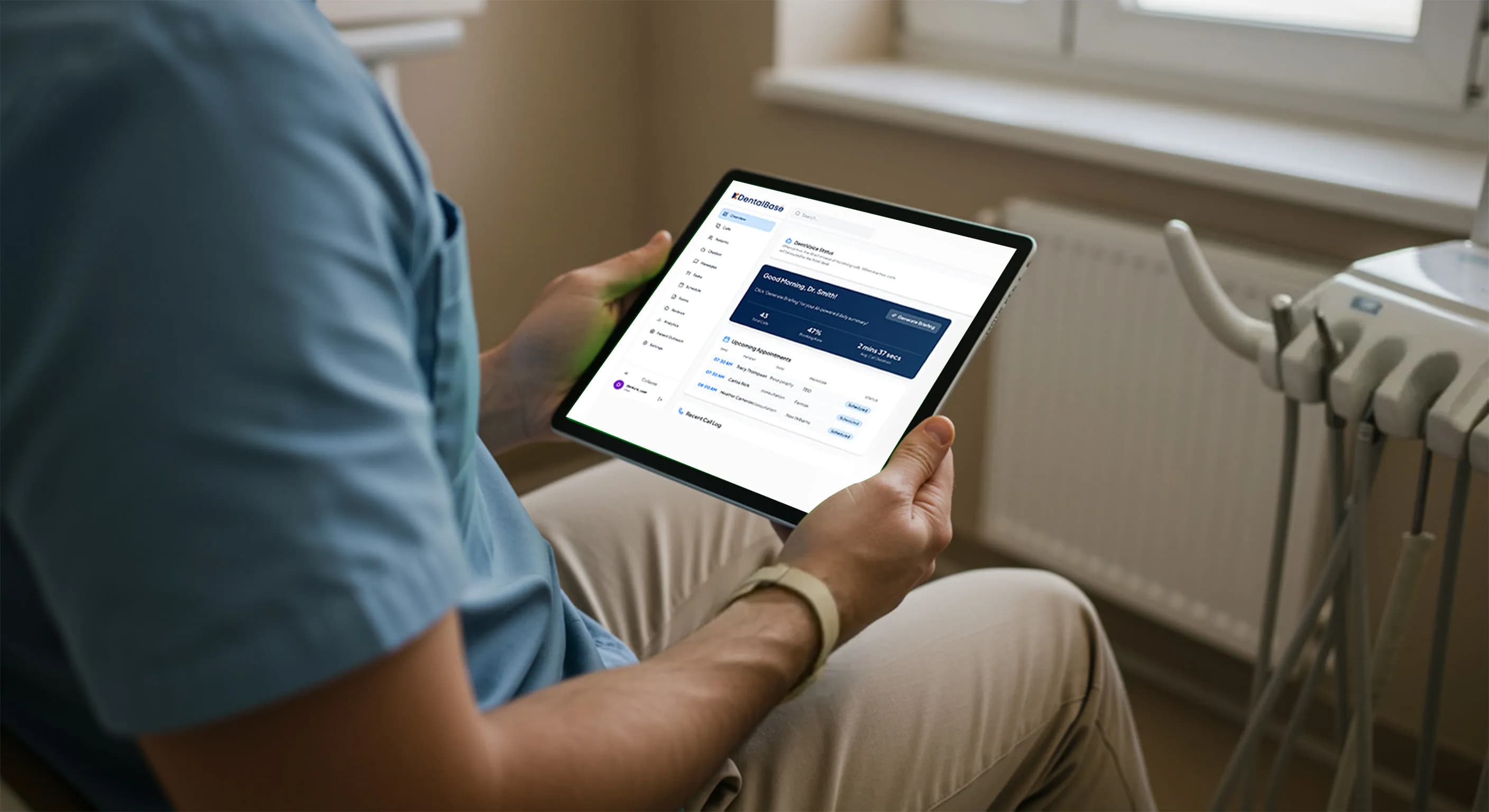
AI Receptionist for a Dental Implant Practice: 2026 Guide
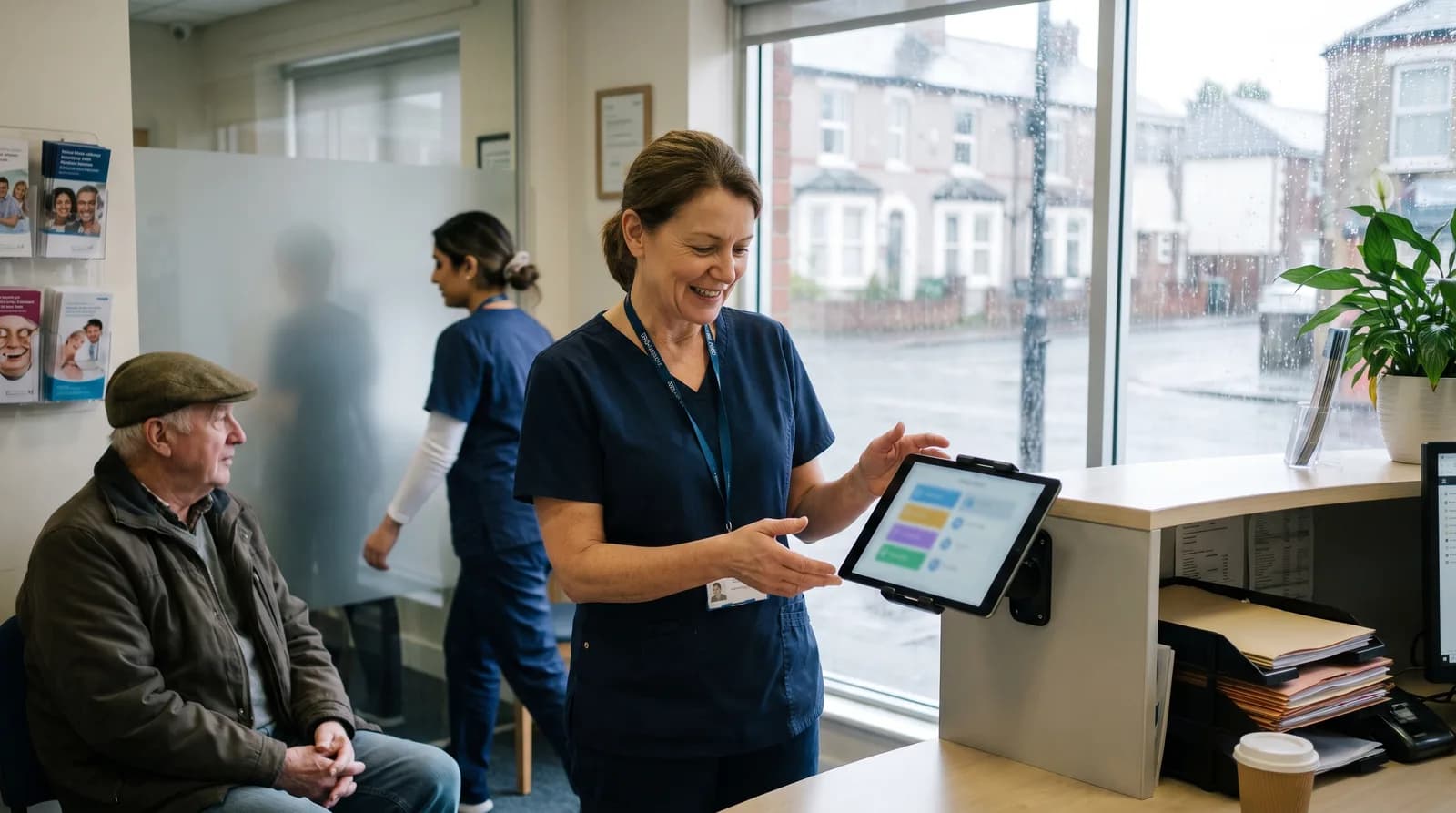
How an AI receptionist dental implant practice setup handles consult calls, multi-visit case sequencing, cost questions, and referring dentist traffic.
Share:
Table of contents
An AI receptionist dental implant practice setup has a harder job than one at a general office. A caller asking about All-on-4 has usually spent 6 to 18 months reading, comparing, and worrying about the price before they ever pick up. Miss that call and they dial the next name on their list.
These phones exist in a different category than general dentistry phones. It answers on the first ring, captures the case details your treatment coordinator actually needs, and books the consult while the caller is still motivated. Not every call belongs to it, though. Knowing which ones do is the whole skill, and it is worth reading how AI phone coverage works across dental practices before you commit to a vendor.
Below: the call types these offices really get, how multi-visit sequencing works, what to do about cost questions, and how to tell whether any of it is producing seated cases.
What does an AI receptionist dental implant practice setup actually handle?
It answers every inbound call, identifies what kind of case the caller has, and books the right appointment type without a hold queue. In an implant or prosthodontic office that means consult inquiries, second opinions, referral calls from general dentists, post-surgical questions, and denture repair requests, all day and after hours. That around-the-clock coverage matters more than most implant practices realize, and this piece on why dental calls carry more weight than you think explains why.
The mix is what makes these practices different. A general office fields cleanings, toothaches, and insurance questions in roughly predictable proportions. Your inbound volume skews toward high-value, high-anxiety, long-consideration calls. One booked full-arch consult can be worth more than a month of hygiene appointments. A practice fielding 180 calls a week may only see 12 of them touch implants, and those 12 carry most of the production.
Which calls actually come in?
Typical call categories in an implant or prosthodontic practice:
- Cold consult inquiries. Someone missing teeth, often researching for months, calling three offices in one afternoon. These callers are comparing tone as much as price, and they rarely leave voicemail.
- Second opinions. Already quoted elsewhere, now checking whether the plan and the number are reasonable.
- Referral calls. A general dentist office calling on behalf of a patient, or the patient calling with a referral slip in hand.
- Active case questions. Patients mid-treatment asking about healing, temporaries, or their next visit.
- Repairs and adjustments. Denture relines, loose crowns, broken temporaries.
Why one script cannot cover all five
Each of those needs a different next step. The consult inquiry needs a booking. The active case question usually needs a clinical person. An AI receptionist that treats all five identically will book the easy ones and frustrate the rest.
Why are implant and prosthodontic calls harder than general dentistry calls?
Because the decision cycle is long, the case value is high, and the caller is usually anxious about both surgery and money. A cleaning call takes ninety seconds and one question. A full-arch inquiry can run eight minutes and touch bone grafting, sedation, timeline, and financing before anyone mentions a date.
How many of these callers are out there?
Tooth loss is common enough that this call volume is not going away. The National Institute of Dental and Craniofacial Research tracks tooth loss across adult age groups, and the pattern is clear: the older the population you serve, the more edentulous and partially edentulous callers you get. The CDC reports similar age-related patterns in its oral health data.
What makes the call hard is not the clinical content. It is the emotional load stacked on top of it. People who have lost teeth are often embarrassed. They ask indirect questions. They test the office before they trust it. Terms like osseointegration, CBCT imaging, and immediate load mean nothing to them, and neither does your credential list.
What that means for scripting
Your phone script has to do three jobs at once: reassure, gather, and book. Most general-purpose call scripts only do the third. A caller who feels judged in the first thirty seconds will not schedule, and will not tell you why.
Phones built for high-value case types
DentiVoice answers implant and prosthodontic calls with the case-specific context your treatment coordinator needs, not a generic booking script.
See how it works →How does an AI receptionist handle multi-visit implant case scheduling?
It books by phase rather than by single appointment, matching each visit to the provider, chair, and block length that phase requires. Surgical placement, healing checks, and restorative delivery all carry different durations and dependencies, so the receptionist has to understand sequence, not just availability.
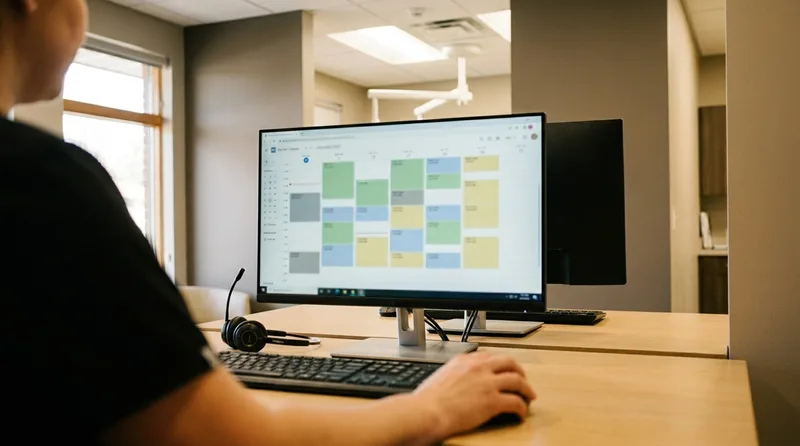
This is where most generic AI phone tools fall down. They are built to find the next open slot. An implant case does not want the next open slot. It wants a 90 minute surgical block eight weeks out, a 15 minute post-op check at day 14, then a restorative visit only after osseointegration is confirmed, often 3 to 6 months later.
What the booking sequence looks like
A workable booking sequence looks like this:
- Consult first, always. No caller gets booked straight into a surgical block. The consult is the qualifying step.
- Tag the case type at intake. Single tooth, multiple units, full arch, or restoration of an existing implant. Block length follows from the tag.
- Book the anchor visit against the right provider. If a surgeon places and a prosthodontist restores, those calendars are separate and the AI needs both.
- Hold the downstream visits provisionally. Healing timelines shift. Provisional holds protect the sequence without hard-committing a patient to a date nobody can honor.
- Confirm sequencing changes with a human. Any reschedule that breaks the phase order should escalate, not auto-resolve.
Why integration depth decides this
Whether this works depends almost entirely on your integration depth. Practice management systems such as Open Dental expose appointment types and provider schedules through their scheduling modules, and a receptionist reading real availability books very differently from one reading a static ruleset. Read up on how AI receptionist booking integrations are built before you evaluate vendors.
One practical note. Pre-visit paperwork matters more here than in general dentistry because medical history drives surgical clearance. Pushing digital intake forms at the moment of booking saves your team a chase later.
Can an AI receptionist answer implant cost and financing questions?
Partly. It can give an honest range, explain what drives the range, and describe your financing options, but it should not quote a specific case. Pricing depends on grafting, sedation, and unit count, none of which anyone can determine over the phone without imaging and an exam.
Why saying nothing costs more
Refusing to say anything about money is the worse failure. Callers who get stonewalled assume the number is bad and hang up. Callers who get a range and a reason usually book, because they now feel the office is being straight with them.
Which money questions the AI can take
Here is a workable split:
| Caller question | AI handles it | Escalate to a person |
|---|---|---|
| "How much is an implant?" | Yes, as a published range with the variables named | Only if pushed for an exact figure |
| "Do you take my insurance?" | Yes, plan participation and general coverage limits | Benefit verification for a specific case |
| "Can I make payments?" | Yes, name the financing partners you work with, such as CareCredit or Proceed Finance | Application status or approval amounts |
| "What did the other office quote me?" | Log it, do not compare | Treatment coordinator, at the consult |
Cost transparency has become a competitive issue across dental services generally, and the ADA Health Policy Institute has published extensively on how cost concerns shape whether adults pursue dental care at all. For implant cases, where a single arch can run into five figures, that dynamic is amplified.
Related: Vendor pricing for the receptionist itself is a separate question worth understanding before you budget. AI dental receptionist cost breakdown →
What should an AI receptionist say to a consultation shopper?
It should qualify without gatekeeping, capture enough case context for the coordinator to prepare, and book a real appointment instead of promising a callback. Shoppers are calling several offices in one sitting, so the office that ends the call with a date on the calendar usually wins the case.
Why the callback promise loses the case
"We will call you back" is where implant leads die. The caller has 3 more numbers to dial and no reason to wait for yours. An office that books on the first call keeps the case; one that promises a callback within 24 hours is usually too late.
What to capture on a first consult call
Consult call intake
Five things to capture before the call ends
Miss all five and your coordinator meets a stranger. Capture them and the consult starts halfway through.
That last item is the one most scripts skip, and it is the most useful. A caller whose denture cracked last week has a different urgency than one who has been thinking about it since 2022. Your coordinator can prepare very differently if she knows which she is meeting.
The mechanics here overlap heavily with elective case handling generally. If you also market veneers or smile design, AI handling of cosmetic consultation calls covers the same shopper psychology in more detail.
How should referring dentists and specialist coordination calls be routed?
Down a separate path from patient calls, with faster escalation. A general dentist calling about a referral is a professional colleague and a referral source, not a lead to be qualified. Treating that call like a consult inquiry is the fastest way to lose a referring office.
Referral relationships are the backbone of most surgical and prosthodontic practices. If a general dentist two miles away sends you 8 cases a year and her front desk gets put through a booking script every time she calls, she will find someone easier to reach.
How to route each caller type
Build the routing around two questions the receptionist asks early: is this a professional office calling, and is there an active case involved. Those two answers determine everything downstream.
- Referring office, new case. Capture patient name and referral reason, then either book directly or route to your referral coordinator.
- Referring office, active case. Escalate to a clinical person. Do not attempt to answer treatment questions.
- Patient with referral in hand. Book the consult and flag the referral source so it gets credited.
- Lab or supplier. Route to the business side, never the patient queue.
Where caller context pays off
Caller context makes this dramatically easier. When the system recognizes a known referring office by number and surfaces that history to whoever picks up, the handoff feels like continuity rather than a cold restart. That is the practical case for caller context and screen pop in dental phone systems. And when escalation does happen, the transfer itself needs a defined workflow, which is covered in this guide to AI receptionist staff handoffs.
If you're comparing this against a general-practice setup before committing, DentiVoice's guide to what an AI dental receptionist actually does across a practice walks through the fundamentals before you configure anything implant-specific.
Once those fundamentals are settled, this step-by-step guide to implementing an AI receptionist in a dental office covers the rollout mechanics, training, go-live, and what to track, before you layer on implant-specific workflows.
Referral calls should not sit in a queue
DentiVoice recognizes returning callers, routes referring offices separately from patient inquiries, and escalates active cases to your team.
Explore DentiVoice →How do you train an AI receptionist on prosthodontic terminology?
By feeding it the exact vocabulary your patients use alongside the clinical terms your team uses, then mapping between them. Callers say "the screw-in teeth" and "permanent dentures" far more often than they say All-on-4 or implant-supported overdenture, and a receptionist that only recognizes clinical language will mis-tag cases.

How to build the translation layer
Build the translation layer deliberately. Listen to 20 recorded calls, write down every phrase patients actually use for the procedures you offer, and load those as recognized variants.
Terms worth mapping explicitly
- Full arch. Patients say "all on four," "teeth in a day," "permanent dentures," "screw-in teeth."
- Single implant. Often described as "a fake tooth" or "a post."
- Overdenture. Usually "snap-in dentures."
- Bone graft. Frequently "they said I don't have enough bone."
- Temporary. Called "the flipper" by anyone who has worn one.
- Materials. Callers ask about zirconia and titanium without knowing which is the fixture and which is the crown.
What else the receptionist has to know
Beyond vocabulary, the receptionist needs your practice-specific answers: whether you sedate, whether you place and restore in-house or coordinate with a surgeon, and which cases you do not take. Getting those wrong wastes consult slots on cases you cannot serve. The mechanics of loading all of this are covered in AI receptionist script customization.
Review it monthly at first. Recording those calls carries state-level consent rules under both HIPAA and wiretapping statutes, so confirm your policy before you build the library. Terminology drift is real, and new callers will surprise you.
How do you know whether it is actually producing cases?
Track consult bookings and consult show rate, not call volume. Answering more calls is easy to measure and easy to celebrate, but for an implant practice the only number that matters is how many qualified consults sat in the chair and where those callers came from.
Why volume metrics mislead
Volume metrics flatter every vendor. A receptionist that answers 400 calls and books nine consults is worse than one that answers 320 and books twenty-two.
Which numbers to watch each month
Metrics worth watching monthly:
- Call-to-consult conversion. Of callers who asked about implants, what share left with an appointment?
- Consult show rate. High-value consults get rescheduled and forgotten more than cleanings do.
- Case type mix. Are you booking full-arch inquiries or mostly single-unit questions?
- Source attribution. Which ad, page, or referring office generated the call.
- Escalation rate. Rising escalations mean the script has a gap worth closing.Set your own baseline in month one, then watch the trend rather than a benchmark.
Attribution deserves particular attention in this segment. Implant marketing is expensive per lead, so knowing which channel produced a seated full-arch case changes your budget materially. Market analysts including Statista track dental services spending patterns that show how much of practice revenue concentrates in a small number of high-value procedures. The practical mechanics live in this guide to tracing every booked call back to its source, and the payback math is worked through in the AI receptionist ROI breakdown.
Where should an implant practice start?
Start with the consult call, because that is where the money is. An AI receptionist dental implant practice deployment that does nothing but answer every consult inquiry within one ring, capture case context, and book a real date will pay for itself before you configure anything else.
Everything after that is refinement. Referral routing, terminology mapping, phase-aware scheduling, attribution: each one adds margin, but none of them matter if the first call still goes to voicemail at 5:40 on a Thursday.
Your first move this week
Pull your last month of call logs. Count how many implant inquiries were missed, abandoned on hold, or ended without a booking. That number is your starting case.
Stop losing implant consults to voicemail
DentiVoice answers every call, qualifies the case, and books the consult while your caller is still on the line.
See DentiVoice for implant practices →Comparing AI receptionist vendors for a specialty practice?
Read the ROI and payback breakdown →Frequently Asked Questions
It should not. Surgical blocks require a completed consult, imaging, and medical clearance, so the receptionist books the consult and holds downstream visits provisionally. Any reschedule that breaks the treatment phase order should escalate to your scheduling coordinator instead.
By identifying the call as an active case and escalating it quickly. Post-surgical questions about bleeding, swelling, or pain belong with a clinical team member. The receptionist should capture the patient name and reason, then transfer or page rather than answer.
Only if you train it on both the clinical terms and the phrases patients actually use. Load recognized variants like 'permanent dentures' and 'screw-in teeth' for full arch, and 'a post' or 'fake tooth' for single-unit cases.
Give the published range, name the variables that move it, and book the consult. Grafting, sedation, and unit count all change the figure, and none can be determined by phone. Specific quotes belong with your treatment coordinator.
They mind being treated like a lead. Route professional offices down a separate path with faster escalation and caller recognition. A referring office that gets put through a patient booking script every time will start sending cases elsewhere.
Most of the work is terminology and routing, not installation. Plan a week for call review, vocabulary mapping, appointment type configuration, and escalation rules. Practices with a surgeon and a restorative provider on separate calendars need extra integration time.
Call-to-consult conversion and consult show rate. Answered call volume flatters every vendor and tells you nothing about seated cases. Track case type mix and source attribution alongside them to see which channels produce full-arch consults.
Sources & References
- 1
- 2
- 3
- 4
- 5
- 6
Topics
Was this article helpful?
Written by
DentalBase Team
Expert dental industry content from the DentalBase team. We provide insights on practice management, marketing, compliance, and growth strategies for dental professionals.